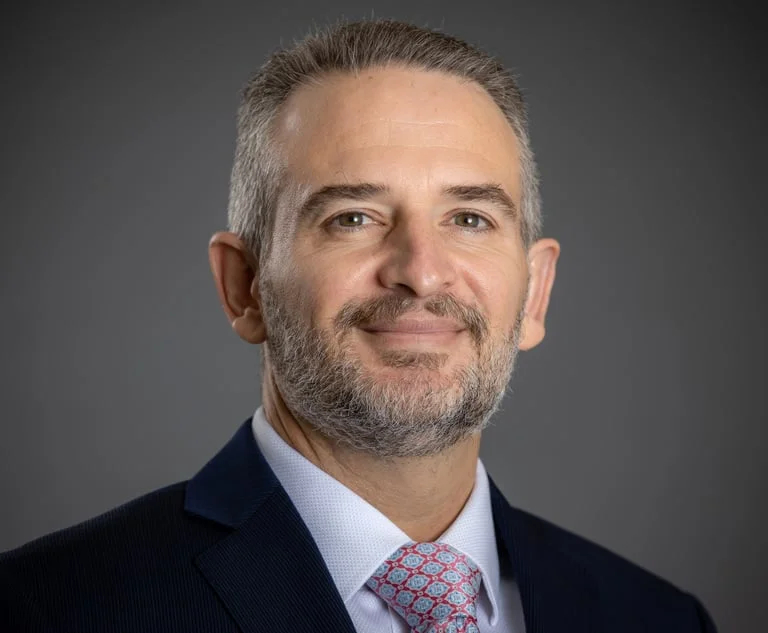
When Tom Scolaro opened his new firm, Scolaro Law, he had one goal in mind: To no longer be bound to a financial bottom line.
“I didn't want to keep fighting the defendant while also having to worry about fighting internally,” he says. “I feel that I should only serve the clients, and if that conflicts, it conflicts, but my heart has to go where it goes.”
When he launched Scolaro Law in March 2025, Scolaro was solidifying a promise to take on only the cases he truly believed in – the hard cases, the cases others wouldn’t touch. Combining calculated risk, decades of experience and a whole lot of heart, Scolaro is creating a firm where the clients, not profits, are the bottom line.
Scolaro has been a force in plaintiffs’ personal injury law in Florida for more than 25 years. In that time, he’s secured more than $500M for injured plaintiffs and reshaped laws to protect consumers. Early on, he developed a niche practice in carbon monoxide (CO) matters – taking on cases on behalf of those who were injured or had family members die as a result of carbon monoxide poisoning in homes, hotels and resorts.
In 2008, he represented over a dozen guests who were injured due to CO poisoning in a Key West, Fla. hotel. Scolaro then helped enact Florida’s first law addressing CO exposure in residential buildings, which required that all new constructions of public accommodations with fossil-fuel-burning appliances, fireplaces or attached garages have CO detectors installed – preventing future similar injuries and saving lives. Scolaro continues to do substantial work in the area – in June of 2024, he obtained an $11.75M settlement for a couple who were exposed to CO while on vacation abroad.
Cases arising from vacations with thorny jurisdictional and venue questions take up a substantial part of Scolaro’s practice; he also takes on maritime cases in the 11th Circuit, known for its specific and restrictive pleading requirements. Scolaro often represents cruise ship passengers who have faced a host of injuries, from slip and fall cases to sexual assault, medical negligence and wrongful death.
In other recent matters, Scolaro represented the family of a young woman who was killed by a drunk driver, securing a verdict of $12.8M – one of the largest wrongful death verdicts in Duval County history.
Those difficult cases are proof of Scolaro’s commitment to taking on challenges for worthy claims. In a case that defines that approach, five years back, Scolaro represented a grieving family after a mother and two of her young children were trapped inside a house fire and killed due to sealed windows. Eschewing resistance to a drawn-out – but Scolaro felt, worthy – litigation process, Scolaro successfully took on multiple defendants, fire investigators and settled theory – ultimately bringing justice and dignity to his clients.
“This is my money now. This is my money, my time, my reputation, and I'm willing to put my money where my heart is. If my heart believes in a case, I'll put my money there,” Scolaro says. “I'm not always going to be right. I'm going to get my teeth kicked in, I'm sure, at some point. But I am not ever willing to lay down.”
Scolaro is a member of the Lawdragon 500 Leading Plaintiff Consumer Lawyers.
Lawdragon: How would you describe your mission as a lawyer, and how was starting your firm in keeping with that mission?
Tom Scolaro: The mission has always been the same for me – to use every ounce of my being, my talent, my time and resources to deliver exceptional results for clients and hopefully right wrongs and fill the holes in people's lives. So, I had to have a real heart to heart with myself and figure out if where I was at truly reflected my values, what I wanted and how I viewed my role in this society and in justice. I felt that I could better serve the clients and my mission by going out on my own and doing it my way.
LD: What is your way?
TS: To me, the bottom line is always about the clients. It’s about getting the best results and taking on hard cases. Hard cases don't always work out, but if you truly believe in your mission to affect change and to get justice, you can't be as committed to the bottom line because sometimes those two things conflict. You have to have faith in your ability to get it done and understand that sometimes you may just have to sacrifice something for the greater good. That's what I want to devote the rest of my career to: taking on those cases that may otherwise get ignored or put to the side because there's an adherence to the bottom line.
LD: Since you've started the firm, what cases stand out as taking on more of those calculated risks?
TS: I'm dealing with a multi-jurisdictional quagmire for a case involving a carbon monoxide death. There are other cases in the maritime realm that have equally difficult jurisdictional challenges, as well. Is it easy? No. Is it guaranteed? No. But to me, the sin is not trying. You have to try – because if not me, who, right? I cannot sit on the sidelines. I cannot have fear. I have to move forward. I hate bullies, so I'm going to fight.
That's what I want to devote the rest of my career to: taking on those cases that may otherwise get ignored or put to the side because there's an adherence to the bottom line.
LD: Speaking of that fight, can you tell me about the challenges of starting your own law firm?
TS: The very first thing I would tell people who find themselves in a situation where their personal mission is not being met by the environment they are in is that while there's definitely going to be a need to think through the steps, when you start having those thoughts, you've already left. Now the only thing is to decide, “Am I going to settle for a life that intuitively is not in keeping with my beliefs and values, or am I going to have the courage to pull the pin on the grenade and just go for it?” I am, again, of the mindset that you’ve got to follow your heart.
Then, you have to come up with a plan. I didn’t have much of a plan, in all honesty – I had to start from scratch. I had to incorporate right away. I didn't know how to do that. I had to get a firm name. I didn't know how to do that. I had to register domains. I didn't know how to do that. I had to establish a relationship with a bank. I didn't know how to do that. I had to set up an IOTA account. I didn't know how to do that. I had to get insurance. I had to get a business license. I had to find space. I had to figure out how my clients were going to come with me. It was a lot to do.
LD: How did you learn those things? Did you look to anybody?
TS: Oh, yes. I am blessed with some very good friends here in the legal community who have had their own firms for a while, and they were incredibly generous with their time. They gave me introductions to banks, to software providers, to cybersecurity people. I'm forever grateful to them. That's why whenever anybody ever asks me for advice, I don't care what I'm doing, I spend 20, 30 minutes with whoever needs it. Yes, we all compete with each other, but there's a way to do it in a generous manner. And people were generous with me.
LD: And you and your team have had enormous success. Looking at your most recent victory, can you tell me about the drunk driving case?
TS: That was one where a friend of mine who had helped me out needed trial counsel, and that's what I love to do. It was a tough case because there were a lot of evidentiary restrictions, and I understand why. It was bifurcated in terms of damages. So, the first jury we had was not allowed to know at all about the drunk driving. They just knew that there was a death; they didn't know anything about the alcohol. Being in that vacuum was very challenging. You can see the jury's struggling, because everybody wants to know why this happened – they want to know the story. We were not allowed to go there because of pretrial rulings, which I understand and ultimately are the correct rulings – just the competitive side of me doesn't like it. Then, in the second part of the case, it was flipped. So, the jury was only allowed to know about the alcohol, but they were not allowed to know the quality of the relationship between the decedent and her family. They weren't allowed to know about the love, the bond, the stories, the heartache. There was just so much that we just wanted to tell them, but they weren't allowed to know. They were only there to address the punitive nature of punishing drunk drivers without regard to any other facts. Again, the right decision by the judge.
LD: The jury awarded a symbolic one dollar in addition to $2.5M in punitive damages. Tell me about that.
TS: That was interesting. There is a quirk in the law in Florida on punitive damages where they say that you are not allowed to give any punitive damage award which would bankrupt or be financially detrimental to the defendant. So, the defense spent their entire time during that part of the trial showing that he had a massively negative net worth. Their argument in closing was, “Yes, drunk driving is terrible, but under the law, you cannot give anything.” The defense attorney said, “You can give one dollar.”
As soon as I heard that, a switch flipped in me. It was just red. There was a complete overload and I was very upset. I don't even know what I said afterwards in rebuttal. It was just so insulting. So I think that's why the jury gave $2.5M – and one dollar. I viewed it as a complete and utter contempt for that type of argument.
LD: You also had a recent victory in a carbon monoxide matter. How did you carve out a niche in carbon monoxide cases?
TS: Early in my career, I started doing some carbon monoxide cases, and I've done maybe a dozen now. They're not a very frequent occurrence because these things are generally safe, but when they go wrong, they go wrong in spectacular fashion. Carbon monoxide is odorless; it's colorless. When people have symptoms, they think, all right, maybe it's a gastrointestinal issue, or maybe it's food poisoning. And so there's no real deep dive into the source by the resort or the hotel or wherever these things occur. But I've done a lot of those cases all over the United States, in the Caribbean and in Central America.
My greatest fear in life is wasted potential.
LD: Looking back to your early career, tell me about legislative changes you were able to help get enacted.
TS: There is now a requirement that all new commercial lodging establishments have carbon monoxide detectors thanks to some of the efforts that we did back in the day. The vast majority of what the plaintiffs’ bar does is deal with tragedies, yes. But we also try to affect some sort of change along the way when we can. It's incremental, it's small, but in the aggregate, it really does add up. Bad drugs get pulled off the market, not because of the great magnanimity of these drug companies, but because plaintiffs’ lawyers have developed and shown the science that they've been harming and killing people. These people don't pull off anything from the market because it's making them too much money. Plaintiffs’ lawyers do those things.
LD: Looking at trends that are impacting your practice lately, short-term rentals have come up frequently. Can you tell me a bit about that?
TS: I'm doing a lot of Airbnb and VRBO cases right now. I was actually just asked to speak in Brussels as part of a panel on this topic because it's really an unregulated environment. You have people from all over the country and all over the world staying at these one-off places. Most of them are safe, obviously, but there's no real regulation. There's no certification. You don't know if the pool fence is defective. You don't know if there's Legionnaires' in the pool or in the jacuzzi. You don't know if there's drug residue left from previous partiers.
These platforms have taken the position, “We're just the website. All we do is we put you and you together. That's it.” We're doing our very best to challenge that business practice. It's hard. They have arbitration clauses, so some of this is done in private – which means there's no development of common law. And consumers don’t know any better. Let's say you're from Ohio, you’ve got three kids and you want to go to Disney, but the hotels are too expensive. You want to go to a short-term rental, and you see one that looks good. And they have a pool – that’s great. But you don't know if that pool fence is up to code. You don't know if the lock is broken. I mean, I'm working on cases right now where a two-year-old and a four-year-old were able to get through the pool gate and they drowned. So, if these companies are marketing family-friendly and safe environments, there should be some accountability. To me, it’s a pretty simple issue, but I’m not corporate America.
LD: Looking ahead, how does the firm look now compared to when you first envisioned it, and how do you see it developing?
TS: That's an easy one to answer. I didn't have a vision for what it was going to look like. But I will say, it looks great. I'm surrounded by highly talented people, and we're doing very important and difficult work. I am always looking to grow. I'm always looking to hire great people. I do want to potentially expand geographically as well because I want to be able to use every ounce of myself and my ability to help as many people as I can. My greatest fear in life is wasted potential. So how can I best empty the tank every day, every week, every month, every year?

