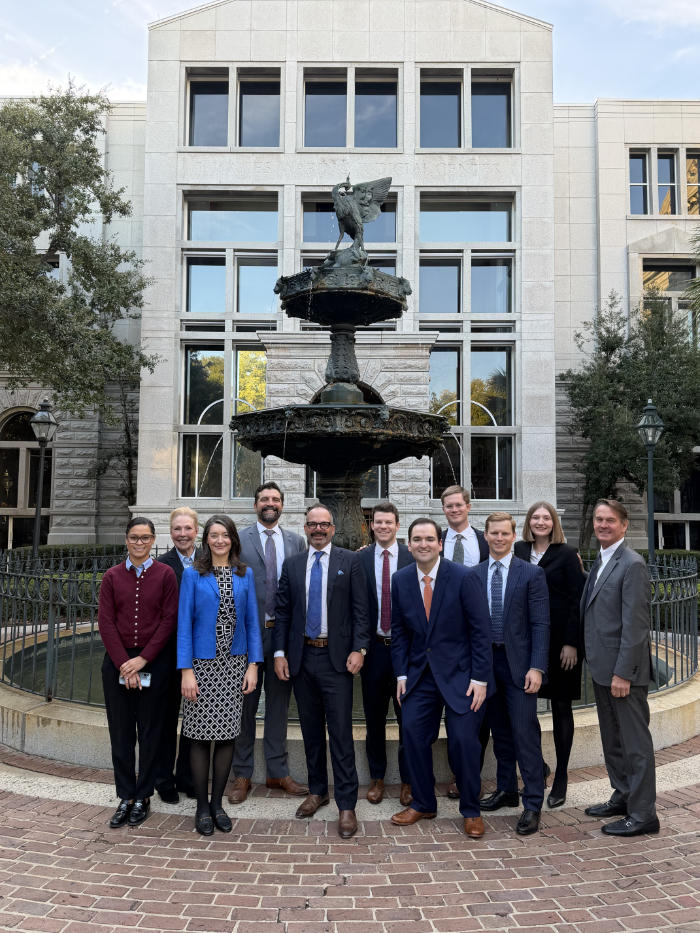
In 2016, we sat down for an interview with Bill Reid and Lisa Tsai, founding partners of powerhouse financial litigation boutique Reid Collins & Tsai. Our final question: “What do you hope we write about the firm in 10 years?”
“I hope you are writing about our next generation of amazing lawyers,” Reid replied.
And here we are.
Now, in the dawn of 2026, the team is celebrating a jury verdict of $112.3M on behalf of client JW Aluminum (JWA) – a verdict the firm’s young attorneys were instrumental in securing. The trial team was led by Bill Reid, Craig Boneau, and Scott Saldana. Boneau and Saldana are partners with the firm that have been with Reid since they started practicing law over a decade ago. The rest of the team consisted of associates or partners who were associates when they started working on the case.
“Scott and I grew up in this firm and we had so many opportunities to be on our feet in court as young lawyers because that is the culture that Bill has always created,” Boneau explained. “So when it came time to go to trial, we wanted to get our younger lawyers every opportunity we could to stand up and get in the game. That is the most fun part of being a lawyer and we want everyone on our team to have that experience.”
The trial came after years of litigating a nine-figure property insurance claim on behalf of JWA related to a fire that occurred in JWA’s facility in Goose Creek, S.C. By the time the case reached the jury, the real dispute was no longer whether JWA’s facility had been damaged – it plainly had – but whether the company could recover its replacement cost for the damaged equipment (as opposed to the actual cash value) and more than $80M in business interruption losses that insurers insisted were “too speculative” to compensate.
A central feature of the trial, then, was whether JWA could prove – with reasonable certainty – the profits it would have earned had the fire not shut down production during a period of extraordinary demand. Insurers argued that any estimate of future sales, capacity utilization, or pricing was inherently speculative. The jury disagreed, issuing a nine-figure award – which doesn’t yet include five years of pre-judgement interest – that will help cover the losses JWA faced after the fire.
“The fire was absolutely devastating. But that was why the company had a massive $250M all-risk insurance policy – to protect against exactly that kind of disaster,” says senior associate John Hammel Strauss. “So, ultimately, the case was about the insurance companies not stepping up and honoring their obligations when that disaster struck.”
Strauss, who has been with the firm’s New York office since the beginning of 2024, was just one of the associates who had a significant role in the five-day trial in the Southern District of South Carolina in November 2025. Joining the case team in September, Strauss immediately began helping draft motions in limine and assisting with witness preparation.
When they reached trial, he was finishing preparing Reid to cross-examine a witness over a lunch break. Court was due to resume in just 30 minutes. Suddenly, Reid turned to Strauss – and told him he should do the cross.
“Those are the types of opportunities that you can only get when the firm puts trust in its young lawyers who seize those opportunities,” Strauss says. “We pride ourselves on being trial lawyers, and you can’t be a trial lawyer if you don’t try cases. It’s as simple as that.”
Since its founding, giving young attorneys significant standup experience has been a cornerstone of Reid Collins’ approach. “At Reid Collins, we don’t train lawyers by having them watch from the sidelines. You don’t become a trial lawyer by observing trial – you become one by standing up, taking responsibility, and owning the moment,” explains Reid.
This nine-figure, unanimous jury verdict, like the billions of dollars in victories at Reid Collins, is proof positive of that strategy’s efficacy. With every case, the firm demonstrates that associate empowerment is essential to success.
THE BATTLE TO TRIAL
The facility accident took place in 2020, and the Reid Collins team came on board the ensuing legal battle in late 2021.
You don’t become a trial lawyer by observing trial – you become one by standing up, taking responsibility, and owning the moment.
One of the initial members of the case’s legal team was partner Dylan Jones. A former competitive cyclist, Jones first started practicing in a New York Big Law firm before a federal clerkship. He then moved to Reid Collins’ Austin, Texas home base in January 2021. Since then, he has worked on several of the firm’s defining cases – including helping secure one of the largest derivative recoveries of all time with a $300M award on behalf of minority shareholders of Chinese social networking service Renren. But the JWA case allowed Jones to have a prominent role from beginning to end – concurrent with his own journey from associate up to the partner ranks.
“Having seen the entire life cycle of a case from pleading state, summary judgement and appeal all the way through jury trial – it was very fulfilling to get to that point,” Jones says.
JWA, an aluminum producer, sells its product to a variety of end users – RV manufacturers, HVAC air conditioning unit producers and beverage companies among them. While the Covid-19 pandemic hobbled many industries in 2020, demand for those products soared. But because of the fire, the attorneys say, JWA was incapable of fulfilling orders.
“Production ground to a halt at this facility at the height of Covid,” Jones explains. “It’s a miracle and a testament to the executive team and JWA’s staff that the company made it through in one piece, frankly.”
The legal case alleged three main areas of damages: physical damage to the machines and the facility, lost profits from established products, and lost profits from other high-demand products that the company could have sold to earn extraordinary profits on if the fire hadn’t struck.
The two central debates throughout the course of the case, however, centered around coverage on the damaged property and the insurers’ liability – whether the coverage could be reduced from the policy limit of $250M to just $10M, as the companies suggested. Both issues went to summary judgement in 2023, just weeks away from jury selection. Reid Collins won on the coverage issue; the district court, meanwhile, found for the insurers on the $10M issue.
The team was undeterred. They filed for appeal and argued to the 4th Circuit Court of Appeals that the $10M limit should not apply. In March of 2025, they were vindicated when the 4th Circuit granted a unanimous reversal of the lower court’s finding, allowing Reid Collins to proceed with their $100M+ claim. According to Boneau, who argued the appeal, the win was a team effort. “The briefing and preparation for argument was a complete collaboration with our entire team, from the most senior partner to the youngest associate. Like everything we do at Reid Collins, we want work together to group think issues and get to the best answer. We have incredible lawyers at every level and everyone’s voice is valuable.”
One of those voices that was instrumental in the appellate briefing was associate Julia Di Fiore Byrne. She explained the impact of winning the appeal: “Having those two issues resolved in our favor going into trial meant that it was really a damages trial.”
Byrne, a former professional singer, decided to enter a legal or public policy career in 2016, earning advanced degrees in both areas. After summering with both a Big Law firm and Reid Collins – guided by her alumni mentor, Lisa Tsai – Byrne joined the firm full-time in 2022. On her first day, she was assigned a case: JW Aluminum, which had come to the firm just a few months before.
She has continued to work on the case over the years, from the initial phases of discovery through to trial. In trial, she took two witnesses and performed a 90-minute direct examination of a niche sub-market expert. After spending her entire career digging into the technical nuances of this case, “my task was making it easily digestible for the jury and for people who have never heard of these products,” she explains.
Since she started with the firm, Byrne has been involved in other hot-button matters, including representing former Fox News employee Laura Luhn in a 2023 Adult Survivors Act case. “It was an honor,” she says.
But seeing the JWA case finally conclude now, from the first day of her career, also holds a special place in her heart.
“Seeing a case from start to finish, as we just did, can really inform how you litigate other cases earlier. You have a better understanding of what really matters,” she adds. “It’s cool to be able to work on any case for a long time and see how your approach changes and your skillset improves.”
DIVING INTO THE DEEP END
Byrne had years of preparation before those stand-up moments in the JWA trial – but that isn’t always the case.
“Bill [Reid] and the other senior partners, they drop you in the deep end,” she says. “I've had cases where we’re in the early stages and I'm told, all right, Julia, you take the first crack at drafting the complaint.”
Like everything we do at Reid Collins, we want work together to group think issues and get to the best answer.
No one knows that experience more on this case than associate Sam Hilliard, whose first official day at the firm was September 22, 2025 – less than two months before trial. It was his first day as a law firm lawyer, and he was assigned the JWA case right away.
“I was thrown in, which is exactly what I would’ve wanted – I wanted to be tested through that experience,” says Hilliard.
Hilliard was primarily tasked with handling the deposition videos in trial. But, in an experience similar to Strauss’, when he thought he was preparing a partner to argue a motion, he suddenly found himself performing the argument on his own.
“That was my first stand-up experience in court. And it was only a month and a half after I started at the law firm,” says Hilliard. “I wouldn’t expect to get that experience anywhere else.”
“Our young lawyers are arguing motions, examining witnesses, and feeling the weight of real consequences. It’s demanding, and it’s supposed to be. It’s also incredibly rewarding,” says Reid. “One of the best parts of trial for me is watching lawyers grow in real time – seeing them realize that they belong on their feet, in court, doing the work. That culture of ownership and collaboration isn’t an accident. It’s who we are.”
Strauss’s first stand-up experience was also at Reid Collins. He left Big Law to clerk in U.S. District Court for the Southern District of New York before joining the firm. Just a few months later, he was tapped to argue a motion before the same court where he’d just finished his clerkship – arguing against the senior partner at the opposing firm.
Associates arguing successfully against opposing counsel’s heaviest hitters is “a regular occurrence at Reid Collins,” Strauss says. “It’s a testament to the trust that the firm puts in its young attorneys and the opportunities that are available to young attorneys to get that standup experience and show what they have.”
MENTORSHIP AND COLLABORATION
At the same time, the attorneys are fully supported and prepared for these experiences both by the partners and each other. “The partners at Reid Collins are very generous with their time to sit with associates, moot them, practice cross-examination questions and get them ready to have their moment in court,” says Strauss.
And because of the fee structure of the firm – no billable hours – Byrne points out that there are flexible opportunities for mentorship. “I haven't worked at a Big Law firm, but I imagine that people are pretty concerned about getting their billable hours,” she says. “And if they can't bill for mentoring you, there's just going to be a lot less of that.”
In his few months at the firm, Hilliard has felt the same way. “I would describe the environment as very collaborative and laid back in that I feel like I can approach anybody on the team with a question,” he says. “It doesn’t feel like there’s a rigid chain of command that you have to formally work your way up through with any thoughts or questions.”
Part of that mentorship also comes from observation – and in the JWA trial, all the attorneys note that watching Reid perform his closing argument was a masterclass. “It was fascinating to see Bill work his magic in closing, and especially in rebuttal,” Hilliard says. “He was able to persuasively disassemble defendants’ arguments on the fly.”
“He laid our case out to the jury in a comprehensive and really understandable way,” Jones agrees.
Then, there’s the learning that happens among the young attorneys themselves. Strauss was tasked with arguing the charge conference, and he recalls a moment where the judge’s questions caught him by surprise. “We handled it as a team,” Strauss explains. As he argued, his fellow attorneys were passing him note after note with case citations and potential follow-up arguments.
“That’s how the firm is always operating, where everyone is participating – not just the person who’s standing up in front of the judge or the jury, but the entire team who is always looking for opportunities to assist the person on their feet and provide them with as much ammunition as possible to win,” Strauss says. “That’s the mark of a great firm culture and group of lawyers – particularly young lawyers – who are all passionate about being trial lawyers.”
LOOKING AHEAD
The jury verdict was a huge win for Reid Collins, but the fight continues. The insurance companies are contesting the verdict vehemently, asking for an appeal on the entire award. “We know the war is not over,” Jones says.
While they await the next steps, the attorneys have many more cases to tackle. “It’s exciting that there's always a steady flow of impactful cases at Reid Collins that we will all – down to the most junior lawyer – get speaking roles in,” he adds. “I can’t wait to start helping young lawyers get the opportunities I have received since coming to Reid Collins.”
Hilliard, having completed his first stand-up experience in any court, is looking forward to exploring his next cases – especially arguing under Cayman law, a niche specialty for the firm. “My career is very, very young at this point, but one of the things that attracts me to litigation, especially at a firm like Reid Collins, is the opportunity to work on cases of a variety of subject matters and law,” he explains.
And, in the meantime, the attorneys are continuing to soak in the years of hard work that have resulted in this initial trial win.
“In this day and age, it’s very rare for a case to go to a jury trial. It's especially rare to get a nine-figure verdict from a jury. And it's really unheard of to have a case like that where the most junior lawyers on the team are standing up and taking witnesses in front of a jury of 10 ordinary citizens,” says Jones. “That’s something really rare and special.”
In those rare moments, says Reid, “the answer isn’t to grab the controls out of fear. It’s to trust the preparation, trust the team, and let talented young lawyers do what they’re capable of doing.”
“Watching them rise to that moment isn’t just effective – it’s energizing,” he adds. “That’s how trial lawyers are made.”

