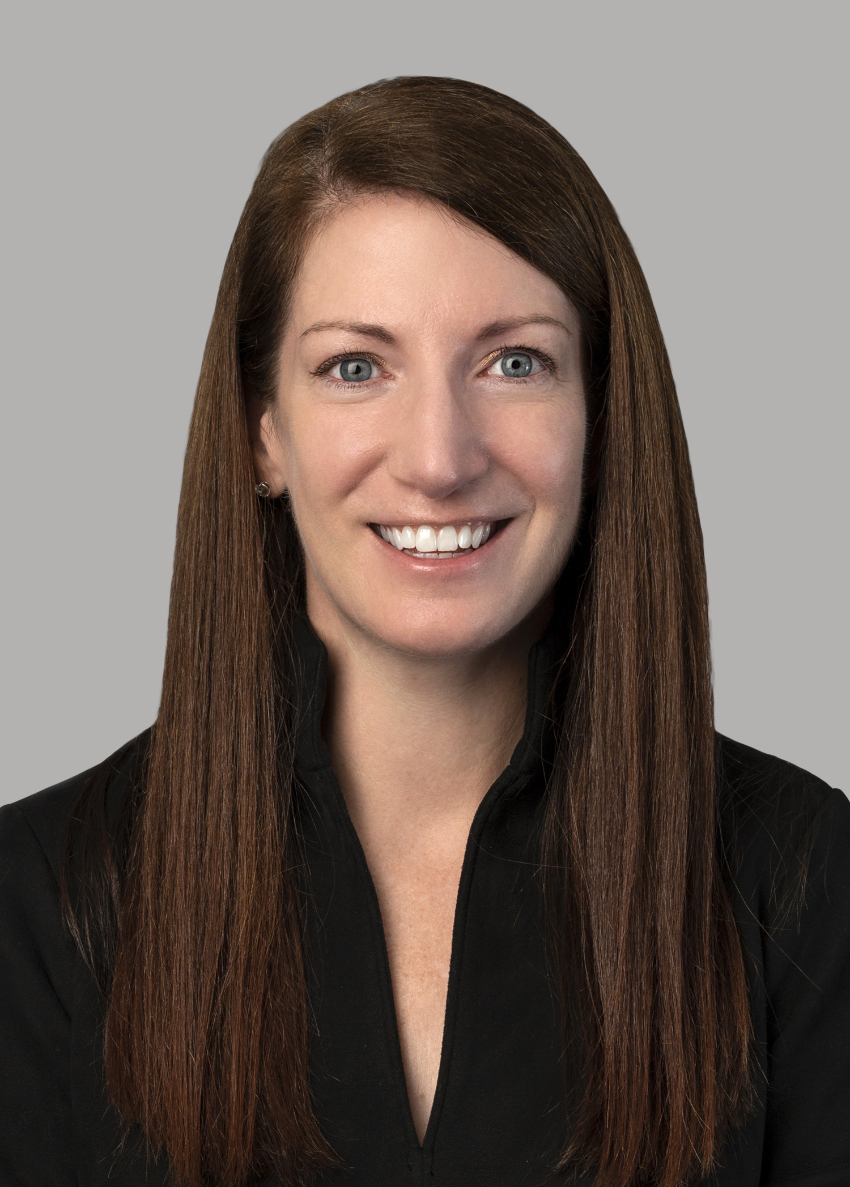
Before Kathryn Borgeson touches a transaction, she draws a picture.
Boxes. Arrows. Lines connecting lenders to borrowers to entities to assets, laid out on paper until the structure of the deal becomes something she can actually see. It’s not a personality quirk or affectation. It’s how she thinks and how she protects deals.
"I'm super visual," she says. "I need to see the actual steps and how it all works out."
In seventeen years at Cadwalader, Wickersham & Taft, Borgeson has been drawing versions of that picture across some of the most complex financial transactions in the market. As a partner in the firm's bankruptcy structuring group, her job is not to litigate matters when things fall apart. Nor can she guarantee total protection when they do. What she can do is lay the foundation to minimize the risk. She works across Cadwalader's practice groups – real estate, structured finance, back leverage – while everyone else is focused on closing deals, she’s spotting the holes and the exposure, advising on the bankruptcy implications of each high-stakes transaction.
"You can never prevent a borrower from filing for bankruptcy," she says. "So, we do the next best thing. We make it as ‘bankruptcy remote’ as possible." She pauses. "We don't say proof. That would be going too far."
THE LONG WAY TO THE LAW
Borgeson grew up outside Washington, DC, went to Villanova and graduated with a finance degree and no particular plan for the law. She only knew she didn't want to pursue finance in New York — too much, too fast – so she came back to DC and did something that, in retrospect, turned out to be the best legal education she never intended to get. She went into business with her brothers.
Her older brother whom she describes as “very techie” was running a small low voltage wiring business and wanted to build it out beyond “a guy in a truck.” Borgeson brought her freshly minted undergraduate degree to the table and came on board to handle the finance side – getting the infrastructure in place, setting up systems and building reports. She was good at it. And then, once it was running smoothly, she was bored by it.
"The fun part was building it," she says. "Once it was in place, I thought, this is going to be boring."
The business had a lawyer who handled whatever came up – employment claims, contracts, the steady drumbeat of small-business legal friction. Borgeson was their primary contact and somewhere in those conversations, something clicked.
"There was always a problem to solve," she says. "I thought, this stuff is way more interesting."
She started law school at night close to home at The George Washington University while still working with her brothers, transitioning fully to a legal career halfway through. She graduated into a job at a boutique white-collar litigation firm, where she learned to draft motions, do legal research and move fast – skills that would matter more than she could’ve imagined when she arrived as a summer associate at Cadwalader in 2009.
2009 was not the best year to be a summer associate for Wall Street’s oldest law firm. Or any financial firm.
“THE ASYLUM”
The historic financial crisis that began in 2008 was still very much in progress when Borgeson walked through Cadwalader's doors, and the firm was neck deep in it. The Lehman Brothers bankruptcy – at the time the largest in American history – was generating a volume of claims work that consumed entire teams. Cadwalader was also advising the U.S. Treasury on the General Motors and Chrysler bankruptcies as well as serving as debtors’ counsel in the Lyondell Chemical collapse, one of the biggest bankruptcies of its kind. Armed with a finance degree and a white-collar litigation background, Borgeson’s summer associateship started immediately in the deep end of the pool.
If one aspect of it doesn't work, we present alternatives. We come up with solutions to preserve the commercial deal, even if we have to structure it a little bit differently.
The daily reality was endless motions. With Lehman, it was systematic objections to thousands of claims – missing signatures, valuation disputes, deal documents that didn't quite say what the claimant thought they said. The goal was to knock claims off the docket wholesale. Borgeson and her colleagues had narrow windows to respond, filing objections to the objections, making their case in writing, negotiating where they could and arguing where they couldn't.
"If there's one thing I remember from that time period," she says, "it's just the constant drafting. Responding to these objections, over and over."
The avalanche of paperwork could’ve buried someone who wasn't paying attention. Borgeson was absorbing case by exhausting case a master class in what happens when financial transactions are not built carefully enough. What provisions fail to hold, what language doesn't survive a bankruptcy court's scrutiny, how broadly a judge can reach when the documents give them room. She had a front-row seat to the anatomy of financial failure, and she was taking notes.
She keeps a Taylor Swift lyric in the back of her mind now, for moments in a tough negotiation when she needs to remind herself that she’s seen worse: "You wouldn't survive the asylum I grew up in."
"Lehman," she says, "was the asylum."
AFTER THE FIRE
By 2013, the worst of the crisis was over. Markets were recovering. The claims disputes that had consumed years of her career were winding down, and two partners in Cadwalader's D.C. office – Mark Ellenberg and Peter Dodson, both of whom had long run hybrid practices spanning bankruptcy litigation and transactional work – came to Borgeson with a suggestion. The storm had passed. Now came the part where you took what the storm had taught you and applied it going forward.
The invitation was to move into bankruptcy remote structuring – the preventative side of the practice, focused on making sure deals were built correctly from the start rather than litigated over after they collapsed. It was a natural pivot, in theory. In practice, it was a transformation.
"I took what I had learned in closing out transactions," she says, "and applied it to better structuring them going forward."
The shift reframed everything. Where bankruptcy litigation meant responding to disaster, bankruptcy structuring meant anticipating it. Where claims work meant understanding what provisions had failed, structuring work meant making sure those provisions never failed in the first place. Every deal document she now touches carries the institutional memory of thousands of transactions that didn't make it – a body of knowledge, accumulated through Lehman and Lyondell and General Motors, that tells her exactly where the guardrails need to go.
What she found, once she was inside the work, was that it suited her completely. Every deal is different. The facts are always different. There is always an unusual problem that requires solving, or a commercial interest that needs to be preserved even as the structure gets adjusted to make it work. And her job is never simply to say no.
"Our goal is never to say you simply cannot do this transaction," she says. "If one aspect of it doesn't work, we present alternatives. We come up with solutions to preserve the commercial deal, even if we have to structure it a little bit differently."
She describes herself, tongue in cheek, as “Chicken Little” with one eye on where the sky could fall. The deal could be great, the businesses could be performing, or the billion-dollar loan might be ready to close – Borgeson is the one pointing at a single provision – something buried deep in the documents, something that won't matter at all unless everything goes sideways – and saying, quietly, this could be a problem.
She’s usually right…and thankfully, hasn’t had to say, “I told you so.”
MENTORS AND STEWARDSHIP
What distinguished Ellenberg and Dodson, in Borgeson's account, was not just the knowledge they passed on but the way they passed it on. They didn't hand her forms and assign tasks. They taught her the reasoning behind every provision – the bankruptcy case law that had shaped each clause, the courtroom decisions that explained why the language was drafted the way it was and what a bankruptcy judge would see when they read it.
"If you know the reasoning," she says, "you can negotiate better. You know what you can give on without losing the force behind the provision."
If you know the reasoning, you can negotiate better. You know what you can give on without losing the force behind the provision.
That distinction matters enormously in practice. When opposing counsel declares that a form document is non-negotiable – Borgeson knows exactly what is actually at stake in each clause and can hold her ground, or find a path around it, in a way that form-followers simply can't. The terms of the deal dictate the document, she says, not the other way around.
Both mentors retired in recent years, and both were deliberate about what they left behind. They invested in training the next generation of the practice, made sure the institutional knowledge was transferred rather than lost, and ensured that the work they had built over decades at Cadwalader would continue. Borgeson thinks about that often.
"They identified me as someone who could carry it on," she says. "I'm taking it and doing new things with it, but in the end, it's not something that's mine. It's a Cadwalader practice. I feel that responsibility."
It is an unusual thing to hear a partner say – the ego genuinely removed from the equation, replaced by something that sounds more like stewardship. But it runs through everything she says about the firm, about the practice, about the seventeen years she has spent in the same place building on what others built before her. She is, at her core, someone who understands that the most important structures are the ones designed to outlast the people who built them.
The firm's sponsorship program, developed by tax partner Linda Swartz, helped give her the visibility to step out from her mentors' shadow and build relationships across the firm on her own terms – putting a name to a face, creating connections that the work alone, however excellent, doesn't always produce. For Borgeson, it was a reminder that being seen matters as much as the work itself.
COOL COLLABORATION
Borgeson's negotiating philosophy starts with collaboration and holds there even when it gets hard.
The opposing counsel she most wants to work across from is the type who picks up the phone rather than firing back a terse email – who says, "let me just call you and we'll talk it through." She cites Lorne McDougall at Troutman Pepper by name as someone who exemplifies the approach: straightforward, solution-oriented, willing to find the middle ground without turning the negotiation into a performance. She actively tries to emulate it.
What she cannot abide is the categorical refusal. We're not accepting any comments on this. This is non-negotiable. Take it or leave it.
"That's not productive," she says. "It's like, okay, we won't accept any comments either. Where does that lead everybody?"
She knows her own weakness in the dynamic: she matches energy. If someone comes at her hard, her first instinct is to respond in kind, and she beats herself up about it afterward. The countermove she has developed is deliberate and almost physical – stop, breathe, slow the speech, bring everyone back to the factual points. "If you're right on the law and the facts, you don't have to yell," she says. "The yellers are usually the ones who feel a little insecure about what they're saying."
She is, at her core, a deal lawyer who wants the deal to close. The bank wants to lend money. The borrower wants to borrow it. Everyone is working toward the same thing. The negotiation is the means to get there, not to prove a point, adding, "It’s not zero-sum. I'm not going to fight you just to spite you."
COLD IN OFF HOURS
During Covid, Borgeson showed her two sons – now twelve and nine – the movie "The Mighty Ducks." The results were immediate and irreversible. Both boys wanted to play hockey. Fortunately, there was a rink ten minutes from their house in Maryland. They took the boys over, got them started, and then Nelson Burton, a former Washington Capitals player who runs the program at the ice rink, looked at Borgeson and her husband Nick and asked a surprisingly transformative question:
"What about you two?"
If you're right on the law and the facts, you don't have to yell. The yellers are usually the ones who feel a little insecure about what they're saying.
Neither of them had ever played. Her husband had been a basketball player. Borgeson had played lacrosse at Villanova and been a serious athlete her whole life but had let that part of herself go quiet after college, the way athletes do when the team ends and there's nothing to replace it.
They signed up for the adult beginner program.
"When the two of us each individually learned how to stop," she says, "that was like a big celebration."
Now all four of them play. Her twelve-year-old is a goalie. They turned her husband's home office into a locker room and even have a gear dryer. Borgeson plays twice a week – typically at 10pm, which is the ice time adults get stuck with – on a women's team in the Mid-Atlantic Women’s Hockey League called – she says with complete composure, The Angry Beavers.
Beyond the enjoyment of returning to team sports as an adult, the late-night practices solve a specific problem. By 10pm, Borgeson can generally step away from work. When she steps back into working on a deal she's been spinning her wheels on, she’s often found that the solution has appeared while she wasn't looking for it – even if her coach’s conditioning drills ground her into the ice.
"It's a great way to kind of reset, doing something just completely physical, it gets me out of my head. It takes some of the gravity away from the all the complexity."
The athlete's wiring – the grit, the team mentality, the growth mindset, the ability to trust that a breakthrough is coming after the hardest stretch – has been as formative as any legal training.
Her team at Cadwalader is made up of people she would not have predicted as natural collaborators. They are very different from each other. But they share the same underlying operating system, the same instinct to go all hands on deck and work through matters together.
"You would not put us together and say these four people would be great working together," she says. "But we all share those common characteristics."
The structure of the institution is as sound as the structure of the deals they protect.
Borgeson has been at Cadwalader for seventeen years. That used to surprise her – she would have guessed six, she says. But the ability to stick through the ups and downs, to know that the difficult stretch usually precedes the breakthrough, to trust the institution and the team – that, she says, is what keeps you going.
That, and the 10pm ice time. And most definitely the gear dryer.
And getting to draw the picture before any of it begins.

