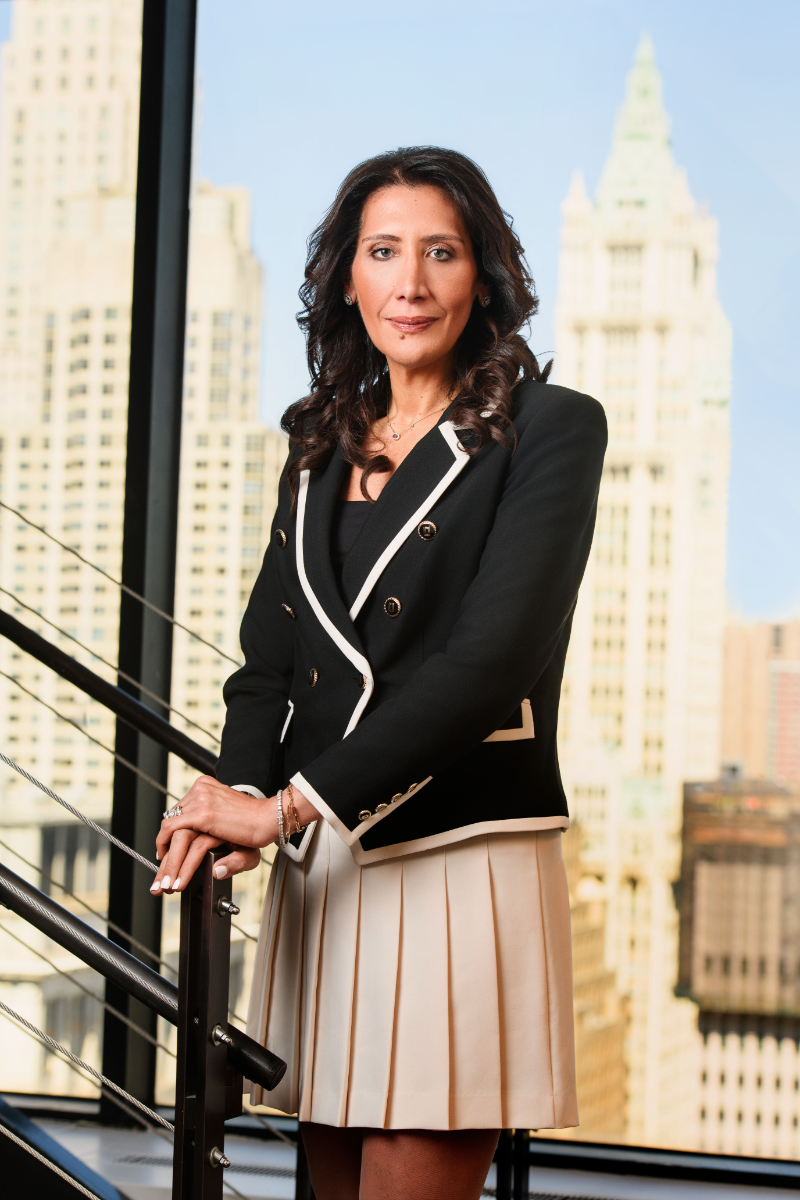
Photos by Nick Coleman.
Amy Greenbaum has always championed the power of teams. A former D1 athlete and manager of the women’s basketball team at Indiana University, Greenbaum says, “It doesn’t matter if you’re the best player, or if you’re a supporting player, or what your title is – we work as a team, and we’re not going to win unless we utilize every single resource we have.”
That outlook, though, isn’t just describing players on the court. Instead, she’s talking about her team that helps secure wins in the courtroom: the investigations team at Labaton Keller Sucharow.
As Chief Investigations Officer for the plaintiffs’-side securities powerhouse, Greenbaum founded the firm’s investigations team along with a former FBI agent in 2005. Together, they began the intensive work of developing confidential witnesses on the front end of Labaton’s sprawling cases – people who have seen harmful conduct within former employers or vendors.
In the two decades since, Greenbaum has built what was originally considered a risk itself – a dedicated investigations arm in a contingency-based plaintiffs’ firm – into an indispensable part of the firm’s success. Not only do they work intensively with confidential witnesses, but Greenbaum and her team study the potential merits of every case in the selection process, evaluating risk versus reward to the tune of tens of millions of dollars per case.
“We can't get a recovery for our clients unless these cases are successful. And most cases are not successful if they do not survive a motion to dismiss,” Greenbaum explains. “That's where my team adds the most value.”
Now a team of seven, the firm’s investigators ensure that their work meets the heightened pleading standard of securities fraud cases, implementing a rigorous code of policies and procedures that Greenbaum crafted and continues to modify as the laws and the world change. A Certified Fraud Examiner and Certified Artificial Intelligence and Investigations Expert, Greenbaum stays current on the issues that drive both case content and legal practice.
Past the investigations stage, her team's research capabilities can support cases into discovery. A few years ago, Greenbaum helmed an investigation that led to a $125M settlement on behalf of investors in biopharmaceutical company Alexion in a suit alleging that the company employed illegal sales tactics in its marketing of the blood disorder drug Soliris. Then, last year, the team saw the fruits of their work in a landmark result in a suit alleging that women’s health app Flo allowed tech companies including Meta and Google access to highly personal health information, including data on users’ menstrual cycles and pregnancy. Meta now faces nearly $8B in liability following a combined $56M in pretrial settlements with Flo Health, Google and Flurry in the first-of-its-kind case.
To that end, Greenbaum’s work thrives not just on teamwork within the investigations team, but on the daily partnership built with Labaton’s lawyers. While other firms may lean on outsourced investigators, Greenbaum says, “you're not going to get the same type of information, and you're not going to have the same interaction between the lawyers and the investigators that we have.”
It’s the lesson that’s come up for Greenbaum time and time again: When you build a team that works together every day, powerful results follow.
Lawdragon: What led you to a career in the legal field?
Amy Greenbaum: I was one of those college students who didn't know what they wanted to do. I went to college pre-med, and then I ended up focusing more on Jewish history and languages; I speak Hebrew. I thought I might be a rabbi at one point. So, I had definitely a lot of soul-searching as a 19-year-old, 20-year-old, as most people should.
My mom had had a legal career. When I graduated college, she said, "I want you to try out the law." So, I interviewed for paralegal jobs. I considered law school for a long time, and I actually eventually did take the LSATs, but then I started working in the general counsel’s office at CIBC World Markets. I got the job two weeks before 9/11.
LD: Wow.
AG: CIBC World Markets was located in the World Financial Center, which is adjacent to the World Trade Center. So, when I started after 9/11, we were working out of Mayer Brown's offices because CIBC’s general counsel was a Mayer Brown alum.
LD: On that note, I saw that you did work for families of the victims of 9/11 early on. Tell me a bit about that.
AG: At CIBC World Markets, I befriended some of the lawyers that I worked with – we used a lot of outside counsel – and I ended up transitioning over to Mayer Brown, where I got to work with a partner who had relationships with a firm working with 9/11 victims' families pro bono. It was probably one of the most impactful parts of my early career. I worked with one family who lost a father; we were working with the mother. In her tradition, you can't acknowledge someone is dead unless you have a body part, and they hadn't found a body part. It was the day before the deadline to sign all the paperwork for the Victim Compensation Fund, and she didn't want to sign the paperwork. But she had a young son, and she needed the money. Her husband was the breadwinner. So, I went to her apartment and sat with her and eventually got her to sign the paperwork for her son.
LD: No wonder that was so impactful. And to that end, your current work is focused on finance, but you're also speaking with people; you're talking to witnesses. How do those human aspects come into your practice?
AG: I’ve always been a people person. I focus a lot on the public markets, but really every day is a different industry – sometimes multiple industries in a day. I could go from talking to someone about their work at an oil and gas company, to speaking with someone about AI washing, to speaking with someone about some sort of retail inventory fraud, and a lot of it is just listening and knowing how to interact with people.
LD: Tell me about how the process of speaking with witnesses works. Can you describe a bit of what you do overall?
AG: There is a heightened pleading standard for our types of cases at Labaton Keller Sucharow. Unlike your typical civil litigation, most of our cases have a stay in discovery pending a motion to dismiss. The judges and courts require that we plead with a certain amount of particularity. And one of the methods of many that we use is speaking with people who have relevant information. Many of those people are former – never current – employees of the companies, but they could also be third parties – customers, vendors, analysts, people who have knowledge.
LD: Right.
AG: Everyone asks me why they speak with us, and they don't have to. But people talk to us because they saw something bad happening at their former employer, or at a vendor, or as a customer, and they feel compelled to talk to us. So, it's really almost like cold calling, but not cold calling, right? So, I spend a lot of time speaking to people who want to talk but may have reasons they don't want to talk. They're fearful of retribution from their former employers; they are concerned because they still work in the industry and they don't want to be outed. Sometimes they want a lawyer to represent them, and we can refer them to counsel if they want counsel.
LD: You said cold calling – how often is it that the witnesses come to you to talk, or is it mostly you reaching out to them?
AG: You'd be surprised how many people will reach out to us.
People talk to us because they saw something bad happening at their former employer, or at a vendor, or as a customer, and they feel compelled to talk to us.
LD: Interesting. Then, tell me about how you work with both clients and lawyers throughout the life cycle of a case.
AG: I spend a lot of my day in meetings, conveying to lawyers the type of information that we're getting and how it fits into whatever stage of the case we're at. I am actively involved in our case analysis team. I work with Frank McConville, who's the head of that department, daily – reviewing and analyzing potential cases, cases that haven't been filed, cases that have been filed by other firms.
I also meet with our clients and present the findings of my investigations. A lot of our clients are very involved in the investigations, and want updates, so I will meet with them and talk to them about the type of information we are finding. I'm also a vocal critic if I don't think a case has merit. I've been doing this long enough that I'm able to look at a case and evaluate if it makes sense for our clients.
LD: And what brought you to Labaton?
AG: I came to Labaton as a paralegal. I had been in a previous firm where I had done sort of a hybrid job of paralegal/investigator. About a month into working here, I get called into a meeting with a partner, and I'm terrified. I thought maybe I did something wrong. But they called to tell me that they had hired a former FBI agent to run the investigative team and asked if I would want to work with him.
LD: Wow. Does the practice look now how you might have expected when you were just starting out back then?
AG: So much has changed. One of the things that I really pride myself on is that I've evolved this practice as the world evolves. We have people who have expertise in open-source researching; I'm certified now in machine learning investigations.
LD: Absolutely. And, early on, you authored the firm's internal investigative protocol. Tell me about how that developed and what makes it distinct.
AG: About 15 years ago, I felt that we needed to streamline the way we do investigations. As far as I know, we're the first firm to have those set policies and procedures. Since then, a lot of other firms have adopted our policies and procedures, and we have also evolved them.
These policies and procedures work. They work to protect our firm, but they also work for the witnesses. They know they’re witnesses in a complaint; we tell them prior to a filing. They know what we're planning to include. There are no surprises. I'm very proud of the policies and procedures, and it's something that I insist that we follow, whether it's just us on a case or if we're working with co-counsel.
LD: Looking at your team, obviously it's grown, but it’s still very tight knit. How would you describe a member of your team?
AG: The members of my team are all so different, but they're also the same. Every single person is extremely hardworking and detail-oriented. This is not a 9-to-5 job. We speak with witnesses all over the world; we have to accommodate these witnesses' schedules. Sometimes we travel to meet with witnesses in person. As far as their backgrounds, I have a couple of lawyers on my team; I have former law enforcement on my team. Everyone comes with a different approach, but the common bond is that we work hard and everyone's enthusiastic about their cases. I’m really grateful for them. I think when you're a manager, you're only as good as your team, and my team is excellent.
These policies and procedures work. They work to protect our firm, but they also work for the witnesses.
LD: That’s fantastic. Then, looking at cases, are there any that stand out to you in particular as personally impactful or challenging?
AG: I think that one case that was particularly impactful for me was the Alexion case. It was a turning point in my career.
LD: How so?
AG: I ran that investigation by myself, and that was a case that had been dismissed. The witnesses we spoke with were medical professionals, and they felt so strongly about the conduct. It was impactful to me to speak with them.
LD: And what about other recent cases, like the litigation against Flo?
AG: Carol Villegas, lead trial counsel on the Flo case, is not just my colleague, but she's my best friend. I wasn't directly involved with the trial, but I worked on Flo on the investigation end. We've grown and changed and evolved, and we won at trial in a unanimous jury verdict. I think one of the roles that I play beyond having a seat at the table is I'm sort of the mama bear here now, because I've been here so long.
LD: Looking at your current practice, is there anything you’re seeing in terms of trends driving case origination?
AG: The market is obviously very volatile. So, it's parsing through a lot of information. There’s obviously a trend of AI-related cases, whether it's related to AI data centers or AI data washing. There are also a lot of post-Covid reality cases, if you want to call it that – seeing how businesses changed and evolved following Covid.
LD: Interesting. Finally, you’ve stayed at Labaton for 21 years. What has been most fulfilling over that time – what keeps you doing what you do every day?
AG: What I find most rewarding is that Labaton is really a meritocracy, and the reason I've been able, as a non-lawyer, to get to where I am is because I've worked hard and seen case-changing results. I love the different industries; I love learning new things. And, at this point in my career, I love mentoring people. Labaton has a huge women's initiative that we've started. As a woman who had two children while working here, now the younger associates will come to me if they're thinking of starting a family, or if they're pregnant, and I'm able to mentor them about work-life balance, about being a woman in the workplace. And, as I said, some of the partners I've known since they graduated law school. We work hand in hand every day, and I've seen their ascension to partnership, equity partnership, the executive committee. I get a lot out of that as well.

