The team at Sher Edling are disruptors. Though the California-based environmental law firm only opened its doors in 2016, founders Vic Sher and Matt Edling have been taking on some of the most contentious fights against the biggest polluters for decades. They’ve innovated the practice area, from landmark groundwater contamination cases to defining and leading the emerging field of climate deception litigation against oil and gas companies. In the latter, centering around what Sher calls the companies’ decades-long “campaign of deception,” the cases have caught the eye – and ire – of the fossil fuel industry’s political and corporate allies.
They embrace the challenge. The lawyers are, Sher says, “joyful warriors” for their clients and enthusiastic collaborators with public counsel – with a firm-defining mission to “protect people and the planet.”
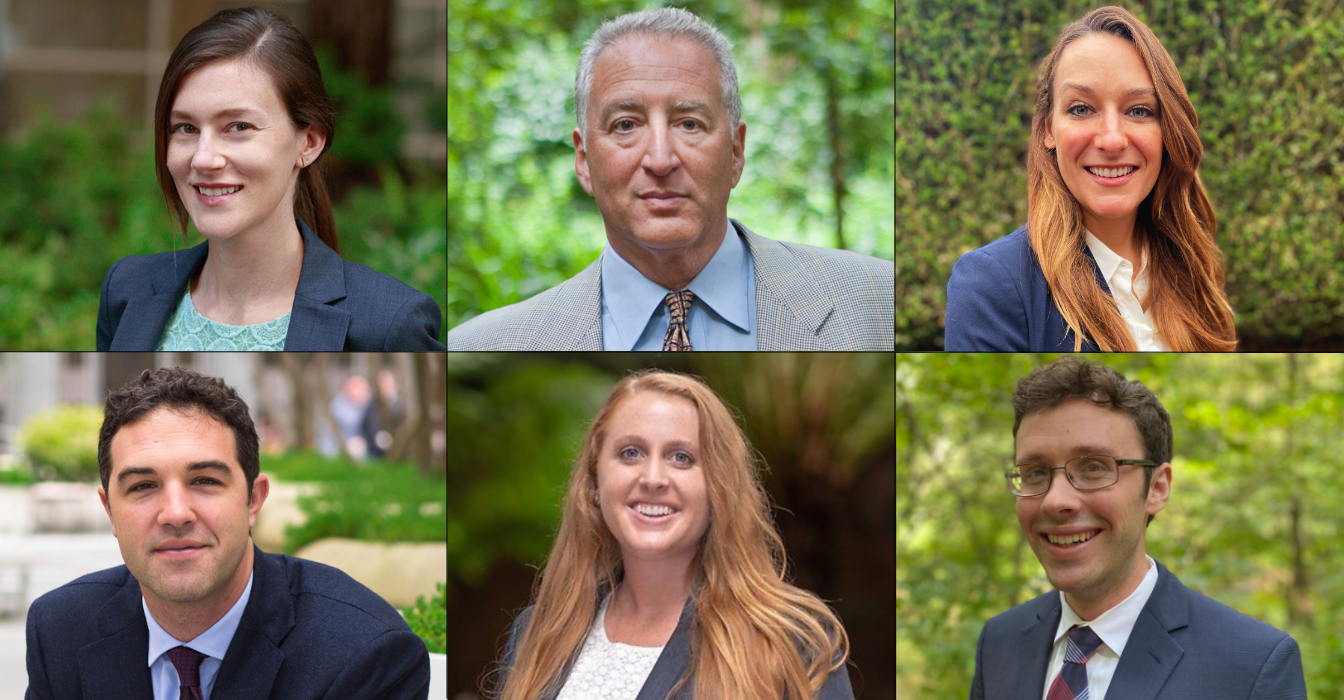
Over the years, Sher and Edling have built a team that will fight those battles with them for the next decade and beyond. They sought out lawyers who “share that drive, ambition and vision,” Edling says. They found all those qualities in powerhouse litigators Stephanie Biehl and Katie Jones, who were promoted to partner in 2022, Ashley Campbell, who was made partner in 2024 and Quentin Karpilow, who was promoted to partner in 2026.
“Like all of our attorneys, our partners go out of their way to make sure clients are not just adequately represented, but extraordinarily represented,” Edling says.
A decade in, those representations are delivering real results. Sher Edling’s clients have realized more than one billion dollars in relief thanks to the firm’s hard-fought environmental litigation. In 2025 alone, water utilities represented by the firm were awarded more than $400M in historic settlements with the 3M Company, DuPont and others as part of the national In re: Aqueous Film-Forming Foams Products Liability Litigation (the “AFFF MDL”), which concerns a firefighting foam containing PFAS. The litigation is one of the largest contamination MDLs in the country.
Our partners go out of their way to make sure clients are not just adequately represented, but extraordinarily represented.
“We are proud to represent public water providers who fight for the health and financial security of their communities and are glad they are getting some relief from the high costs of removing PFAS from their water supply,” Edling declared in a press statement at the time.
Biehl and Campbell have both held substantial leadership roles in the AFFF MDL. Biehl sits on the Executive Committee, co-chairing the Public Water Supplier Committee of the Plaintiffs’ Executive Committee in PFAS-related cases where the MDL is centralized in Charleston, S.C. She is also Co-Chair of the Discovery Committee.
Campbell, meanwhile, is co-chair of the litigation’s Sovereign Committee and has served on the committee nearly since its inception. Back then, there were seven states involved – now, there are close to 40 state attorneys general. She is working to get the sovereigns as the next trial-tracked group.
“Our firm is uniquely equipped to handle these types of cases. That is both the how and why of the team and the practice we have built,” says Biehl. “We help our clients take on some of the wealthiest and most powerful corporations in the world.”
HELPING PUBLIC ENTITIES PROTECT PUBLIC HEALTH
Clean water litigation is a longtime area of expertise for the founding partners. Sher, for instance, has taken on Big Oil companies in landmark litigation. He was designated co-lead plaintiffs’ counsel in a nationwide multidistrict litigation against oil companies over water contamination from the gasoline additive MTBE, which ultimately led to a nearly $500M settlement for water providers. In 2003, the New Hampshire Attorney General appointed Sher lead outside counsel in the first statewide case to sue ExxonMobil and others over MTBE contamination, a case that recovered more than $350M from the defendants, including a milestone $236M jury verdict against ExxonMobil after the other defendants settled before trial. Similarly, in 2008, New York City asked Sher to be lead outside trial counsel for the City against ExxonMobil and other companies in MTBE litigation concerning contaminated well water in Queens, garnering a $125M recovery (including a $105M federal jury verdict against ExxonMobil).
Sher pioneered representing public entities in tort cases against big corporations whose products – like MTBE and other toxic petrochemical and agricultural compounds – polluted drinking water. All of these cases relied on a then-novel product liability theory that held gasoline refiners accountable for impacts on public drinking water systems they knew would occur but failed to disclose or warn about. “Today, that model applies to a wide range of chemicals, including PFAS, and public awareness drives the growth and expansion of this kind of litigation,” he says.
Edling, too, has led high-stakes water contamination litigation. He recently represented the City of Imperial Beach, Calif., and other California public entities in a first-of-its-kind lawsuit concerning failing wastewater infrastructure at the U.S.-Mexico border. In a multi-tier strategy, the U.S. International Boundary and Water Commission agreed to work with its Mexican equivalent, la Comisión Internacional de Límites y Aguas, to put $630M toward infrastructure improvements and pollution abatement.
We help our clients take on some of the wealthiest and most powerful corporations in the world.
Now, Edling is partnering with Jones, Biehl, and Karpilow as lead lawyers in extensive litigation concerning water contaminated by the solvent 1,4-dioxane. They represent public entities including the State of New Jersey and the Suffolk County Water Authority – the largest supplier of groundwater-sourced public drinking water in the country. The cleanup costs for Suffolk County Water Authority alone, Edling says, could reach over $1B.
This is not Edling and Jones’ first time in court addressing 1,4-dioxane contamination. In 2022, after years of litigation and negotiation, they helped the Bethpage and South Farmingdale Water Districts (both on Long Island) secure $49M and $15.5M, respectively, from the US Navy and defense contractor Northrop Grumman. The cases centered around a contaminated groundwater plume emanating from the former Northrop Grumman Bethpage Facility and the Naval Weapons Industrial Reserve Plant in Bethpage.
The matter took tenacity. For years, the water districts had been told that there was nothing they could do, Edling says. But with Sher Edling’s successful representation and the matters now resolved, both districts have the funds to install, operate and maintain the advanced systems needed to treat the groundwater for dioxane contamination.
MISSION-DRIVEN PRO BONO WORK
While all the firm’s work is in the public interest, the lawyers largely represent public entities to achieve those goals. Outside that work, though, they also actively seek out pro bono work on behalf of directly impacted individuals.
Recently, the Sher Edling lawyers, in collaboration with the Leadership Counsel for Justice and Accountability, represented a group of 22 residents of Thermal, Calif.’s Oasis Mobile Home Park, along with a tenant association, Juntos Por Un Mejor Oasis, in a clean water and safe housing case against the park owners. The suit sought relief after tenants of the 60-acre park were supplied drinking water that contained levels of arsenic nearly 10 times the legal limit, as well as sewage spills and other contamination concerns. The U.S. Environmental Protection Agency issued multiple Emergency Administrative Orders against the owners of Oasis’s Public Water System – which reached 1,100 people – concerning the high arsenic levels. The 2021 order stated that they had “caused or contributed to the endangerment of Oasis consumers from arsenic” by not taking proper action to address the contamination levels.
In Thermal, a small, predominantly Latino community in the Coachella Valley, average temperatures range up to 108 degrees in the summer. A lack of clean water is dangerous in any environment, but particularly one in which most of the residents work outside in agriculture in the summer sun. Those same residents, the lawyers say, are often shut out of legal recourse and left without safe places to live. “The law can be a way to help call out some of those problems and compensate the people,” Jones says.
After three years of litigation, the case settled. The lawyers are still working to enforce the agreement; the aspects of the settlement that can be announced, however, include guarantees restricting rent increases and preventing retaliation for involvement in the lawsuit or failure to pay rent. In March 2025 the EPA announced a consent decree with the operators, charging a $50,000 fine and mandating upgrades and operational changes that will improve water quality and ensure compliance.
A GROWING PARTNERSHIP, ROOTED IN COLLABORATION
When Quentin Karpilow was promoted to partner at the beginning of 2026, he was recognized by Matt Edling for his “expertise in the law, dedication to our mission and contributions to our clients’ success.” He became the sixth partner at the firm, which now boasts nearly three dozen attorneys working across climate, water and natural resources practice areas.
The law can be a way to help call out some of those problems and compensate the people.
Karpilow joined the firm as an associate in 2020 after clerkships with the Honorable Susan L. Carney of the U.S. Court of Appeals for the Second Circuit and the Honorable Janet C. Hall of the U.S. District Court for the District of Connecticut. He earned his law degree from Yale Law School, where he served as co-director of the Yale Environmental Law Association.
Campbell, meanwhile, found her way to environmental law at a personal crossroads: After earning her BS in biology, political science and conservation science, she says she could either get her PhD in science or “force people to listen to scientists through the law.”
Campbell’s scientific training is imperative to her work. After law school, where she received her JD with a focus on environmental and international law, she clerked for New Hampshire’s Superior Court, where she was assigned to a judge on an MTBE case. In that landmark case, Vic Sher was representing the State of New Hampshire as they took on Exxon and other oil companies for contaminating the state’s groundwater. She was hooked. She continued to follow Sher Edling’s work until, she jokes, “they either needed to file a restraining order or hire me.”
Jones, similarly, has been drawn to environmental work since undergrad because of its ability to help people directly. She wanted to do work that emphasized “leveling the playing field to give people a voice for what matters to them,” she says.
Jones received her degree from Georgetown in science, technology and international affairs with an emphasis on environment and energy. She was also a Fulbright scholar, working in an indigenous community in Veracruz, Mexico to conduct research on traditional environmental knowledge. In law school she received both her JD and an Environmental Law Certificate. She was drawn to Sher Edling because the firm was unafraid to take on the largest corporations and polluters – cases she wanted to spend her career working on.
Biehl, meanwhile, worked her way into environmental litigation – and, like Campbell, by following Sher Edling. She worked with Edling at his previous firm from day one of her legal career. After he partnered with Sher, he recruited her to join him just a few years later.
While her work at the previous firm hadn’t focused on environmental law, she knew she wanted to “work with people who took the law and trial lawyering seriously,” she says. After learning the subject matter, advancing Sher Edling’s mission inspired her to continue building her career at the firm.
While the team is single-minded in their mission, their approach is a collaborative one. Representing public entities, from states and local governments to tribes and public water providers, requires in-depth teamwork with the entities’ counsel. The lawyers treat that relationship as a true partnership rooted in trust and mutual respect.
Those qualities start at the firm. Jones, Biehl and Campbell say working together as female partners is a privilege. Campbell says that when she first became a lawyer, she was not particularly focused on achieving partner status. But the more she practiced and saw that all too often – especially in Big Law – women were not in leadership roles, it became something she cared about deeply.
Jones adds that becoming a partner next to Biehl and Campbell has “reinforced my own commitment to be a mentor and to champion newer lawyers including women and others underrepresented in our profession.” Biehl, meanwhile, once gave Campbell and Jones a gift – an art piece that says, “empowered women empower women.” For her, that’s the most important aspect – the recognition that their wins are team wins.
As the partnership continues to grow, each of its members recognizes others’ contributions and elevate each other to become more tenacious, successful advocates. That’s easy to do when you share a passion for the mission and a dedication to delivering on it.
That combination yields impactful results. Asked what they’re most looking forward to in their careers, Biehl says, “Winning – because that’s what our clients deserve. We’re just the boots on the ground that help them get there.”

