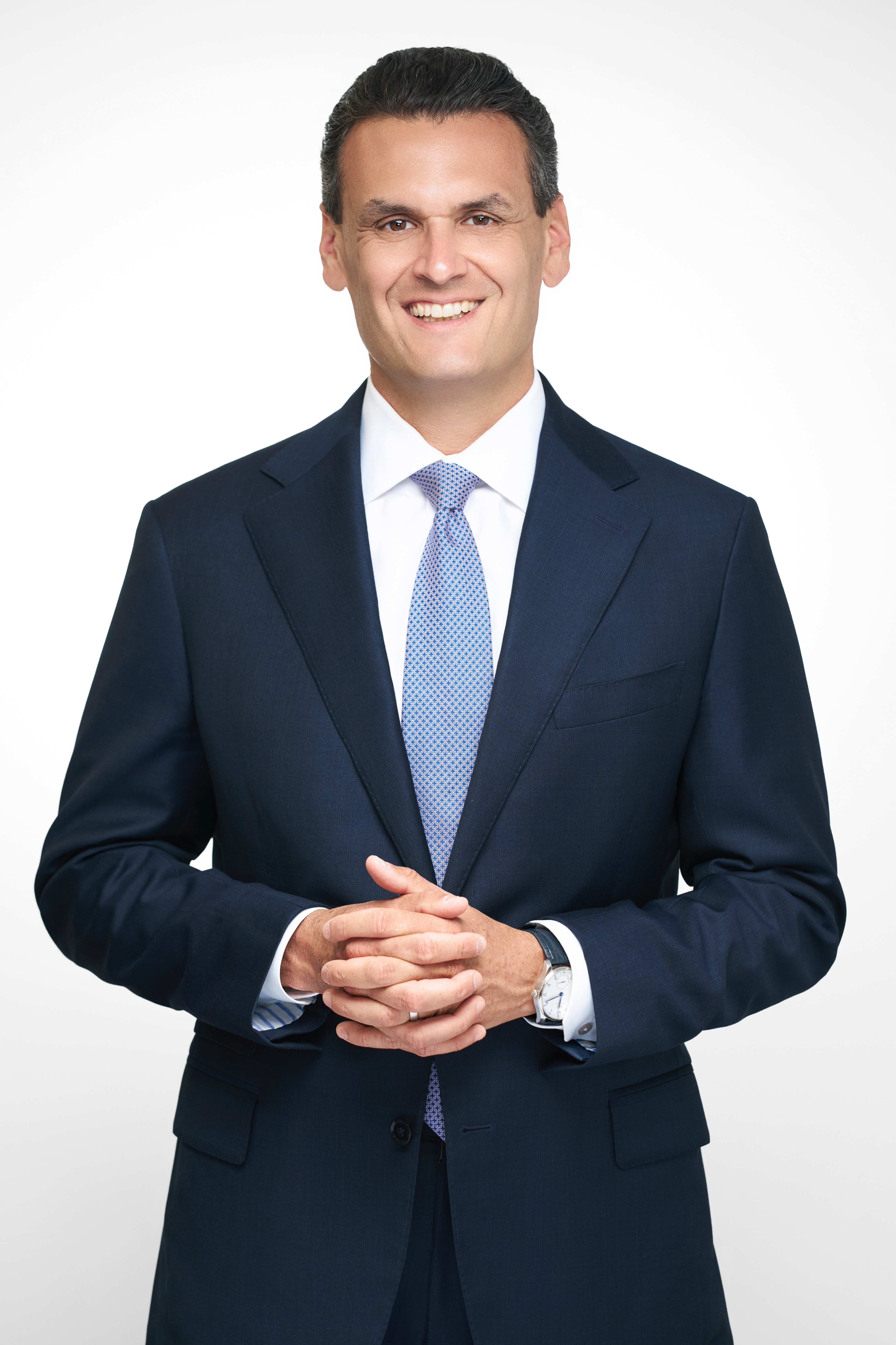
Everyone needs a good lawyer. But not every lawyer has the client roster of L.A. defense heavyweight Michael Freedman.
In the six years since the former federal prosecutor left the U.S. Attorney’s office, he has taken on some of the nation’s most high-profile, high-stakes cases in Los Angeles and nationwide. Just a few names in his client list: Harvey Weinstein, Bill Cosby, Trey Songz and Ippei Mizuhara, translator for Dodgers star Shohei Ohtani.
“I’m very passionate about defending people and helping them through a crisis, whether high-profile or otherwise,” says Freedman. “As a Los Angeles native, I feel very lucky to have built a practice doing just that in my hometown, where it just so happens that some of the people who have trusted me to represent them are high-profile.”
Even so, the bulk of his practice as founder and managing partner of The Freedman Firm is on the quieter side – serving those out of the public eye. The Freedman Firm represents executives, doctors, lawyers and corporations involved in criminal, civil and white-collar litigation.
His caseload is steadfastly nonpartisan: Freedman has represented both a Jan. 6 defendant and an anti-ICE protester. Recently, he defended former L.A. Deputy Mayor Raymond Chan in a complex federal RICO and corruption trial.
Freedman’s firm aims to provide its clients with aggressive, creative and personalized service. Last year, Freedman took on a partner – with an eye toward growth commensurate with the work they’re seeing come in – and the firm now has five lawyers and recently celebrated its fifth anniversary this year.
Freedman earned a B.A. in history at the University of California, San Diego, and a masters in Middle Eastern Studies at Harvard before getting his law degree from the University of California College of the Law, San Francisco.
He externed and clerked for several federal judges before becoming an attorney with Bird, Marella, Boxer, Wolpert, Nessim, Drooks, Lincenberg & Rhow. He spent almost four years as an Assistant U.S. Attorney, and then joined Werksman, Jackson & Quinn as a partner. He started The Freedman Firm in 2021.
Lawdragon: You have represented a lot of famous and notorious people in cases that have made headlines in the press. Was that your goal?
Michael Freedman: My goal has always been to practice criminal defense at a sophisticated level and with independence. I think there is a lot of room in the Los Angeles legal market for that kind of practice, handling high-stakes cases that might make bigger, full-service firms a bit squeamish. It just so happens that some of the people who need that kind of representation themselves have a high profile or attract headlines.
LD: Is having a press strategy important when trying a high-profile case?
MF: My strategy is always based around how I can best defend my client and get them through an investigation, prosecution or crisis. So, for my purposes, having a press strategy isn’t necessarily high on the list of priorities, unless it’s something the specific client needs. And even then, I can’t think of a case where the press strategy actually improves the legal strategy. I’m very much of the view that “less is more” or “first, do no harm.”
LD: Do you have to coordinate with PR teams?
MF: Yes. If clients need to put out a statement because of their own business or reputational needs, I have relationships with several excellent communications professionals who can advise them on that. I often use a medical analogy: My job is to be the brain surgeon, and we want you to be comfortable in the recovery room, but I’ve got to be focused on the brain surgery. If I lose sight of the most important thing, I’m not doing my job. But we need PR professionals in only a very small percentage of cases.
LG: So besides what we see in the press, who does the firm represent?
MF: I’m lucky to represent a lot of very smart, accomplished people, which is not only an honor, but something I find immensely helpful in my work because they’re engaged and involved in their own defense. That is a great thing because you really get to partner with them and learn from them. In representing individuals from the community, I like to joke that I feel like a country lawyer, but the country happens to be Los Angeles, which is the center of industries like entertainment, health care and sports. So, being from here and in the mix is only natural and part of the practice.
LD: Why do you take the cases you take?
MF: I like standing up for people. I like helping people through a crisis. I'm a very empathetic person, and I like the challenge of being up against the government or defending people being attacked in the public square. It's my personality to not be afraid of a challenge, which has allowed me to take on tough cases, like trying a murder-for-hire or RICO case.
In representing individuals from the community, I like to joke that I feel like a country lawyer, but the country happens to be Los Angeles, which is the center of industries like entertainment, health care and sports.
LD: Your father was a federal prosecutor. Did that influence your choice to become a lawyer?
MF: For sure. My dad was a DA and an AUSA before becoming a civil litigator, so I grew up hearing about trials and courtroom tales. I always liked standing up and talking and also helping people. My mom was a teacher and school psychologist, so helping people in the community and in crisis was her focus, too. I got it from both sides.
LD: But your plan was to get a PhD. in Middle Eastern history. How did that evolve?
MF: I started college right after 9/11. I was drawn to what was on the front page and wanted to understand it better. I went to grad school but, for a variety of reasons, I decided that academic life didn’t tick all the boxes in terms of the career I wanted to have. So, like for a lot of people, law school was a backup. I enjoyed it. It quickly came together that criminal law, in particular federal criminal law, was my area of interest.
LD: What did you like about criminal law?
MF: The first summer after law school, I externed for a federal judge in San Francisco and just being in the federal courthouse and seeing that level of practice and high-stakes trials was great. I watched the death penalty phase of a RICO trial, and I was struck by the intensity, the big stakes, the big cases. You’re dealing with human nature and all its varieties. From that point on I knew I wanted to be a federal criminal trial lawyer. It’s a perfect fit.
LD: Did you join the U.S. Attorney’s office to get trial experience?
MF: Yes. I started at an excellent litigation boutique in L.A. that had a lot of former prosecutors whose practices really inspired me. I felt like going to the U.S. Attorney’s office would help me get the kind of trial experience they had. When I was fortunate enough to get hired there, I made it my goal to try as many cases as I could. In three and a half years, I had eight trials: a huge two-month mafia trial, a health care fraud trial, a national security trial and I got to work on a wide variety of cases – everything from drugs and gangs to environmental crimes and fraud cases. It was an incredibly good opportunity, and I felt like being an E.R. resident where they just throw you in the deep end every day.
I watched the death penalty phase of a RICO trial, and I was struck by the intensity, the big stakes, the big cases. You’re dealing with human nature and all its varieties. From that point on I knew I wanted to be a federal criminal trial lawyer.
LD: How did you learn the right way to practice?
MF: I spent a lot of time seeking out senior mentors who were very, very experienced trial lawyers. I would just sit with them and ask questions like, “How do you introduce evidence?” “How do you organize witnesses?” “How do you deal with issues that pop up during jury deliberations?” “How do you get over the nerves?” I asked them about the different styles of defense lawyers. What works, what doesn’t. And I tried to get into court as much as I could to figure out what worked for me personally, because you need to be authentic and develop your own style.
LD: What else did you learn at the U.S. Attorney’s office?
MF: I learned that not everyone wants to do what I wanted to do — representing individuals, focusing on trials, handling any type of criminal case — and that helped me realize that’s there’s a lot of fertile terrain in the market in L.A. and nationwide for a practice like that. I’m gratified that so many of my colleagues and friends have trusted me with referrals for those types of cases.
LD: What’s it like having your own firm?
MF: I love it for so many reasons. It’s allowed me to learn how to build and run a business, which helps me better understand my clients who have done the same in various industries. Personally, the independence allows me to take on a wide variety of cases and trials, which gives me the opportunity to grow and improve. I’ve been out on my own now for longer than I was a prosecutor. I’ve kept up my trial practice, with four federal criminal trials in the last four years, and several more trials and arbitrations on top of that. There’s a lot more challenges and lessons to learn on the defense side, and I relish every chance I get to keep learning and improving as a trial lawyer and a defense lawyer.
LD: How do you approach trying a case?
MF: There's always a theme – and you don't want to lose sight of that theme. You may have been through gigabytes upon gigabytes of discovery and motions may have changed the tenor of the case. There’re all kinds of developments, but it's often helpful to go back to the start and think, "What's this case about?"
I tell clients all the time, "I'm thinking of the closing argument in the first meeting.”
LD: What kind of personality do you want the firm to have?
MF: I pride myself on being very client-focused and want the firm to reflect that spirit. Every client's different and every case is different, but every case is equally important to the client, and we must keep that front and center and earn and keep their trust by fighting for them. You must really explain options and strategies, but also listen to their concerns, goals, risk tolerance, timelines and other issues in their lives and design the defense accordingly. As the firm grow, it’s a real privilege to be able to show younger lawyers this kind of practice and help train them to provide this level of client-focused representation.
LD: Are you attracting the kinds of cases you expected?
MF: Yes. It took a few years, but when I look now at the variety and complexity of cases I’m handling, it’s the kind of practice I always dreamed of. At the same time, the market has changed since I went out on my own, so you must be responsive and flexible. Some people will say there's less white-collar work under the Trump administration, which is accurate. But from where I am in the market, focused on representing individuals in investigations and prosecutions, there's still plenty of white-collar work. For me, the white-collar practice is busier than ever.
I tell clients all the time, 'I'm thinking of the closing argument in the first meeting.'
LD: What other kinds of cases are you taking on?
MF: There are always a lot of health care fraud cases in L.A. Recently, I’ve had a lot of SEC cases representing financial professionals. Then, in state court, I have quite a variety right now of public corruption cases the D.A.'s office is bringing.
But it runs the gamut. I have a homicide case, an assault case and then I have a novel Labor Code felony prosecution and an Iranian sanctions case. On top of that, it starts to blend into the civil practice where I have False Claims Act cases and a crypto securities fraud class action.
Right now, in L.A., the U.S. Attorney's office is investigating homelessness fraud. And by pure coincidence, I happen to have several different clients in those cases. They're all unrelated, but it’s a new priority area that didn't even exist a year ago.
LD: What’s the biggest challenge you face in your cases?
MF: When you're dealing with the federal government, everyone says the same thing: You can get buried in discovery because of the nature of these investigations. By the time they charge a client, they've had years to collect phones and interview witnesses. And it can be very hard in this day and age to cut through it all while not losing sight of the big-picture themes that are at the center of any case.
LD: Do you have to hire more lawyers to deal with the caseload?
MF: We’re now up to five lawyers and two support staff. We are getting bigger to keep up with the work and I'm trying to keep it going so that I can practice the way I want and respond to client demands and stay as busy as possible, but in a way that feels the same as it always has been. We've been lucky to be so busy. It's still funny to look around and be like, "Oh, now it's a real law firm. All these people here are working together to help our clients.”
LD: It sounds like you’re enjoying life at the firm. Is that right?
MF: It's nice having started my own firm because I can truly make independent decisions about my practice while also getting to work with lots of great lawyers and now getting to mentor younger lawyers as well and help train them. There's a great network of former prosecutors at smaller firms around the country, and I am lucky to have developed a network of peers and mentors. I’ve been very involved in the Federal Bar Association and the American Bar Association for many years, which is such a strong community of white-collar practitioners.
LD: You said your clients are often going through life-altering situations. How does that affect your approach?
MF: One of my first mentors used to say, “Winning is never as good as losing is bad,” and I really get that. Even when the outcome is not ideal, you must find a way to keep fighting for your client. Sometimes, that means avoiding a worse outcome or stopping the bleeding. I had a case last year where the government was seeking over seven years. Through years of litigation, the client got probation. We keep in touch and we talk about how the strategy worked. I had another case where we beat a murder charge. I took my client for coffee after we left court for the last time, and he told me about the new company he was going to start. He’s a young guy, and to see the difference you can make in someone’s life through hard work, strategy and a little bit of luck is really fulfilling.
LD: Would you say that brings you satisfaction?
MF: I feel incredibly lucky to have built a practice and a firm that allows me to help people every day and keep growing as a lawyer.

