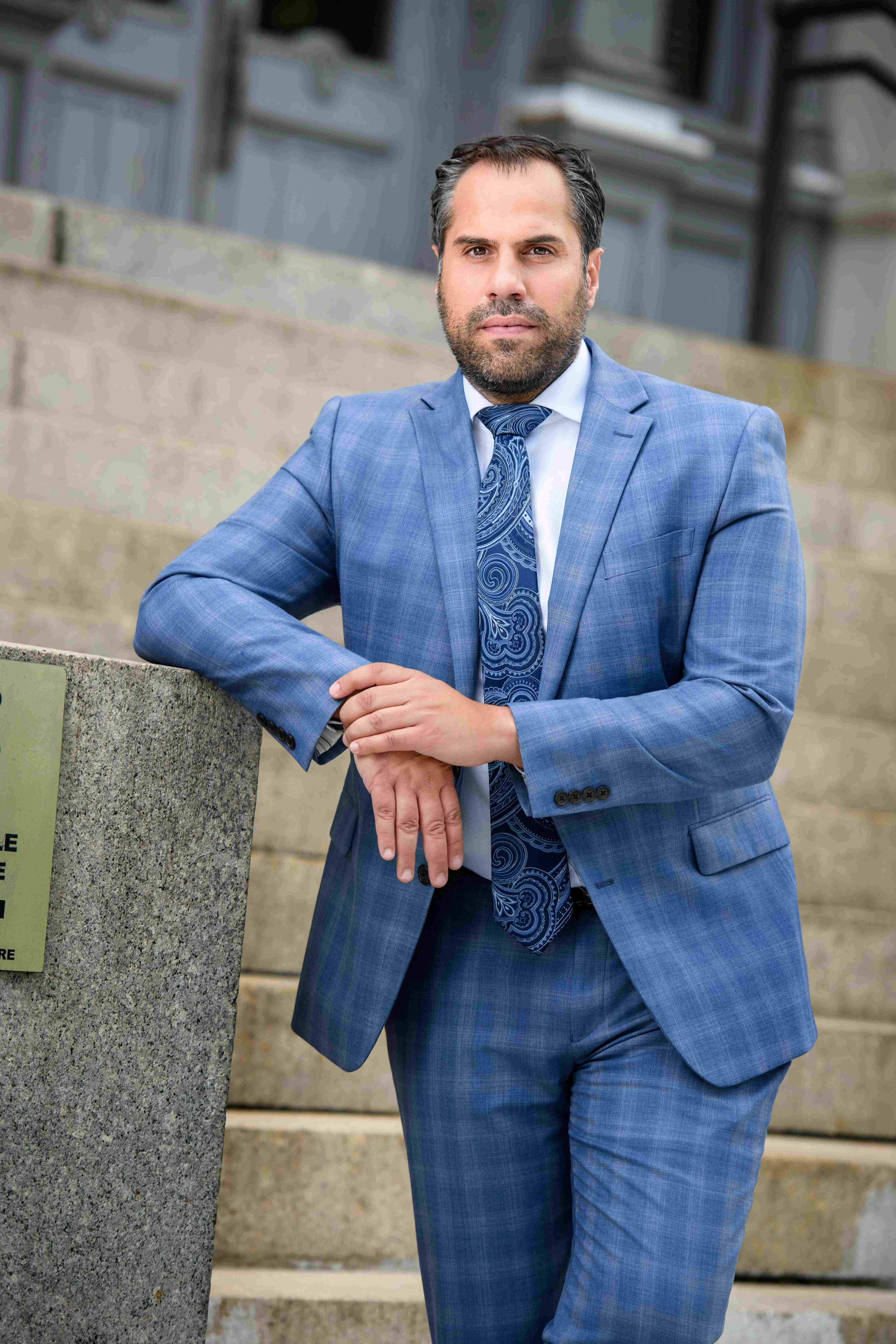
to his firm. Photo by Nick Coleman.
In June, the U.S. Supreme Court declined to hear a gun-industry challenge to New York’s first-in-the-nation firearms liability law. The decision closed one chapter in the fight over gun-industry accountability – and, for Mark D. Shirian, opened the next.
Shirian represents Ilene Steur, a victim of the 2022 Brooklyn subway shooting who was catastrophically injured with a Glock gun during one of the most violent attacks in New York City transit history. With the case now moving forward in federal court, Shirian is arguing that Glock should be held liable under New York law for the negligent marketing and distribution of its firearms.
“Gun manufacturers should not be able to look away from how their products are marketed and distributed,” Shirian says. “These are not easy cases, but this is cutting-edge litigation, and we are ready to keep moving forward.”
High-stakes litigation is familiar terrain for Shirian. Since founding his firm, Mark David Shirian, a decade ago, he has built a lean plaintiff-side practice. His cases span employment, personal injury, survivor claims, medical malpractice, nursing-home matters and sports-related litigation. As host of “The Millennial Lawyer Podcast,” Shirian also shares insights on personal injury law, legal mentorship and navigating today’s legal landscape.
“The law is changing, and the industry is changing,” Shirian says. “But the work still comes down to real people, real problems and real damages. You cannot lose the human compassion these clients and cases require.”
That discipline was forged long before Shirian entered a courtroom. Before law school, before founding his firm and before taking on cases against some of the country’s most powerful companies and institutions, Shirian was a wrestler. Litigation is not so different.
Lawdragon: What led you to a legal career?
Mark Shirian: I grew up on Long Island and went to Great Neck North High School. During my sophomore year, we were learning about HIV and AIDS in health class, and our teacher showed us the movie “Philadelphia.” Watching that really inspired me to become a lawyer.
What struck me was the advocacy – one person standing up for himself, and another standing up for his client in a case that other people may not have seen as meritorious at first. The employment-law piece also had a major impact on me. Tom Hanks’ character loses his job because his employer suspects he has AIDS, and that showed me how devastating workplace discrimination can be.
Personal injury came into my life a little differently. In law school, one of my professors suggested it might be a natural fit given my background as an athlete. I interned at a personal injury firm, and it ended up being the right fit.
LD: Did you always know you wanted to start your own firm?
MS: When I first started out, I thought I would go to law school, work at a big firm and follow that traditional path.
But I graduated from NYU in 2009, during a very difficult economy. I saw smart, capable people losing their jobs because of the recession, and that uncertainty shifted the way I thought about security. I became less focused on working for someone else and more interested in building something of my own.
I was also fortunate in law school to work with young lawyers who had already started their own firm. For some people, security means working for someone else. I learned that, for me, security meant building my own firm, developing my own cases and making my own decisions.
LD: What has building the firm taught you?
MS: One of the biggest things I have learned is to be grateful for the challenges. When I first started out, I had this mentality of perfectionism. I thought I needed to be perfect in order to move forward. I have learned to have more grace with myself.
You are not going to spend 10 years building a business as a litigator in New York City and have everything go perfectly. But the challenges teach you, and the faster you learn those lessons, the better attorney and business owner you are going to be.
What struck me was the advocacy – one person standing up for himself, and another standing up for his client in a case that other people may not have seen as meritorious at first.
LD: Your firm has remained intentionally lean. What is the philosophy behind that structure?
MS: My middle name is David, and it is part of the firm name intentionally. One of my favorite stories is David and Goliath, and Malcolm Gladwell’s book “David and Goliath” really stayed with me when I read it before starting the firm.
What looks like an advantage is not always an advantage. What looks like a disadvantage is not always a disadvantage. That is how I think about the work we do. I thrive on David-and-Goliath matchups. Just because an opponent is bigger, has more resources or is represented by a large corporate firm does not mean they are going to win the fight.
Whether someone has been injured, discriminated against at work or forced to go up against an employer, insurance company or large corporation, it often starts as a David-and-Goliath fight. We are prepared for that fight, and we do not back down from it.
LD: How do you position your cases for success?
MS: It starts with intake and case selection. My rule of thumb is: If I would not hire myself for a case, I am not going to take that case. If we do not have the right expertise, I will refer it or reject it.
Because we take these cases on contingency, we do a thorough intake so we can understand the facts, the risks and whether there is a viable path to success. Once we take the case, we are thinking about the theme of the case, the lawsuit, the case law and where the pitfalls may be. We are also pushing discovery, scheduling depositions and using the tools available to us when defendants try to delay.
A lot of times, when you are pushing discovery, that is when cases resolve. It is also when you really begin to see what happened. By the time we get to trial, we want to be in a position where we can prove the case and be successful.
LD: How do you define the firm’s mission?
MS: People come to us when they are often at one of the lowest points of their lives. They have lost something: a loved one, their health, a job they wanted to keep or the security they should have felt at work. Our job is to help get them back on track.
Lawyers, if they are doing their job, should be promoting and providing justice. In civil litigation, the tool we have is compensation – in many cases, that is the only way to help make someone whole. But it is not just about money. A lot of people are looking for the opportunity to be heard. Having your day in court does not always mean going to trial. It can mean a mediation, a settlement conference with a judge or even a deposition.
Justice means different things to different people, but what you often see at the end is relief. That is what I want for my clients: a result that feels like justice and gives them enough peace of mind to move forward.
LD: How has your mix of cases changed in recent years?
MS: Over the last few years, changes in New York law have opened the door for survivors to bring claims that previously may have been time-barred. The Child Victims Act, the Adult Survivors Act and New York City’s amended Gender-Motivated Violence Act have allowed survivors to pursue claims involving abuse that happened years, and sometimes decades, ago.
That has allowed us to take on more sex-abuse and survivor cases, including cases involving conduct from the ’50s through the ’90s. These cases are different because they allow us to advocate for people who were silenced for a very long time.
We have also gotten more involved in medical malpractice and nursing home cases, including nursing home abuse, pressure-ulcer cases and scams targeting older adults. So the work has expanded, but the throughline is the same: representing people who have been harmed and need someone to advocate for them.
LD: Can you tell us about a particular survivor case?
MS: One case that stands out involved a client who is now in his 70s. He was sexually abused as a child during a school trip to a farm in upstate New York. He had attended a public elementary school in the Bronx, but the school does not even exist anymore. At the beginning, the only proof we had was a school picture of him standing next to the teacher. We had the teacher’s name, the year and the school he attended. That was it.
With many of these sex-abuse cases, especially when the abuse happened decades ago, credibility is everything. This client was incredibly credible. He remembered what happened – how his mother tried to make sure the teacher and the person who abused him were held accountable, and how he later left that school.
We pushed for records that could help confirm what happened after the abuse, and the city eventually came to the table to discuss settlement. We were ultimately able to resolve the case for $1.5M.
That meant a great deal to the client. His mother, who is no longer alive, had tried so hard to advocate for him when he was a child. Decades later, we were able to help carry that effort forward and secure a measure of accountability for what happened to him.
The work has expanded, but the throughline is the same: representing people who have been harmed and need someone to advocate for them.
LD: Are there any other cases that have really stayed with you?
MS: I worked on a medical malpractice case involving a client who sustained an ectopic pregnancy that was not detected in time. There was a real question about whether she would ever be able to have children on her own, and IVF treatment was not something she otherwise would have been able to afford. We were able to obtain a very meaningful settlement for her, and she was able to pursue IVF.
One day, I got a text from her saying that she and her partner were expecting. Later, I received a photo of her baby daughter. She told me, “This would not have been possible without you and the work that you did.”
That was one of my proudest moments. Our mission is to right wrongs. She wanted to have a child, and the malpractice had set her back in a very serious way. We were able to get her the compensation she deserved, and that put her in a position to afford IVF. Now she is the mother of a beautiful baby daughter.
LD: On “The Millennial Lawyer Podcast,” you discuss personal injury law, legal mentorship and trial strategy. What kinds of issues are you focused on right now?
MS: In a recent episode, we discussed private equity in the personal-injury space and what that could mean for the industry, especially in the contingency-fee world.
For me, the question always comes back to values. I understand this is a business. But I started my firm because I wanted to work on my own cases and give clients the hands-on approach they deserve. This is not a cookie-cutter business where you can just come in and maximize profits. You are dealing with real people, real problems and real damages.
I think we are going to see a lot of change in this space over the next five years. Private equity could be beneficial in some ways, as long as the core values of the firm remain intact. But I would not get involved in anything if it meant selling out my clients or selling out my values.
LD: You are handling a case against Glock involving a victim of a 2022 subway shooting. What can you tell us about that case?
MS: We represent a victim of a 2022 subway shooting who was catastrophically injured with a Glock gun.
For several years, there was a constitutional fight over the New York law that allows these kinds of claims to be brought against gun manufacturers. That law, New York General Business Law Section 898, was enacted in 2021 and allows plaintiffs to bring claims against gun manufacturers for the negligent marketing and distribution of their products.
The Second Circuit affirmed the constitutionality of that law, and the Supreme Court denied the gunmaker’s petition to review that decision. As a result, our case against Glock can now move forward.
The case is about accountability. Gun manufacturers should not be able to look away from how their products are marketed and distributed. These are not easy cases, but this is cutting-edge litigation, and we are ready to keep moving forward.
This is not a cookie-cutter business where you can just come in and maximize profits. You are dealing with real people, real problems and real damages.
LD: How has your background as an athlete and coach shaped your work as a lawyer?
MS: Wrestling and litigation have a lot in common. Preparation is everything. You cannot be undone by setbacks. You have to stay mentally tough, stay focused and be quick on your feet.
Coaching taught me something different, but just as important. I coached at an all-boys private high school on Long Island, and I learned that you cannot coach everyone the same way. Some kids needed tough love. Some needed encouragement. Different people need different things.
That has carried over into my work as a lawyer and business owner. Clients are not one size fits all. Some need reassurance. Some need directness. Some need every step explained. Others just need to know you have it handled. Coaching taught me that if you want to get through to someone, you have to meet them where they are.
It has also shaped the kinds of cases I take on. I have handled cases involving soccer, baseball and wrestling, and we are currently representing clients in a hazing case against Seton Hall, which is in the discovery phase.
LD: Your firm is approaching its 10-year anniversary. What does that milestone mean to you?
MS: This August will mark a full decade of running my own firm. That means a lot to me. I am proud of my younger self for having the vision and wherewithal to start this business in the first place. Building a firm, keeping it going and weathering storms like the pandemic takes a lot.
I’m proud of my staff, my team and my brother, who has worked with me for the last five years. Working with him is like a marriage. At the end of the day, you love each other and you trust each other. Of course there are arguments, but you know that person has your back.
Together, we have done a lot of great work for our clients, and we have built something I really believe in. I am excited for the next 10 years.

