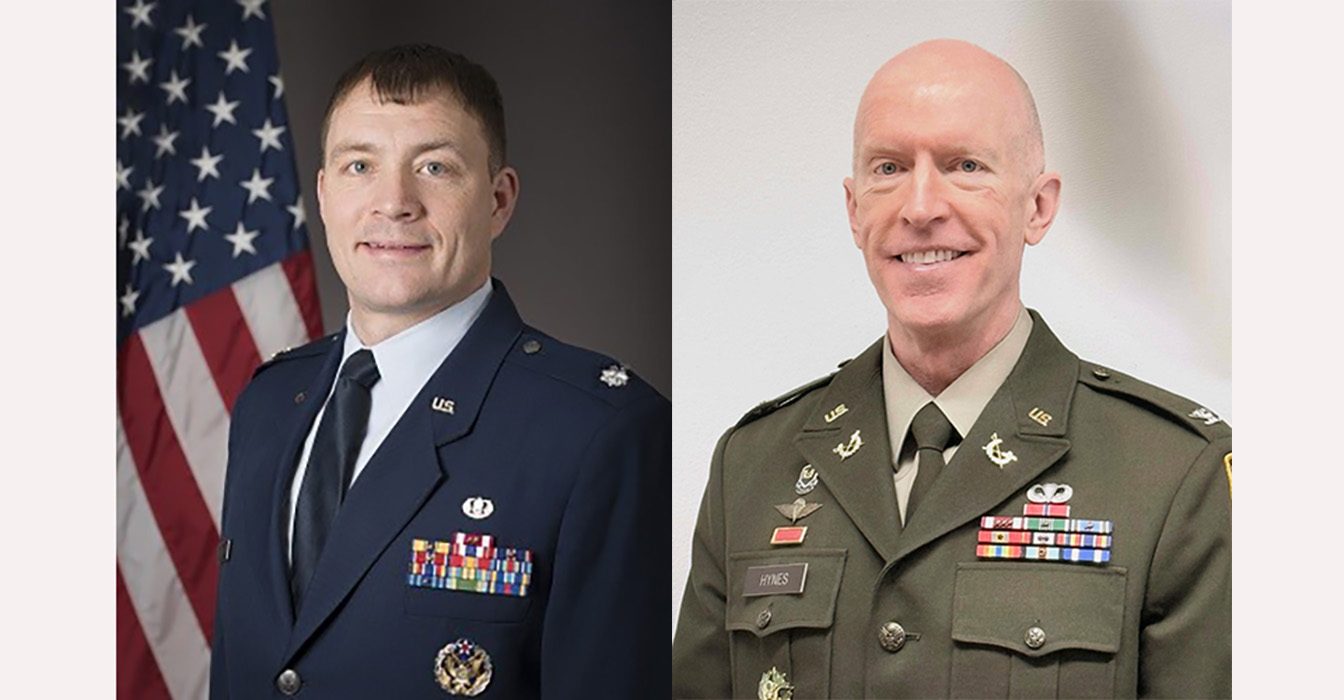
Guantanamo Naval Base, Cuba – Air Force Lt. Col. Michael Schrama was a 19-year-old undergrad at Georgetown University when hijacked plane American Airlines 77 crashed into the Pentagon on Sept. 11, 2001, about four miles from campus. That’s a day that the military judge, now in his mid-40s, recalled as “surreal” during his brief voir dire on Monday in a Guantanamo Bay courtroom. Schrama also remembered feeling bad for the victims but said he was “not personally impacted” by the attacks.
“There is nothing about that day that I believe would affect my ability to be impartial in this case,” Schrama, who joined the JAG Corps in 2009, said.
He is the fifth military judge to preside over hearings in the 9/11 military commission – one that began with the May 2012 arraignment of the men accused of planning the attacks. There still is no trial date. None of the four defense teams nor the prosecution sought his removal, which means Schrama will attempt to guide the case through one of its most uncertain phases.
Three of the defendants are now refusing to participate in the proceedings claiming that their agreements to plead guilty – since withdrawn by the government – should be enforced. A fourth defendant’s case is on hold as the prosecution appeals the prior judge’s suppression of the most critical evidence against him. And the government now wants to rejoin a fifth defendant to the case who was severed more than two years ago after he was found to be mentally incompetent.
Schrama’s first hearing also marked the first day in court for the case in nearly a year. In January, Khalid Shaikh Mohammad, the accused mastermind of the attacks, was just 15 hours from entering his guilty plea when the U.S. Court of Appeals for the D.C. Circuit halted the proceedings to give the government time to petition for its right to withdraw from the plea deals. A split three-judge panel eventually ruled in July that the government could back out of the agreements, just a few weeks before Schrama was appointed to the case.
Shortly after, the defense teams for Mohammad, Walid bin Attash and Mustafa al Hawsawi urged Schrama in a written motion to suspend all proceedings until the plea-deal dispute ran its course. The defendants are seeking a rehearing with the full D.C. Circuit and have vowed to go to the U.S. Supreme Court, if necessary, to see the terms of the plea deals enforced. Under the deals signed in July 2024, the defendants avoided any possibility of death sentences in exchange for full admissions to their roles in the 9/11 attacks.
The agreements also obligated the defendants to not participate in contested pretrial motions – a provision that creates the current legal predicament. Defense lawyers said in their motion for a suspension that participating now could potentially give the government a reason to withdraw from the agreements if they are ever reinstated – what the teams referred to as “a forced breach” of the deal terms.
Schrama declined to grant their request for a suspension, in a ruling issued on Sept 19. (The D.C. Circuit also denied a later request to stay the proceedings.) However, Schrama was unfazed that the three teams declined to participate in his voir dire or to suggest any other motions that might be ready for oral argument this week.
Matthew Engle, the lead lawyer for bin Attash, told Schrama that he was bound by “ethical obligations to abide by the terms of our pretrial agreement” to not participate. Clay Trivett, the lead prosecutor, characterized the plea deals on Monday as “voided.”
“We are ready anytime, anywhere to argue any motion or to answer any questions that the military judge gives at any point in time for anything that's currently on the docket,” Trivett said.
Trivett reiterated in court what the government promised in its written pleadings: Should the defendants prevail on reinstating the plea deals, the government will not argue that the defendants violated their agreements by participating now as their appeals move forward.
Schrama, however, did not rely on the government’s concession in his ruling, which instead was based on his conclusion that the defense teams failed to meet the legal burden for seeking continuances. He wrote that relying on the government’s promise “would be imprudent because there is no documentary or testamentary evidence of record to support that assertion.”
Looking towards 2026, Schrama is prioritizing the pretrial dispute that occupied much of the case’s long history before the attempted plea deals – defense efforts to suppress confessions the defendants gave to FBI agents on Guantanamo Bay in early 2007, about four months after their transfer from secret black sites where the CIA subjected them to torture, isolation and other abuse.
Earlier this month, Schrama issued an order that contained a series of deadlines for resuming the suppression hearing at the next session, set for two weeks beginning Jan. 12. Schrama first wants the government to present the remainder of its case in support of its position that Mohammad, bin Attash and al Hawsawi each gave voluntary and admissible statements to the FBI.
Defense teams already have filed motions to cancel the January hearing as well as to suspend the deadlines for the suppression litigation. Those requests, made recently and subject to additional briefing by both sides, are pending.
We are ready anytime, anywhere to argue any motion or to answer any questions that the military judge gives at any point in time for anything that's currently on the docket,” Trivett said.
Mohammad, bin Attash and al Hawsawi signed plea deals on July 31, 2024, with the court’s convening authority, Susan Escallier. Sec. of Defense Lloyd Austin issued a memorandum withdrawing from the agreements two days later amid political and public opposition to settling the case. His successor, Sec. Pete Hegseth, has said he supported Austin’s decision.
Air Force Col. Matthew McCall, the case’s fourth presiding judge, ruled in November 2024 that Austin acted unlawfully and could not withdraw from the plea deals because the defendants already had begun performance under their terms. The Court of Military Commission Review upheld that ruling on Dec. 30. McCall had intended to hold plea proceedings in January 2025 until the government successfully sought intervention from the D.C. Circuit, which hears appeals from the military commissions.
January was significant for another reason: McCall heard closing arguments on the suppression case for the defendant who did not attempt to plead guilty, Ammar al Baluchi, a nephew of Mohammad’s. In April, shortly before his long-planned (and repeatedly delayed) retirement, McCall suppressed the confessions al Baluchi gave to the FBI on Guantanamo Bay in January 2007. McCall determined that the CIA’s earlier program of torture and isolation rendered the statements involuntary, even though the FBI agents used traditional interview techniques. The ruling applied only to al Baluchi because the other three defense teams had stopped participating in the suppression hearing after signing their plea deals.
The prosecution wanted to move forward with al Baluchi’s case as it appeals McCall’s ruling to the Court of Military Commission Review. However, Schrama decided in September to place al Baluchi’s case on hold. He cited a commissions rule that requires a case’s suspension in the event of an appeal of a ruling that affects all of the “charges and specifications.” He said in his decision that he would not preclude al Baluchi’s participation in certain discovery and administrative matters, which included voir dire. Navy Lt. Matthew Burns, a new military lawyer on the team led by James Connell, was the sole defense attorney to question Schrama on Monday.
In their exchanges, Schrama said that he had not read any books about the 9/11 attacks or the case itself, though he did read a New York Times article about his appointment to the commission in July. He said he was aware through “open-source media” of some of the controversy surrounding the plea agreements and Austin’s withdrawal from them.
“Would public backlash, anger, or admiration, or any other sentiment affect your ability to make decisions in this case?” Burns asked.
“No,” Schrama said.
Schrama told lawyers on the other teams that he would allow them to ask voir dire questions later “if the time becomes appropriate” based on any resolution of the plea-deal litigation. He did not state if he would adopt a similar strategy – such as recalling witnesses – if he allows the government to move forward with its suppression case next year and the teams choose not to participate.
Government Attempts to Move Forward with Bin al Shibh Prosecution
Meanwhile, the status of the military commission for Ramzi bin al Shibh, one of the five original defendants, has become mired in its own procedural complexity. Judge McCall severed bin al Shibh from the case in September 2023 after a military panel of mental health professionals determined that his mental illnesses prevented him from effectively participating in his defense. The three-member panel found that bin al Shibh suffered from post-traumatic stress disorder with secondary psychotic features, along with an alternative diagnosis of delusional disorder, which his legal team blamed on his past torture by the CIA. Bin al Shibh has long complained that the detention facility’s guard force subjects him to a range of “painful physical sensations” and vibrations that cause ongoing misery and interfere with his ability to rest.
The government now wants to resume the military commission against him. His legal team, led by David Bruck, opposes doing so on the grounds that bin al Shibh has not received any treatment to restore him to competency. The case’s new judge, Army Col. Thomas Hynes, who also was appointed in July, has so far tabled a motion filed by the prosecution to rejoin him to the original case. Haynes said in a Dec. 10 ruling that the motion was “not yet ripe for decision” given the dispute over bin al Shibh’s competency.
On Friday morning, Trivett told Hynes that the government did not dispute that bin al Shibh still suffers from a delusional order, one that he is likely to “have for the rest of his life.” However, he repeated what he told McCall in September 2023 – that the condition does not prevent him from intelligently assisting in his own defense. Trivett cited a determination by a prison psychiatrist that bin al Shibh displays the type of “decisional capacity [that] would lend to his ability to participate in non-clinical activities.” He said that bin al Shibh has been resistant to treatment by the prison mental health team and that the dilemma over his contested competency “will continue to happen.”
“We are never going to stop trying to hold Mr. bin al Shibh responsible for the 9/11 attacks,” Trivett said.
Bruck told Hynes that bin al Shibh's condition has not changed since his severance from the case. He noted that his client was once again in disciplinary status and being held in isolation at the camp for destroying property. He said that bin al Shibh’s “volitional activity” and decision-making abilities, cited by the government as evidence of his competency, were all directed at stopping the persistent feeling of being attacked.
“It’s just evidence of how profound and deep the problem is,” Bruck said.
Hynes told the parties on Friday that he was unlikely to rule on the matter before February. Bruck’s team is currently seeking discovery on the September 2024 firing of a staff psychiatrist who had begun to establish rapport with bin al Shibh and develop a plan for trauma-based treatment.
About the author: John Ryan (john@lawdragon.com) is a co-founder and the Editor-in-Chief of Lawdragon Inc., where he oversees all web and magazine content and provides regular coverage of the military commissions at Guantanamo Bay. When he’s not at GTMO, John is based in Brooklyn. He has covered complex legal issues for 20 years and has won multiple awards for his journalism, including a New York Press Club Award in Journalism for his coverage of the Sept. 11 case. His book on the 9/11 case was published on Aug. 12.

