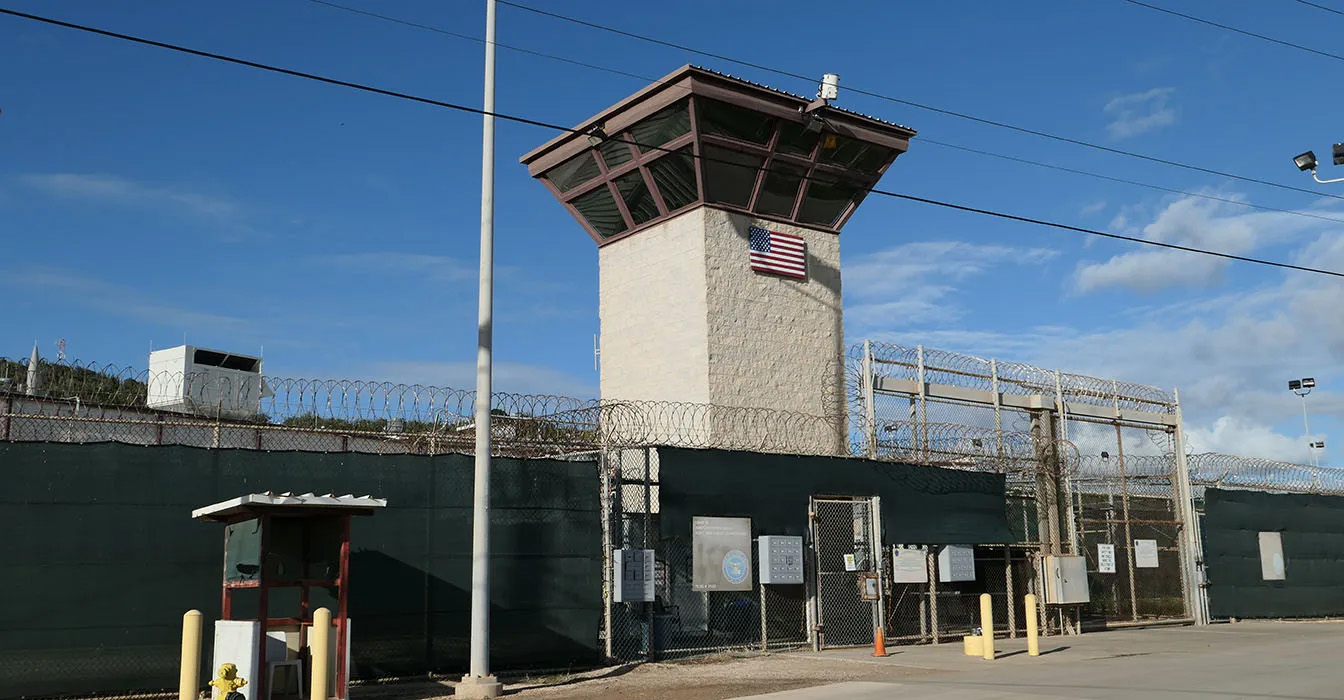
Guantanamo Naval Base, Cuba – Prosecutors this week made what might prove their final attempt to convince a military judge that the CIA’s brutal treatment of the accused 9/11 conspirators at overseas black sites did not permanently taint confessions they made to law enforcement agents after they left the agency’s custody.
Clay Trivett told the judge, Air Force Lt. Col. Michael Schrama, that Khalid Shaikh Mohammad believed that he was no longer in the custody of the CIA after he was transferred to the U.S. Naval Base here in September 2006 and that he did not have to talk to the FBI personnel who travelled to the base four months later to meet with him. Trivett argued that Mohammad voluntarily and proudly admitted to his leadership role in the Sept. 11 attacks throughout four days of interviews – despite being told each day that he did not have to participate, could stop the questioning at any time and faced no risk of return to his CIA captors.
Trivett repeated what has become the prosecution’s refrain over a suppression hearing that dates to the late summer of 2019: The FBI interviews on Guantanamo Bay were sufficiently attenuated from the “undeniably harsh” CIA interrogation program that elicited hundreds of coercive statements that could not be used at trial. He claimed that Mohammad grasped the difference between the two agencies and had a propagandic desire to brag about his role to anyone who would listen.
“Mr. Khalid Shaikh Mohammad could not shut up about his role as the emir of the 9/11 attacks,” Trivett argued on Tuesday morning, near the start of a presentation that lasted until mid-day Wednesday.
Trivett asked Schrama to “completely divorce” himself from any emotions he might have about the Sept. 11 attacks or the controversial former CIA interrogation program. He said the judge’s role as an impartial umpire was to call “balls and strikes” and that the decision whether Mohammad confessed voluntarily was “a fastball right down the middle.”
So far, however, the judges in the commissions system have called the statements outside the zone. Schrama’s predecessor, Air Force Col. Matthew McCall, suppressed statements that Ammar al Baluchi, one of the four remaining defendants in the 9/11 case, gave to the FBI during his January 2007 interviews. In April 2025, McCall ruled that the CIA had tortured and conditioned al Baluchi into a compliance that rendered involuntary his subsequent confessions to the FBI.
The government appealed that ruling to the U.S. Court of Military Commission Review (CMCR), which has put al Baluchi’s case on hold. A three-judge panel from the CMCR, the first line of appellate review over the proceedings, heard oral arguments in February and is expected to rule in the coming months. Last year, a panel from that court upheld the suppression of statements made by Abd al Rahim al Nashiri, accused of planning the USS Cole attack. He was also tortured by the CIA and gave a subsequent confession to the FBI on Guantanamo Bay that is now inadmissible.
Trivett’s team also argued this week that confessions made to the FBI by 9/11 co-defendants Walid bin Attash and Mustafa al Hawsawi in January 2007 were voluntary and should be admissible. Defense teams are expected to rebut those arguments next week.
Al Baluchi’s proceedings contesting his confessions have moved ahead of his co-defendants, who in July 2024 agreed to plead guilty to planning the Sept. 11 attacks. The pleading defendants’ legal teams continue their efforts to uphold the agreements that removed the death penalty as a sentencing option before the government withdrew those deals. The U.S. Court of Appeals for the D.C. Circuit, which has appellate authority over the commissions system, decided by a 2-1 vote last July that Sec. of Defense Lloyd Austin acted lawfully when he backed out of the deals two days after they were signed. Schrama, the fifth judge to preside over hearings in the case, ordered the teams to resume the pretrial proceedings as they seek U.S. Supreme Court review.
The prosecution bears the burden of establishing the voluntariness of the Guantanamo interview sessions, which were led by the FBI and assisted by investigative agents from the Department of Defense. The legal standard, Trivett noted repeatedly this week, was proof by a preponderance of evidence – which he said meant “more likely than not” or “50.1 percent.” Trivett said the government easily passed that threshold.
The accused 9/11 mastermind, Mohammad, sat for interviews over roughly 12 hours with FBI Special Agent Frank Pellegrino and an FBI intelligence analyst, Brian Antol, between Jan. 12-16 of 2007. Trivett painted a case of cooperation, noting that Mohammed largely determined the duration and pace of the interviews, declining to attend on Jan. 15 and to not return after Jan. 16. Pellegrino and Antol sent word through the guard force they still wanted to meet with him, and “Mr. Mohammad just decided not to show up,” Trivett said. “He exercised the option to not go.”
Mohammad even joked with his interviewers about the FBI’s dated laptops and Pellegrino’s weight.
“This is not a man who is frightened of his captors,” Trivett said.
Over several hours, Trivett highlighted the consistency of Mohammad’s statements to the FBI with statements he made in other contexts. Those statements include an interview Mohammad gave to Al Jazeera in 2002 before his capture in Pakistan the following year; secret recordings made of him and other detainees at the Guantanamo Bay detention facility; Mohammad’s statements in March 2007 to the Combatant Status Review Tribunal, which was established to review the legal status of Guantanamo detainees; and oral and written statements made by Mohammad during his first military commission, which began in June 2008 during the Bush administration. (President Obama halted all commission proceedings after he assumed office in 2009. The defendants were arraigned again in a reformed commission system in May 2012.)
Among all the government’s evidence, Trivett said the FBI interviews are “qualitatively the best” statements for the level of detail elicited by Pellegrino – who had been tracking Mohammad’s activities since the mid-1990s – and for Mohammad’s total lack of remorse when discussing the destruction and death caused by the 9/11 attacks.
There would be a “huge societal cost” for not allowing this evidence to be aired at trial, Trivett argued.
Mr. Khalid Shaikh Mohammad could not shut up about his role as the emir of the 9/11 attacks,” prosecutor Clay Trivett argued.
Trivett yielded the floor to his colleague, Army Col. Joshua Bearden, on Wednesday afternoon. He presented a similar case for the voluntariness of statements by Mustafa al Hawsawi, who allegedly assisted the 9/11 operation by providing money to the hijackers. Trivett returned to the podium Thursday afternoon to present the case against Walid bin Attash, who is accused of researching flight timetables and testing how to bring weapons on to planes as part of an effort to train the hijackers. Both lawyers pointed to testimony of the FBI and Defense Department agents who interrogated the defendants, eliciting from them admissions of their roles in the 9/11 attacks during relaxed conversations framed by repeated reminders they did not have to answer questions.
A touchstone for each case is the testimony from the first Army commander of the Camp 7 detention facility at Guantanamo Bay that housed the four 9/11 defendants and 10 other high-value detainees who arrived from the black sites in September 2006. The commander, whose identity has been withheld, testified that he informed the newly arrived detainees that they were now in the custody of the Department of Defense and protected by the Geneva Conventions. In subsequent weeks, they were allowed to meet with International Committee of the Red Cross (ICRC) delegates and began limited communications with family members. The defendants’ interviews with the FBI did not begin for another 120 days or so.
In assessing the voluntariness of the statements, Schrama will weigh conflicting arguments on the operations of Camp 7, much of which has not been made public. The Senate’s report on the CIA program stated that the agency maintained “operational control” of the Camp 7 facility for an unspecified period of time after the detainees arrived. The first Camp 7 commander testified in 2019 that the guards wore military uniforms but were not actually members of the military. While he returned to the stand in July 2024, his entire testimony over three consecutive days was held in a classified session closed to the public and the defendants.
The government likely faces an additional attenuation hurdle with al Hawsawi, who spent time on Guantanamo Bay between 2003 and 2004 when the CIA used a portion of the facility as a secret black site amidst the ongoing coercive interrogations being held in other secret overseas sites. The FBI conducted its January 2007 interrogations in the same location, known as “Camp Echo 2.” However, Bearden argued that none of the so-called “enhanced interrogation techniques” or “EITs” were used on al Hawsawi at the Guantanamo black site because he had long been transferred into the debriefing phase of the program for cooperative detainees. Another of the original 9/11 defendants, Ramzi bin al Shibh, also spent time at the Guantanamo black site, though McCall severed him from the case in 2023 after finding him mentally incompetent to assist in his defense.
Much of the government’s case this week drew upon the secret recordings made at the Camp 7 detention facility in the years after the detainees arrived. Both Trivett and Bearden played lengthy segments of the recordings in which each of the three defendants happily discussed his role in the attacks and other topics with detainees who were not charged in the case.
The segments played in court were accompanied by typed Arabic-to-English translations displayed on monitors. The defendants did not appear to question the identities of their interviewers in the prosecution’s chosen audio selections, nor did they express any fear or feelings of coercion associated with the meetings. Mohammad can be heard telling his fellow detainee that the agents showed him their FBI badges “like in the movies” and explained to him that they could not rely on the “secret” evidence generated by CIA interrogations.
Trivett played close to two hours of the bin Attash recordings on Thursday and Friday. Bin Attash can be heard boasting about his role in the 9/11 attacks and described in detail his sessions with FBI Special Agent Stephen Gaudin and Naval investigative agent Robert McFadden.
“There’s a big difference between those people and CIA,” bin Attash said to a fellow detainee in January 2007.
Bin Attash even hugged Gaudin goodbye after their four days of interviews, Trivett argued, while also saying he remained obligated to kill him if he ever saw him in the free world. The prosecutor added that bin Attash was thrilled to see the agents again when they returned for additional interviews in October 2007 and February 2008. The agents gave bin Attash the government’s rights advisement about the voluntary nature of the interviews so many times – in at least 27 separate instances – that bin Attash became annoyed by it, Trivett said. He also read into the record portions of letters that bin Attash wrote from Guantanamo Bay to family members in which he explained his desire for martyrdom for his role in the 9/11 attacks and praised his conditions of confinement at the detention facility.
“Those here care a great deal about health,” bin Attash wrote in one letter.
Trivett described the voluntariness case against bin Attash as “over the top.” He noted that the military judge in the USS Cole bombing case will allow that prosecution team to use portions of bin Attash’s interviews with Gaudin and McFadden against al Nashiri. (Bin Attash is not charged in al Nashiri’s commission but discussed with the agents his suspected role in assisting the October 2000 plot in Yemen.)
There’s a big difference between those people and CIA,” Walid bin Attash was recorded saying.
Prosecutors addressed the condensed periods of "enhanced measures" used on the defendants – two days for bin Attash, three days for al Hawsawi and about three weeks for Mohammad, who resisted the longest. They argued that the fear conditioned into the defendants by the CIA would have dissipated throughout their years of cooperative debriefing sessions at the black sites and been fully extinguished by their final transfer to Guantanamo Bay in 2006. In these arguments, Trivett and Bearden referred back to the testimonies of Drs. James Mitchell and Bruce Jessen, the former contract CIA psychologists who helped design the interrogation program.
Defense attorneys have sharply criticized this position as ignorant of the science of the human brain and dismissive of the harsh conditions and isolation that lasted for years, which included a permanent threat to resume torture if they stopped cooperating. In his closing argument to suppress al Baluchi’s statements, James Connell argued that the CIA’s intense physical violence and unyielding dominance, manipulation and control – which included more than 1,100 interrogations over three years – permanently changed his client’s brain. McCall was persuaded that the conditioning worked and that al Baluchi really had no way of knowing if he had ever left the CIA program.
The government’s portrayal of the defendants as cordial, professional and intermittently humorous during their FBI sessions – supported by extensive witness testimony for each of the defendants – has been a double-edged sword in the suppression litigation. Throughout the hearings, defense attorneys have referred to CIA cables that report on the success that personnel at the black sites had in producing the same type of interview subjects who later cooperated with the FBI.
If Schrama finds that the government has met what he's termed an “initial burden” on voluntariness, he will allow the defense teams to present suppression cases beyond their anticipated oral arguments at this hearing – a plan that reinforces the uncertain path of a case that just passed the 14-year anniversary of the arraignment.
The week began with Col. Bearden asking Schrama to set a series of deadlines that would lead to a trial beginning in about a year. Each of the four defense teams portrayed that timeline as unrealistic, in part because of the unresolved suppression litigation unfolding on separate tracks for al Baluchi and the other three defendants. If Schrama suppresses any other defendant’s statements, a government appeal could trigger another set of protracted and unpredictable delays. Bearden argued that the existence of a trial date in 2027 might factor into the government’s decision whether to appeal an adverse suppression ruling or move forward towards trial without the FBI statements as part of its case.
Once suppression is resolved, defense attorneys will file additional suppression motions over other categories of the government’s evidence – including the Camp 7 recordings played this week and intercepts of phone calls between the defendants, though not including bin Attash.
One scheduling likelihood appears to be less court time this summer. In addition to the suppression litigation, Schrama now has before him more than 90 motions that have not been ruled on. He hinted this week that he might use the summer period to issue rulings rather than preside over hearings. The next scheduled session is set for one week beginning June 22.
About the author: John Ryan (john@lawdragon.com) is a co-founder and editor at Lawdragon. John's coverage of proceedings on Guantanamo Bay has earned three New York Press Club Awards and his book on the case, "America's Trial: Torture and the 9/11 Case on Guantanamo Bay," came out last year.

