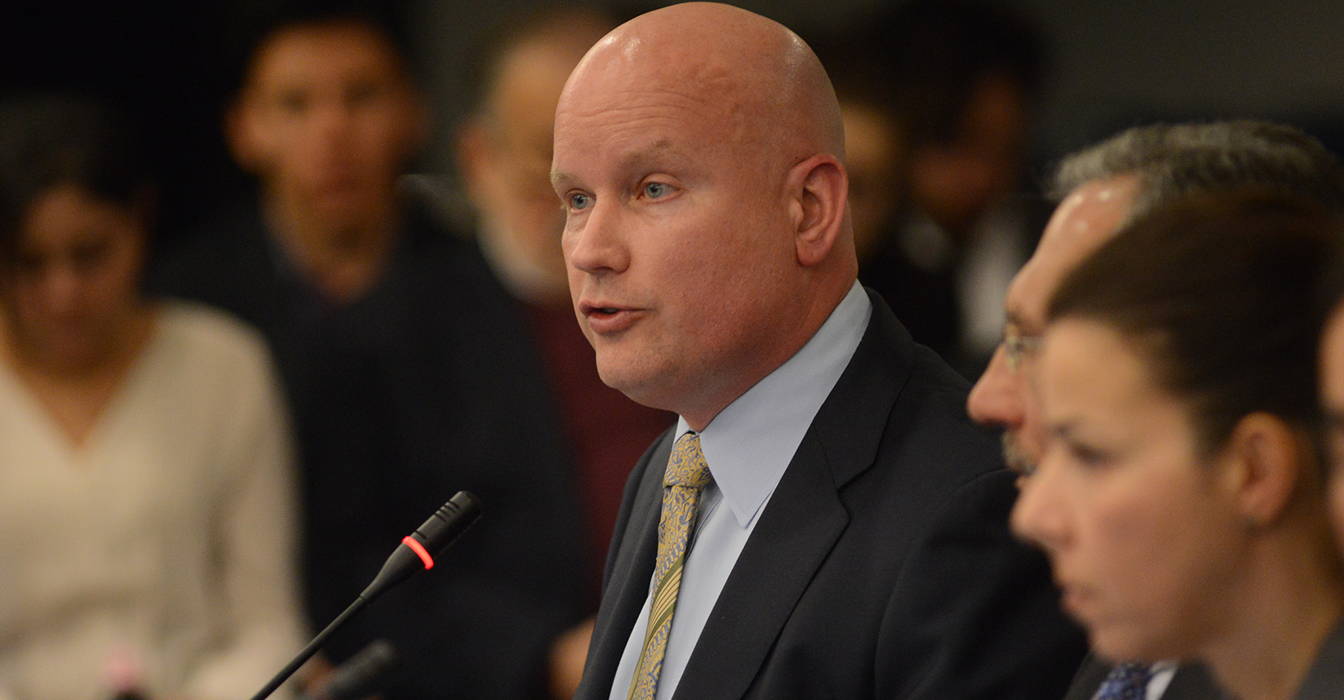
Washington, D.C. – Clay Trivett and James Connell have squared off countless times in court, doing so regularly on Guantanamo Bay over the wending road of the past 13-plus years. On Friday, the lead lawyers from the Sept. 11 case opposed each other for the first time stateside – at the U.S. Court of Military Commission Review, where three appellate judges heard arguments on which they will determine the fate of the case’s most critical evidence.
Defense lawyer Connell and other team members last year succeeded in convincing the trial judge to suppress confessions their client, Ammar al Baluchi, made to FBI agents on Guantanamo Bay in January 2007. The judge, Air Force Col. Matthew McCall, ruled that the CIA’s torture and incommunicado detention of al Baluchi rendered his later statements involuntary and, therefore, inadmissible.
On Friday, Trivett argued, however, that McCall got it wrong. “Overwhelming evidence” showed that al Baluchi voluntarily admitted to facilitating the 9/11 attacks during four cordial interview sessions with the FBI.
Al Baluchi, a nephew of the accused 9/11 mastermind, Khalid Shaikh Mohammad, is accused of moving money and providing other forms of assistance to several of the 19 hijackers. Al Baluchi freely discussed his involvement in January 2007 when showed documents and photos collected by the FBI relatively early in its investigation of the 9/11 attacks, Trivett said. He was captured in Pakistan in 2003 and soon rendered to CIA custody before being sent to Guantanamo in September 2006.
Trivett reiterated arguments that prosecutors have made on Guantanamo Bay to McCall: that al Baluchi was repeatedly assured his participation was voluntary and that he would not be returned to CIA custody. McCall incorrectly concluded that the FBI interview sessions – which took place about four months after al Baluchi’s transfer from the CIA black sites – were not sufficiently attenuated from his prior coercive treatment when assessing “the totality of the circumstances,” Trivett argued.
Connell countered that McCall could not be held in error merely because prosecutors “would have liked him to give different weight to facts they thought were important.” The trial judge, he said, determined from the voluminous suppression record – nearly 30 witnesses along with hundreds of thousands of pages of pleadings and transcripts – that the CIA’s brutal conditioning program successfully turned al Baluchi into a compliant subject.
At the hearing, Connell urged the judges to “decline to overturn all that hard work” and leave the suppression issue unresolved before a new military judge, who replaced McCall after his retirement last spring. A trial date is still not scheduled in the case, which dates to the May 2012 arraignment.
Connell noted that McCall had even visited the former site on Guantanamo Bay where al Baluchi’s FBI interviews took place to assess the similarities between that room and black sites where al Baluchi had been interrogated by the CIA. (Before it was deemed a non-coercive black site, and suitable for interviews, the Guantanamo locale had served as a CIA black site. Al Baluchi did not spend time at the Guantanamo location when it was a black site.) McCall, he argued, had a “unique vantage point” to support his 111-page ruling. The panel should avoid the expansive review of the record sought by the prosecution’s arguments, he argued.
Under the law, the government has the burden of establishing by a preponderance of the evidence that the defendants’ statements were voluntary. Connell told the CMCR judges on Friday that, if they rule for the government, the defense will be able to call additional witnesses for its suppression case that the government has so far made available. Trivett did not address this matter on Friday. Previously, however, prosecutors have said that al Baluchi’s suppression case is now complete and that he would not be entitled to additional witnesses if the government is determined to have met its burden.
The CMCR is a standing court for appeals arising from the trial-level commission cases, whose panel on Friday were Lisa Schenck, a retired Army colonel who is the presiding judge; Army Col. LaJohnne Morris; and Marine Col. Keaton Harrell. All three judges asked questions during the arguments, which lasted a little more than an hour. At the conclusion, Schenck said the pleadings and oral presentations were “excellent.” The hearing took place at the U.S. Court of Appeals for the Federal Circuit in downtown Washington, D.C.
Lawyers for Mohammad, as well as for co-defendants Walid bin Attash and Mustafa al Hawsawi, did not participate in Friday’s hearing, though several were in attendance. Those defendants exited the suppression hearing in summer 2024 after signing plea agreements with the case’s convening authority, Susan Escallier. The parties have been embroiled in additional layers of litigation with the government after Sec. of Defense Lloyd Austin withdrew from the deals two days after they were signed.
Both McCall and the CMCR held that Austin’s actions were unlawful and that the plea deals had to be enforced. However, the U.S. Court of Appeals for the D.C. Circuit, which hears appeals from the commissions, sided with the government last July and allowed it to back out of the plea agreements. The three teams are preparing petitions to request a review of that decision by the U.S. Supreme Court.
In December, Air Force Lt. Col. Michael Schrama became the fifth military judge to preside over hearings in the Sept. 11 case. He plans to resume the suppression hearing for Mohammad, bin Attash and al Hawsawi this year. The next session, scheduled for one week beginning March 23, may include witness testimony. Schrama has ruled that al Baluchi’s pretrial proceedings will remain on hold until the CMCR rules on the government’s suppression appeal, which could take several months. (A fifth defendant, Ramzi bin al Shibh, remains severed from the case after McCall found him to be mentally incompetent to assist in his defense in September 2023.)
In its appeal, the prosecution is also asking the CMCR to reverse McCall’s conclusion that al Baluchi’s statements to the FBI were “obtained by” torture, or cruel, inhuman or degrading treatment, which are barred by the military commissions statute. Trivett said that the conclusion was clearly wrong because the FBI agents used traditional rapport-building techniques during their sessions with al Baluchi, which also included prayer breaks, shared lunches and friendly banter. Connell countered, however, that the relevant caselaw gives “obtained by” a plain meaning and that McCall appropriately concluded that al Baluchi would not have given his FBI statements if not for the earlier CIA conditioning.
In February 2025, a CMCR panel upheld the suppression ruling in the separate military commission of Abd al Rahim al Nashiri, charged with helping to plan the USS Cole bombing, based on his past torture by the CIA. At various points on Friday, the judges asked about differences between the abuse endured by al Nashiri and al Baluchi, given that al Nashiri was subjected to longer periods of “enhanced interrogation techniques” that were intermittently more aggressive and threatening.
“The suffering is not something we can compare,” Connell replied. Al Baluchi’s inability to tolerate physical torture for longer suggests that he was more susceptible to the CIA’s efforts to make detainees compliant through violence, he said.
About the author: John Ryan (john@lawdragon.com) is a co-founder and the Editor-in-Chief of Lawdragon Inc., where he oversees all web and magazine content and provides regular coverage of the military commissions at Guantanamo Bay. When he’s not at GTMO, John is based in Brooklyn. He has covered complex legal issues for 20 years and has won multiple awards for his journalism, including a New York Press Club Award in Journalism for his coverage of the Sept. 11 case. His book on the 9/11 case was published on Aug. 12.

