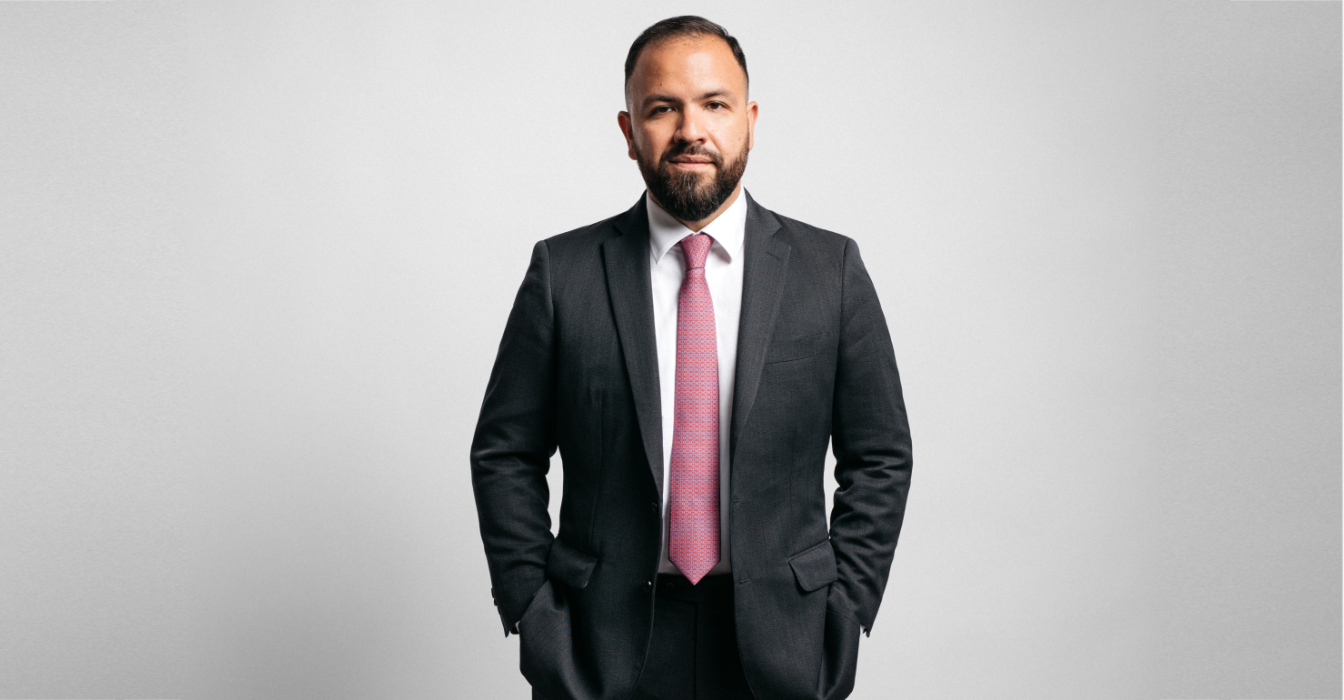
“I don’t know if you’re familiar with Al Pacino in ‘The Devil’s Advocate,’” Jorge Altamirano says, as we sit down to discuss his new firm, Altamirano PLLC.
“There’s a really good quote about pressure: ‘Pressure. It changes everything. Some people, you squeeze them, they focus. Others fold.’”
In little more than a decade, Altamirano has guided investors through the largest debt restructuring in U.S. history, achieved groundbreaking arbitration awards, and, in October, opened the doors to his own firm.
He’s not the folding type.
Directly contrary to Pacino’s devilish persona, Altamirano fights on behalf of the injured and the swindled – those who have lost their life’s work and savings to seemingly indomitable financial bad actors. From day one of his career, Altamirano has been devoted exclusively to investor-side securities law, taking on more than 1,500 claims and helping clients recover multi-millions of dollars in losses through FINRA arbitration. His expertise spans cases in investment fraud, broker misconduct, unsuitable products, and more in New York City and across the nation.
Altamirano is known for his work at the start of his career representing investors who were harmed in the Puerto Rico municipal bond crisis, as well as for securing the only award in the meme stock frenzy of 2021. When online trading platform Robinhood suddenly restricted trading on viral stocks like Gamestop, Altamirano represented an investor who suffered losses. Motivated by an entrepreneurial spirit and a passion for helping clients who need it most, Altamirano secured a nearly $30,000 FINRA arbitration award – still the only award arising out of an investor moment that drew the eyes of the nation.
Altamirano takes an empathetic, unorthodox approach to case selection – he is equally happy to represent a sophisticated investor, a self-directed trader or a retiree who’s lost lifelong savings. His firm is emphatically inclusive and wholly focused on the client benefit.
“The firm’s mission is simple: My goal has always been to do the best possible job for the clients, putting together the strongest case I can on their behalf and getting back the money they lost,” Altamirano explains. “My test for success is straightforward: Is the client better off now than when I found them? I have been fortunate enough that one hundred percent of the time the answer has been yes.”
Lately, Altamirano has been representing clients who lost money in the collapse of GWG Holdings’ L Bonds; following the company’s bankruptcy, he has continued seeking recoveries for investors through individual arbitration claims. He is also investigating cases involving alternative investment sponsor Inspired Healthcare Capital, which is under SEC review, as well as concerns about misleading marketing in Easterly ROCMuni’s municipal bond funds.
With his firm in its earliest days, Altamirano is busy – and he wouldn’t have it any other way.
“[Pressure] is one of the things that drives me. I'm extremely driven and I do really well under pressure,” Altamirano explains. “I've always been a fighter in life. Nobody has ever given me anything. So, I bring that pugilistic approach to my own style of representation.”
Lawdragon: Right out of law school, you didn't choose to go the Big Law route. What do you feel draws you to the boutique environment, including in your new firm?
Jorge Altamirano: I think that you have to be entrepreneurial to be on the claimant or plaintiff side of things. So, I think boutique work fits my personality much better. You have to be a go-getter; you have to make things happen for yourself and for your client. That fits the fabric of who I am.
I remember him telling me, 'You’re a young guy with all your senses. Imagine that you’re me, who is in his mid-sixties and blind. How am I going to be able to make this money back?'
LD: That’s exciting. Where do you see your firm heading?
JA: I'm very excited about the future. I believe this will become the premier securities arbitration law firm, certainly in New York City – and I’m aiming to make it one of the premier firms in the country. Because I've been forged under pressure, I feel like I have both the gravitas and the experience to do that.
LD: Wow. What are your plans for your next steps?
JA: Beyond just growing by adding more talented lawyers to the team, I want to make sure that we continue to cast a wide net for the types of clients we represent. It's not just your typical 80-year-old retiree who deserves representation. There are many complex products out there, and alternative investments are blowing up every day. The market is up and down. I want all those investors, whether they're investing through a broker who turns out to be a bad actor or a self-directed trader who relies on a platform to not preclude or restrict their trading, to know that they can count on a firm like mine.
LD: You’ve talked about setting a new standard in the investor protection space. What does that look like?
JA: Frankly, it looks like not phoning it in; not leaving any sort of stone unturned. One thing that I take great pride in is not only my work ethic, but thriving in a plane of extreme productivity. Clients deserve somebody who's going to be at the office on Sundays to make sure that the discovery is getting reviewed and that every angle is covered to add value to the case and get the best possible outcome for the client.
LD: Your career began right when the Puerto Rico municipal bond crisis was happening. How were you involved there?
JA: The Puerto Rico municipal bond crisis was huge, and it was a very unfortunate and sad situation because thousands of people lost essentially their life savings. I was involved in a large number of cases. I went to Puerto Rico 25 or 26 times. I lost track by the 20th time. But I was always down there negotiating settlements, mediating cases. I got to meet and represent some incredible people. I have represented folks worth $200M, and I have also represented folks like a blind piano tuner who lost his entire life savings.
LD: Wow.
JA: I remember him telling me, “You’re a young guy with all your senses. Imagine that you’re me, who is in his mid-sixties and blind. How am I going to be able to make this money back?” I’m quoting him 12 years after the fact because it definitely left a mark.
Hearing that kind of pain fuels you as an attorney. It reminds you that people are trusting you with something that’s deeply important, and it makes you push as hard as you can to get the best possible result for them.
LD: How did it shape you as a lawyer to work on those cases, with such volume and significance, so early in your career?
JA: By year five as a lawyer, I felt like I had 15 years of experience. I think that a lot of early-career lawyers are used to doing back office work – you write a memo, you research and then you don't even get to talk to the partner. Whereas from very early on, I got to be in the deep end of the pool and work a case from point A to point Z. With repetition, you get good fast. You're able to spot the issues with certain cases and find where the real pressure points in a case are.
LD: Looking at more recent hot-button issues, let’s talk about the meme stocks case.
JA: Unfortunately, there is a feeling in our industry that if you are a self-directed trader, you're out there on your own. If something happens, trading is restricted, or if your platform glitches or freezes, you're SOL. I got involved to right that wrong and make sure people felt heard because it was huge news and thousands of people were affected. It was incredibly exciting to be at the forefront of filing those cases and securing a win, because part of the goal was to try and change the narrative that you're on your own and that the rules don’t protect you if you trade by yourself.
LD: That's a really good point. How would you describe your strategy – how were you able to achieve that elusive win?
JA: You have to make sure you get the right discovery, and then frame your arguments in a way that’s going to be effective. A lot of arbitrators are retired judges or lawyers, but some don't have a legal background. Anyone can be an arbitrator. So, you have to articulate your case theory in a way that a layperson will understand, if you have one on your panel. I think there's a real strength in putting things in simple terms so that people understand what you're arguing and what you're putting in front of them, without being distracted by the legalese.
I got involved to right that wrong and make sure people felt heard.
LD: To that end, how would you describe your style as a lawyer, whether that's in arbitration or while working with your clients?
JA: With clients, they’ve already been through enough. Oftentimes they come to you and they don't feel good about themselves. Many feel betrayed by their financial advisor because they had a good relationship with him or her. Sometimes they tell me, “I feel stupid. How could I believe this?” You have to work through those feelings. But at the same time, my approach is to be direct, focused and no-nonsense. I try to give them an honest read of the case. Then I take that same energy to the other side, and if we end up in a hearing, I’m going to outwork and out-prepare them.
LD: When clients come to you feeling betrayed, how do you build trust with them in a moment when they’re less inclined to give that trust?
JA: I think the best way to restore their trust is by showing clients that you’re genuinely on their side. That you're not one of those advisors who was trying to churn their account to make a quick buck, but that this is a place where we’re going to be honest with each other and work as partners. The FINRA arbitration process will take time, but I make sure they know I'll keep them informed and put in the work so that at the end of this, they feel like it was worthwhile – and that they can trust someone in my position again.
LD: Finally, what do you find most fulfilling about your work?
JA: Representing everyday retail investors. I get a lot of joy out of that. One of the best things you can do as a lawyer is to use the skills you’ve acquired and polished over your career for the benefit of others. A lot of the people who come to me need help. Being able to put both my work experience and my life experience at their disposal – that's what I find fulfilling.
LD: What in your life experience do you feel helps those investors?
JA: Having had to work hard for everything. I wake up every morning knowing nobody's going to give me a yard. I have to make the play so that when I go to bed, I can feel like, all right, we moved the ball another five yards. And sometimes you do really well and the play gets you closer to the field goal, but the goal is to be in constant forward motion.

