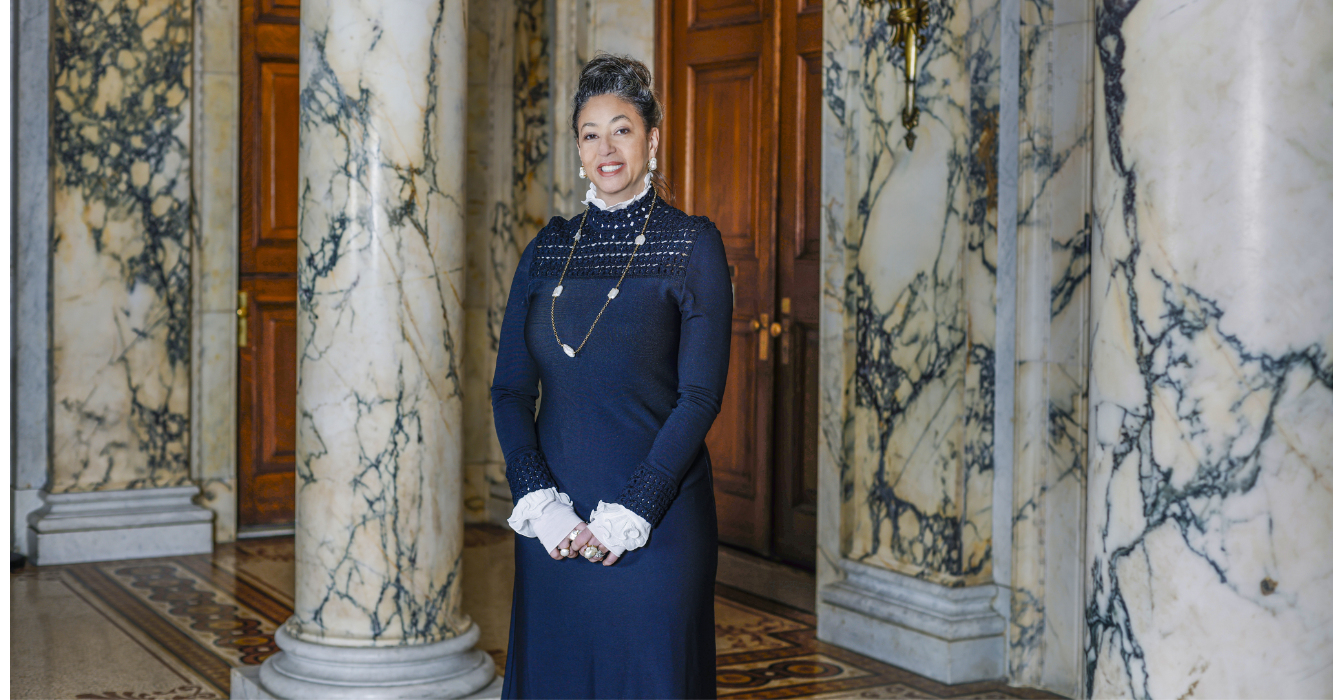
Ellen Holloman did not become a litigator by accident.
The Kaplan Martin partner grew up in a household where service wasn’t aspirational – it was expected. Her mother was an operating room nurse who also was one of the most formidable contract negotiators for the New York State Nurses Association, and her father was a physician and decorated veteran who became the first Black CEO of New York’s Health & Hospitals Corporation. They rose before dawn, worked long after dark and taught their children by example that expertise carries responsibility.
“You use your skills to help others,” Holloman says. “That’s how I was raised, and that sense of obligation is deeply ingrained in me.”
Holloman built her career in high-stakes corporate litigation – first at Sullivan & Cromwell, then as a partner at Cadwalader – representing financial institutions, multinational corporations, boards and C-suite leaders in securities and regulatory matters. Yet running parallel to her corporate practice is a second lane she considers inseparable from the first: a decades-long commitment to pro bono work.
Her docket tells the story: A death-row appeal that earned her the New York City Bar Association’s Thurgood Marshall Award. A Vietnam veteran whose 30-year felony conviction she helped erase so he could work again. Asylum cases for separated children and Afghani veterans. Name and gender marker changes for trans youth seeking legal recognition and safety.
To Holloman, these aren’t separate pursuits. “Women’s rights, LGBTQ rights, issues of racial equity and immigration justice – these are human rights,” she says. “A pro bono client is one person with one problem that feels enormous, and many have been failed by the system before. As an officer of the court, I have a responsibility to repair that trust where I can.”
In 2025, Holloman made a defining move that she felt would serve her corporate and pro bono clients alike. She left Big Law to join Kaplan Martin, the elite litigation boutique co-founded by Roberta Kaplan and Timothy Martin, whose landmark victories from Windsor to Carroll have reshaped civil-rights precedent.
“This is the practice I always wanted,” says Holloman. “Corporate excellence and impact work in one place, with equal time, energy and dedication to both.”
Today, Holloman stands at the center of that convergence – a powerhouse commercial litigator for Fortune 50 companies and major financial services clients, a champion for those the system has neglected, and a mentor shaping the lawyers who will follow her. At Kaplan Martin, she has found alignment – a firm that matches her compass.
“As a woman in this profession – especially as a Black woman – visibility matters,” Holloman says. “When young lawyers see me in this role, I want them to know they can get there too.”
Lawdragon: Can you give us an overview of what your practice looks like these days?
Ellen Holloman: My practice today looks very much like the work I was doing at Cadwalader – complex commercial and financial litigation for major corporate clients with a particular focus on post-acquisition disputes, internal investigations and high-stakes commercial matters. I also continue to represent businesses and individuals in the C-suite or who are public figures in highly confidential employment situations. The transition to Kaplan Martin was seamless. My clients came with me; I’ve opened several new matters since arriving and our practices fit together incredibly well.
When Robbie sued the American Nazis after the violent Charlottesville rally, I remember thinking – that is the kind of lawyering I want to do.
I’m working with Robbie [Kaplan] and Tim [Martin] on a series of nationwide class action lawsuits for a multinational alcohol beverages manufacturer. We continue to advise the same client on several other disputes. We’re also handling work for an Italian company with a U.S. subsidiary, advising on a recent restatement, post-acquisition issues and potential litigation strategies. We are handling five litigations in New York and Delaware for a sovereign wealth fund that we are especially excited about – the governance issues raised in the situation are incredibly interesting. Another major matter on my desk is a family dispute for which we are preparing for long term litigation in multiple jurisdictions. It’s very busy and it’s been very fun.
What I love about Kaplan Martin is that the work is sophisticated, global and fast-moving – that part is no different than the large, distinguished firms I have worked at previously. Everyone here has a corporate defense background and was trained in elite law schools and institutions, so we speak the same language and, as a firm, we always hit the ground running.
LD: What are the trends you're seeing in securities litigation or corporate governance these days?
EH: 2025 started out with the Trump administration issuing a number of executive orders and particularly targeting areas like ESG and diversity, equity and inclusion. Naturally, companies have been trying to understand what compliance looks like ever since. There has been a lot of dismay and distress about the future of racial and gender progress and equity given not only the Administration’s attacks, but also the failure of media companies, corporate institutions and law firms to stand up for their rights.
But there’s a positive side to this moment, too. The pressure has prompted many organizations to take a thoughtful look at their approach: What’s working? What isn’t? What should evolve? Instead of throwing up their hands, our clients have been using this as an opportunity to refine, fortify and future-proof their diversity efforts while avoiding partisan scrutiny during this political moment. So while there’s valid concern that certain orders will roll back progress, there’s also been innovation and reflection happening.
Our society aspires to be a meritocracy someday, but it never will be until artificial barriers to opportunity have been removed. Diversity efforts are the most recent manifestation of the work of great Americans to break down barriers based on prejudice and bigotry, and fulfill the promise of our Constitution and other founding documents. That struggle has a long history in this country, and it’s that spirit which makes America great. There have always been people who are hostile to diversity, equity and inclusion, writ large, but those things aren’t going anywhere. They will continue to evolve. And because politics now moves at internet speed, shifts that once took decades are happening in a matter of months, weeks or days. It’s a challenging moment, but also an incredible opportunity for meaningful advocacy – and an exciting time to practice law in this space.
LD: Tell us about how you came to Kaplan Martin.
EH: I joined not long after the firm launched – I always say I’m the fifth Beatle. Robbie, Tim and I had been talking about working together for years before it finally happened.
I’ve admired Robbie for a very, very long time. She was a new partner at Paul, Weiss when I first started working as an associate at Sullivan & Cromwell in the late 1990s. There were and still are not a lot of women partners at the elite law firms back then and young associates like me, even at other firms, were aware of her reputation and how fearless she was. She was punching above her weight and making a name for herself even then. I followed the Windsor case and then Obergefell – which, for my family, was personal. I grew up in the ’80s during the AIDS crisis. Homophobia was open and everywhere. My father, who was the CEO of New York’s Health & Hospitals Corporation, was deeply involved in public health efforts and we talked about it constantly at home. Discrimination in any form was unspeakably ugly to him, and his stance on equity was clear. That shaped me. I realized very early that what people were calling “gay rights” were simply human rights.
When Obergefell was decided, it was my mother’s birthday – she bought champagne for the entire restaurant. That moment is seared in my memory. We were all just so grateful and deeply impressed, not only with the legal work but with the values behind it. And it’s more than just values, we’ve seen that anyone can talk about their values, but not everyone has the integrity to act on their values or the courage to be defiant when their values are challenged. When Robbie sued the American Nazis after the violent Charlottesville rally, I remember thinking – that is the kind of lawyering I want to do.
Anyone can talk about their values, but not everyone has the integrity to act on their values or the courage to be defiant when their values are challenged.
When Robbie, Tim and I ended up together on a major litigation for a mutual client, something clicked. We were utterly confident that our client was in the right and would prevail. But still, the accusations, however unfounded they were, were terrible and the client took the matter very seriously. Every day was a bottom-of-the-ninth, two out and three on situation. And yet we were having the best time. We’d start talking at 7 a.m., finish at 9 p.m., trade drafts, strategize, text constantly – and it all felt natural and joyful. Our teams meshed even though we were at different firms. There was a lot of celebration and a lot of laughter. When that case ended, the client was thrilled and I realized I missed working with Robbie and Tim – which tells you everything, because who misses 18-hours a day, 7 days a week workload, unless the company is that good?
When I was asked to get involved in the Wendy Williams case right after our other matter was dismissed, I had to move quickly. The only person I wanted to call was Robbie.
LD: What can you tell us about the Wendy Williams case?
EH: Wendy is a New York icon – a true pioneer. In the late ’80s and early ’90s she helped bring hip hop to a wider audience as a radio DJ. She was glamorous, outspoken, quick on her feet – she could talk to anyone about anything. Later she had a long, incredibly successful run on television.
After a series of health-related events, she was placed under a court-appointed guardianship. Unfortunately, not everyone had Wendy’s best interest in mind during this time. I was asked to step in to pursue legal action against media networks for filming an exploitative so-called “documentary” of Wendy when she was in no condition to consent. Robbie joined me as co-counsel in September and we continue to work on that matter together.
LD: Tell us about your philosophy when it comes to pro bono work.
EH: In my career, I've committed thousands of hours to pro bono work. Being a lawyer isn't just a job, it’s a profession. It's a calling. I think it's the best job in the world. I get paid to read and write and advocate for a living – what a privilege! And those same skills can change someone’s life – a brief, a letter, the way you frame an argument can be the difference for someone who has no one else to speak for them.
I started at Sullivan & Cromwell and from week one of my career, it was made clear that giving back was valued and an important part of being in the serious legal community in New York. And that aligned perfectly with how I was raised. As I mentioned previously, both of my parents worked in public health and served communities that needed care most. They left before dawn and came home after dark and they never complained. That was my model of what work looks like – you use your skills to help others. That sense of obligation is deeply ingrained in me from my parents’ good example.
A pro bono client is one person with one problem that feels enormous to them – and many have been failed by the system before. They come with fear, trauma or distrust. As an officer of the court, I have a responsibility to repair that trust where I can. I give a pro bono matter the same intensity and care as a corporate one.
At Kaplan Martin, all the lawyers have the exact same philosophy. Pro bono isn’t something that gets pushed aside, and it certainly isn’t forced on you, either – everyone is encouraged to do the work that moves and excites them, it is supported and properly resourced. We don’t treat pro bono as “extra.” A pro bono client is just that – a client. We take the time to do it right. That’s exactly how I want to practice law.
LD: Is there a particular pro bono case that has really stood out to you over the years?
EH: One that’s always in my top five is a case involving a Vietnam veteran. He had served his country, struggled with severe PTSD and spent years unhoused. During a freezing New England winter, he sheltered in an abandoned building and was later convicted in absentia of fourth-degree felony trespass. Nearly 30 years passed with that conviction on his record.
By the time I represented him, he had recovered from addiction and received mental health counseling, secured housing, reconnected with his family – he was ready for the next chapter of his life. But that decades-old conviction was still preventing him from getting well-paid work with benefits. We secured a pardon for him and it changed everything. He could finally get a good job, support his family, and move forward without the weight of the conviction.
A brief, a letter, the way you frame an argument can be the difference for someone who has no one else to speak for them.
It was a privilege to advocate for someone who had served this country, and it reminded me how meaningful pro bono work can be. Sometimes one legal victory restores dignity, opportunity and a future.
LD: Are you an active mentor?
EH: Yes. In fact, this morning I was walking into my office building when a woman stopped me and asked, “Are you Ellen Holloman?” It was a former mentee from the SEO internship program whom I met almost a decade ago. She went on to have two prestigious clerkships and is now working in a firm in the same building as ours. The moment meant a lot to me: of course I remembered her, but I was so touched and humbled that she remembered me too, and was so happy to see me. We immediately made plans for lunch. Those small reconnections are such a joy – that’s why mentoring is so satisfying.
And it’s even more important for groups that are under-represented in the profession. Many Black lawyers – and especially Black women lawyers – do not have legions of predecessor attorneys after whom they can model their careers. I recently heard a statistic that something like one to three percent of equity law partners in the U.S. are Black women – an incredibly small number. Becoming a partner at Cadwalader came with incredibly hard work and a great deal of help and support from my mentors, and I take the responsibility seriously. When young lawyers – particularly women and lawyers of color – see me in this role, I want them to know they can get here, too. And if I can use my experience to help steer them through their paths, then I feel like I have paid forward the guidance I received.
Mentoring isn’t one-directional either. I learn constantly from younger lawyers. They bring fresh perspectives, new language, new ways of thinking about and understanding identity and culture. In a recent internal investigation involving a non-binary employee, one of my younger colleagues helped me rethink how we were framing the issues. It was invaluable – and a reminder to stay curious and teachable. The day you stop learning is the day you start getting old.
LD: Among your many career accomplishments, you were admitted to the U.S. Supreme Court through the Federal Bar Council – what did that moment mean to you?
EH: The experience was nothing short of magical. I’ve been fortunate enough to have filed Supreme Court amicus briefs before, but standing in that courtroom and hearing my name called was overwhelming in the best way – especially thinking about where my ancestors began in this country and how far that journey has carried us. It was a moment of profound pride and gratitude.
Justice Ginsburg was still with us then. She met with us afterward – a New Yorker speaking to New York lawyers – and despite everything on her plate, she took the time to look each of us in the eye, ask who we were, and encourage us. That kind of presence is its own mentorship. I’ll never forget it.
LD: When you look back on your career, what feels most rewarding about where you’ve landed?
EH: I’m exactly where I want to be. Practicing here with Robbie and Tim and with my other partners, feels like I landed at the firm I hoped for when I started. I began at Sullivan & Cromwell surrounded by brilliant lawyers who taught me to work hard, think carefully and pursue excellence. Many of those colleagues are now in-house – and some of them hire me today, which is a gratifying full-circle moment.
The day you stop learning is the day you start getting old.
I’ve always believed people remember you best by how you make them feel. Litigation is stressful enough. When you treat people with respect even in difficult situations and moments, they’ll want to work with you again.
Kaplan Martin brings every thread of my career together: complex corporate matters, a deep pro bono ethos and cases with social meaning. Here, impact work isn’t squeezed in – it’s built into the mission. Whether we’re litigating Charlottesville, filing civil-rights amicus briefs, handling sensitive matters for public figures, or representing global companies and financial services institutions, or their boards, officers or executives, we’re trusted with cases where the stakes are human as well as legal. Many of our most successful representations are situations you’ll never hear about – which is the point. After 25 years, this feels like alignment.

