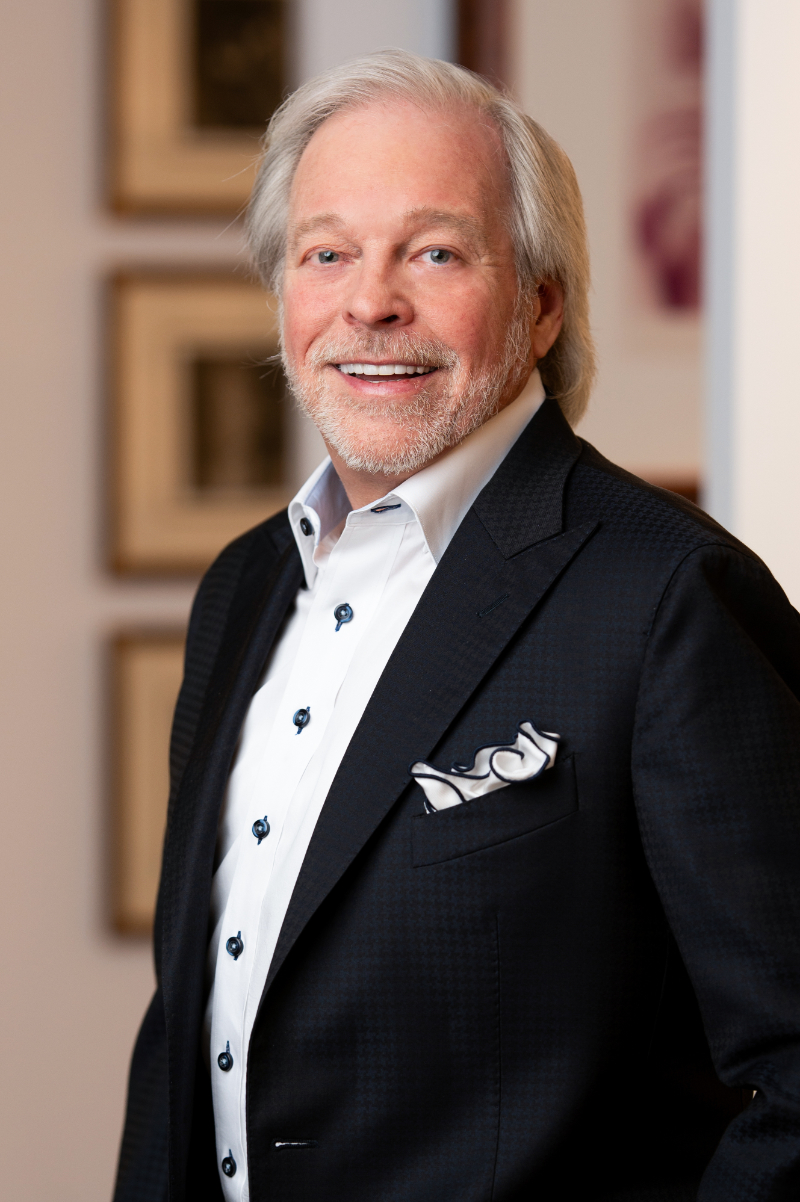
Trial lawyer Rogge Dunn is known for his wide-ranging expertise and passions. A lifelong learner, Dunn is a dedicated student of psychology, geopolitics, history – and, of course, the law. He researches and writes about the psychology of persuasion for D CEO Magazine. He has traveled to Kyiv, Ukraine, to advocate for the Ukrainian cause, raising significant funds for charities Mental Help Global and The Borderlands Foundation. And, as a dedicated history buff, his office displays his eclectic personal collection of rare art and historical artifacts that are part of the permanent collections at the Museum of Modern Art in New York, the Smithsonian Institution and the Victoria and Albert Museum in London.
While they may not seem directly connected, these numerous passions make Dunn a truly singular lawyer.
Founder of Dallas-based trial boutique Rogge Dunn Group, Dunn’s multifaceted practice encompasses seemingly every polar opposite within civil law. He represents both plaintiffs and defendants at a nearly even split; his clients are both individuals and companies. As a sixth-generation Texan, he represents clients located in his home state, but also throughout the U.S. and as far as Scotland and Qatar. He is one of fewer than 30 attorneys in Texas Board-Certified in both civil trial law and labor and employment law. And just a few of the areas of law he’s successfully practiced over the years include employment, sports and entertainment, whistleblower and qui tam, sexual harassment and abuse, FINRA, business disputes and trade secrets. Altogether, he has secured more than $2B (net) for his clients in his 35-plus year career.
What unifies his practice and his out-of-office pursuits: a mission to find new ways to help people. As a student of history, Dunn believes that we are doomed to repeat it if we don’t make a change. In all of his work, no matter the practice area or side of the V, he strives to do just that.
Dunn has consistently taken on challenging, high-profile work to stand up for underdogs. Last December, Dunn made history when he secured the first successful trial win under a new Texas law making individual business owners and employees personally liable for sexual harassment, rather than requiring plaintiffs to sue the company exclusively. In a six-day trial, Dunn argued that his client suffered traumatizing sexual harassment, assault and retaliation at the hands of her employer's CEO, a well-known Dallas-area real estate mogul. Dunn won $5.75M, reported as the third-largest sexual harassment judgement for a single plaintiff in Texas history.
In a similar matter, Dunn and partner Collin Quigley are currently litigating a gender discrimination and Equal Pay Act case against advertising heavyweight Omnicom Group, alleging that a former high-level female executive was consistently paid less than her male counterparts over her two-decade career.
If it’s a David versus Goliath matter, Dunn is always prepared to fight: Looking back to 2009, when defendant Goldman Sachs offered his financial advisor clients $60,000 in a wrongful discharge and deferred compensation suit, Dunn pushed ahead – and was eventually awarded $7.9M at arbitration.
Then, there are his celebrity clients; just a few of the other individuals he’s represented: former Dallas Mavericks President and GM Donnie Nelson, Houston rapper Bun B, Kidd Kraddick Morning Show co-host “Big Al” Mack, Basketball Hall of Famer Larry Brown and former MLB Manager Buck Showalter.
In recognition of his wide-ranging work, Dunn is a member of four simultaneous Lawdragon guides: The Lawdragon 500 Plaintiff Financial Lawyers, The Lawdragon 500 Leading Corporate Employment Lawyers, The Lawdragon 500 Leading Civil Rights & Plaintiff Employment Lawyers and The Lawdragon 500 Leading Plaintiff Consumer Lawyers.
Lawdragon: Does your career now look how you imagined it might when you first started out in the law?
Rogge Dunn: I always enjoyed trial work – the hand-to-hand combat. I would say the only thing that changed is when I started out, I wanted to be a lawyer's lawyer, so I didn't spend any time on business development, which actually was good for me because 110 percent of my time was on learning the craft of being a lawyer. Later, I started putting the effort and thought into developing business to give me greater opportunities for going out on my own. That’s how I developed my own set of Fortune 500 clients as well as some of the top C-level executives in both the corporate world and in the sports and entertainment arena, which is one of the areas I’m most excited about – helping young athletes, coaches and sports executives.
LD: What do you enjoy most about representing those folks?
RD: Well, first of all, they're interesting people. Second, the sports industry is dynamic and growing. I've handled a number of these cases including winning a summary judgment for Texas Tech against Coach Mike Leach in his $20M+ lawsuit and representing the Title IX Coordinator who blew the whistle on the gang rapes at Baylor University. I've handled NIL matters on the college front. It's exciting because, in sports law, every day you face new and unique legal issues. I love addressing cutting-edge legal issues. I also represent entertainment personalities. They have a lot of interesting stories, experiences, and legal issues, as well. They're fun people.
LD: You’ve spoken extensively about the psychology of working with the jury, but what about with your clients? How do you use your psychological research when you're working with them, as well?
RD: You always have to remember that if you want to help your clients, you need to be able to effectively communicate with them. I don't believe in using psychology to persuade the clients toward a particular course of action. I believe in educating them so they can make an independent, informed choice. “Here are two or three paths that you can take regarding your legal problem. Here are the pros and cons and cost of each one of those paths.”
LD: They're also going through some of the highest-stress moments of their lives. How does your understanding of psychology help you manage that with them?
RD: It helps to be understanding of and empathetic to those clients. Lawyers are notorious talkers and bad listeners, so you've got to listen to those clients to understand their problems, and, to a certain extent, let them vent. Now, I do tell my clients when they start venting, “Look, I’m happy to listen all day, but I’m charging you $1,750 an hour, and I’m not the most touchy-feely guy. Your money would be better spent talking to a counselor who’s going to be $400 or $500 an hour.”
LD: Right.
RD: I always think of the long run. If you give clients a path for a good, prompt resolution, with a minimum of attorney's fees, guess what? You get multiple repeat clients and multiple referrals. If you take a path of, “How much can I charge?” that’s not ethical and you end up with a one-time client. I think one of the reasons for my success is I practice law the right way. I listen to the clients, understand their goals, and then I try to achieve their goals quickly, confidentially and cost-effectively.
I believe in educating [clients] so they can make an independent, informed choice.
LD: Does that involve picking your battles to a certain extent, especially in a longer case?
RD: Sure. Well, picking the battles that produce results. I always tell clients, “I can be extremely aggressive and play hardball. But when you throw that fastball at a hundred miles an hour, if they hit it back, it’s going to be coming back at you 200 miles an hour. Get ready and understand that there’s a lot of cost to playing hardball.”
LD: Stepping away from the courtroom, tell us about your work in Ukraine and with Ukrainian war veterans. What drove that specific interest?
RD: I traveled to Ukraine with General Petraeus on a charity mission. I've always fought for, believed in, and rooted for the underdog. I think about what Putin and Russia have done, and as a student of history, if we don't stand up and stop it, the next thing you know, he may attack other European countries. Plus, I saw firsthand what the Ukrainians are going through.
LD: What stories stick with you the most from your visit there to Kyiv last May?
RD: My guide took me out into some of the war-torn areas. She sends a care package every month to the troops. She said, “Rogge, what do you think they want the most?” I said, “Cigarettes.” She said no. I said, “Well, let's see. Socks.” She said, “No. Toilet paper.” And I thought to myself, we all go home at night, hug our families, and get into a warm bed. And here are these troops on the front lines, away from their families, in the freezing cold, many of them knowing that guy or gal next to them is going to die. And they don't even have enough toilet paper.
LD: Obviously it is very different from your legal practice, but do some of the themes of why you care about that work come up in your legal work, as well?
RD: Yes. It’s the courage of people to fight against long odds, not give up, and to stand up to a bully like Putin. Just to give you a perspective, when I was there, every day, the sirens went off, and every day there were drone attacks. They would start the attacks at three in the morning and go till nine in the morning. Let's say you're in an apartment building with young kids. Well, you’ve got to go down to the basement with a 2-year-old, a 6-year-old, 10-year-old, after waking 'em up at three in the morning. They're among dozens of crabby, crying and screaming kids. Nobody can sleep. And then you have to try to get the kids off to school. You have to go to work sleep deprived. So it's very psychologically effective warfare. It breaks your spirit. It also reduces the productivity of the workforce. They go to work and they're tired, operating at 60, 70 percent of their mental acuity and making mistakes.
LD: Wow. And speaking of people standing up for themselves, that’s been true for many of your cases. Looking at your recent sexual harassment case that concluded in December, tell me about how that kind of work has been a part of your practice and how you became involved in the case.
RD: It's always been part of a significant part of my practice, both for plaintiffs and defense-side for companies. This case was a labor of love; I took it on pure contingency. I spent more than $180,000 of my own money in litigation expenses. And they fought it hard. We had, I think 10 or 12 depos, and now he's fighting the judgment, so unfortunately, neither my client nor I has seen any money yet. But I would gladly spend another $180,000 and do it all over again, because the good news is I vindicated my client. We have a groundbreaking ruling in place. I don't know that he'll ever change, but hopefully other executives like him will see this and change.
I think one of the reasons for my success is I practice law the right way. I listen to the clients, understand their goals, and then I try to achieve their goals quickly, confidentially and cost-effectively.
LD: On that note of change, tell us about how this case fell under the new 2021 law that held the defendant personally liable instead of just the company, and how that law is going to help other survivors as well.
RD: We started by suing both him and his company. First of all, the normal sexual harassment law only applies to employers with 15 or more employees. If a company has 10 employees, you can't sue the company for sexual harassment, but now you can sue the individual. Then, his company declared bankruptcy, so the only avenue we had was to continue the lawsuit against the executive. So, one of the reasons this law is so important is it gives you an avenue to pursue a sexual harassment claim against an individual in addition to or instead of a company. Individuals are less likely to want to declare personal bankruptcy to try and wipe out a judgement. And, more importantly, if an individual's reputation is on the line, they or the company may be more likely to come forward and resolve it early. That's a really powerful law.
LD: This case was the first verdict under this law. Did the newness cause any challenges?
RD: It required some thought as to the interplay between defendants when we were in the stage of suing both the company and the individual. At the time of trial, the company had been dismissed because it had declared bankruptcy. But until then, yes, the challenge was determining strategy for where we wanted to put our emphasis.
LD: This result has been reported as the third-largest single-plaintiff sexual harassment judgement in Texas history. What did that mean to you?
RD: It was extremely gratifying to me. This has always been a subject near and dear to my heart.
LD: Where else are you focusing your attention now?
RD: I'm handling whistleblower, Sarbanes-Oxley and qui tam cases. I’m also working on mass tort cases representing consumers who contracted cancer after using Roundup and talc. I'm particularly proud of that work because I'm helping consumers and employees regarding the health, safety and public welfare issues – whether it's pollution, selling a cancer-causing product, misrepresenting the nutritional components of food or anything else. I recently represented a Wall Street whistleblower, a financial advisor who blew the whistle on deceptive and misleading tactics by a huge financial Wall Street firm. That was really important, and that's one of the biggest cases I had last year. I certainly felt good protecting the public and investors in that case.

