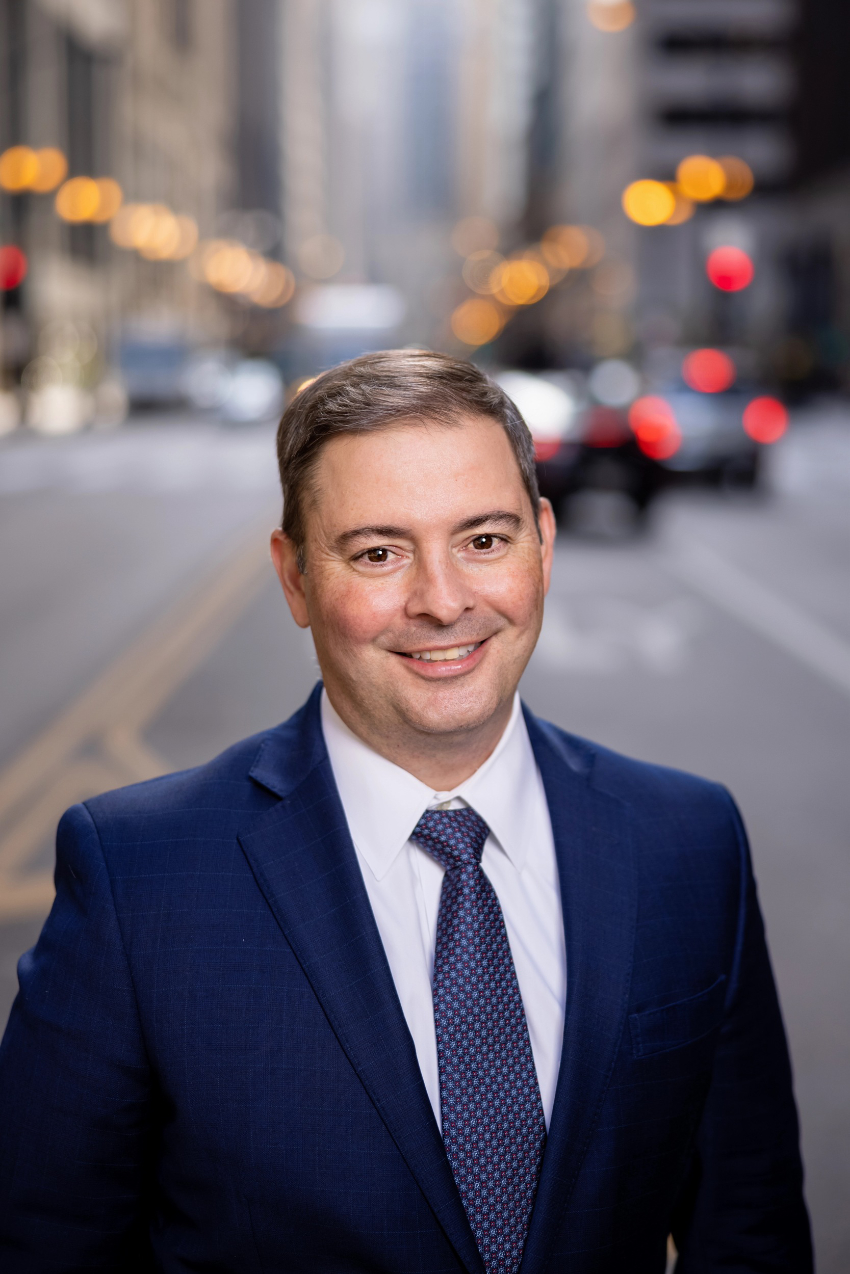
After three grueling years of law school, most new lawyers are happy to see the back of a classroom.
Not James Pullos.
Just after graduating from DePaul’s College of Law, he decided to turn right back around and attend the University of Chicago’s Booth School of Business for his MBA – even as he was beginning a career in the Criminal Prosecutions Bureau of the Cook County State’s Attorney’s Office.
“I wanted another challenge,” Pullos explains.
Driven by an insatiable thirst for knowledge and new perspectives, Pullos would drive straight from the courthouse during the day to his classroom at night, never telling his colleagues for fear they’d question where his heart lay – always, with the law. The secret didn’t come out until his wedding four years later, when Pullos’ best man mentioned his recent graduation from UChicago’s business school. Many of his State’s Attorney’s Office colleagues, dumbfounded, found out for the first time through that speech.
There’s a reason none of them knew: Pullos did his job, and he did it well. A passionate advocate for victims, Pullos quickly ascended through the ranks at the State’s Attorney’s Office, spending seven years in the Criminal Prosecutions Bureau before moving to the Civil Actions Bureau, where, within a year, he was promoted to Supervisor of the Torts and Civil Rights Division before becoming Supervisor of the Labor and Employment Division. Within those 14 years, he reached the heights of every department he joined, learning about every area of law he could.
Pullos doesn’t just gain knowledge – he finds new ways to put that knowledge into practice. With a career spanning both public and private practice and criminal and civil litigation, he has always looked toward the next challenge, the next idea – and, most importantly, the next way to help people in pain.
Being a lawyer, first and foremost, Pullos says, “is an incredible opportunity to be helpful to people who are in distressing, life-changing situations.”
Pullos carried on fulfilling that mission in private practice when he joined celebrated Chicago personal injury firm Clifford Law Offices in 2017. In the near-decade since, he has secured more than $100M for injured individuals and grieving families, with cases ranging from medical malpractice to trucking and motor vehicle collisions to sexual abuse and assault claims.
In 2024 alone, Pullos achieved a $1.5M result for a survivor of sexual assault by a sports coach and a $1.5M result for a mother who alleged that correctional officers could have prevented her son’s suicide; that year, he and his partners also achieved a $15M medical malpractice result for the parents of a baby who sustained a permanent brain injury and obtained $16M for the parents of a child killed in a semi-truck crash. In all of those cases, he is trial-ready, bringing more than 50 cases to verdict throughout his career – experience that has compounded from his earliest days as a lawyer.
“It is fulfilling to live up to our clients’ expectations – to be able to earn the trust that they give us,” Pullos says.
His exceptional advocacy for plaintiffs at Clifford has earned Pullos a spot on the Lawdragon 500 Leading Plaintiff Consumer Lawyers guide four years in a row.
Lawdragon: What first brought you to a career in the law?
James Pullos: I'm the youngest of six, and I was the first in my family to be able to go away to college and graduate from a four-year university. When I was a kid, I saw through civic and community leaders that lawyers are able to provide legislation that changes people's lives for the better, and they're able to fight for people inside a courtroom. I wanted to be someone who makes a difference in society. I also thought that if I could take a career path that would take me into the law, I'd be able to make my family proud.
LD: How did your first job with the Cook County State’s Attorney’s Office play into that goal?
JP: It all really came together there. I was now in a position where I could stand up in court and speak on behalf of the community, and on behalf of the victims of crime or the families of victims of crime who are unable to speak for themselves. I was able to lend a voice to help empower them in a way that was so professionally satisfying. That's where I really knew that this is what our profession is, and this is why I was really proud to have gravitated toward it.
LD: You were there for 14 years, which is a long time in public practice. Tell me about your journey through those years.
JP: You could almost split my career there into two separate halves. For the first seven of those 14 years, I was working my way up on a criminal track to get to felony trial. Because of the way that promotions and movement work there, reaching the level of felony trial was always a destination as a criminal prosecutor. Once you make it into a felony courtroom, you're able to handle the most serious of the crimes. They're the most complex. They're the most challenging. They need a lot of technical expertise.
Eventually, I was right on the cusp of being promoted to be a first chair in the felony trial courtroom. But I ended up finding that the Office’s civil bureau was a chance to get a lot of experience and exposure to different practice groups, including federal and state torts and civil rights. It would be an extension of my trial experience from criminal courts over into the civil courtroom, and I'd use that as eventually a stepping stone so that I could go into private practice.
LD: Then what happened?
JP: Once I got down to the Civil Bureau of the State's Attorney's Office, there was a trial going against a big law firm in Chicago where we would be representing the sheriff’s office and deputies who were accused of excessive force. The trial was going to be in six weeks. It was a federal case, a giant file. But as I got involved, I realized that I knew these kinds of cases. From my time prosecuting aggravated battery to police officers, in prosecuting resisting arrest, I knew exactly what the evidence and the arguments were going to look like in order to show that these law enforcement officers didn't do anything wrong. I was able to bring the framework of my experience from criminal law into the case, and I ended up basically becoming the first chair on that trial.
Later, I became the supervisor of the Torts and Civil Rights Unit. I did that for three and a half years. After that, I was promoted to Supervisor of Labor and Employment; I wanted to learn more about the office and government.
LD: Wow. That’s quite a journey. Do any cases stand out from your time there?
JP: One of the cases that stood out to me is when we prosecuted an individual who, in a case of mistaken identity, opened fire on our victim's car. The intended car was believed to have been involved in a dispute between two warring factions. Unbeknownst to them, rather than the people that they were targeting, the car contained three innocent people. The person sitting in the front seat on the passenger's side was shot and lived. But there was an eight-months pregnant woman in the passenger-side rear of the car, and she was shot and ultimately died. The evidence showed that there was a baby seat that had been placed in the driver’s-side rear seat. The area she was trying to get to had been blocked by the very car seat that was placed there for her prospective child. It was incredibly emotional.
LD: That’s heartbreaking. What were the biggest challenges in that case?
JP: With a case like that, we ended up dealing with a lot of witnesses who didn't want to cooperate. But we had a witness – the victim that survived – who, at the risk of his own personal safety, came forward and offered his testimony. As a prosecutor, you get the technical experience – the standing up, the decorum, the ability to think on your feet, the way to construct a direct examination, cross-examination, opening statements, closing arguments. But the thing that you also get out of those experiences is that you're dealing with people who are at the intersection of some of the most catastrophic events of their lives. They’re living with it. Even some of the witnesses are living with it. When you're interacting with those people, you see what everyday people are dealing with. You understand that, as a lawyer, your two greatest tools are being incredibly confident and being able to listen.
LD: How did all of that experience – on both the criminal and civil sides – feed into the work that you do now as a personal injury lawyer?
JP: At the end of the day, it's not just about punishment for the wrongdoing; it's about accountability, but it's also about making sure that the family gets just compensation. It's that the family is able to have answers to their questions and have some level of closure. Certainly, if you were to draw a fine line, my experience as a prosecutor provided the foundation. But eventually, as you are working on these cases, that experience keeps building on itself.
When you're interacting with those people, you see what everyday people are dealing with. You understand that, as a lawyer, your two greatest tools are being incredibly confident and being able to listen.
LD: Your personal injury cases run the gamut. What do you enjoy about that broad spectrum of work, and what do you find the keys to success are with that kind of widespread practice?
JP: Professionally, I like the challenge of being able to handle a diverse area of litigation. But I also will say that the exposure to diversity makes my case development better. You have to remain humble and show some humility for every case so that you don’t go into it saying, “I’ve done this before.” You have to be willing to reevaluate and reassess all the time.
LD: That makes sense. Then, once you entered private practice, what brought you to Clifford Law Offices?
JP: I wanted to work here because I knew that this law firm had a standing that was second to none. It’s personally and professionally an incredible privilege for me to work here. The draw for me was being able to work with my colleagues on cases involving some of the most important types of life situations. I feel really honored to be a member of the team.
LD: Are there any cases in particular that stand out to you from your time with the firm?
JP: We represented a family of a two-year-old who was brought to a daycare with no pre-existing health problems. When the child was dropped off, it was any other day. Early in the morning, the infant was recognized to have been unresponsive and leaning into a toy bin. He ended up passing away.
Our belief and our theory of the case is that this child died due to positional asphyxiation – the child was reaching into a deep toy bin, and the child, with shorter arms and a smaller body, positioned himself in such a way that his airway was cut off.
LD: That's horrible.
JP: That case was heavily litigated. Of course, the only just outcome would be that we go back to the day before this incident ever took place. Unfortunately, we can't do that. Because we can't do that, the only means of justice that we can give to our clients is financial compensation.
The daycare involved had limited insurance, but it took all of that litigation to force them to pay the million dollars available. To me, that should have been done before we even filed suit. We were able to secure the full amount of the insurance coverage, which, quite frankly, was not enough, because we were firm and resolute, and the clients were firm and resolute and prepared to try this case without any compromise.
It really starts with [firm founder] Bob Clifford – that position that we are not willing to compromise. We're going to do the right thing. And the right thing in that situation was to hold the line to make sure that they get that full million dollars.
LD: Right. And because the firm has that reputation for trial readiness, does that act as a strong negotiating tool?
JP: Absolutely. Back to the diversity of my work, being trial-ready on a host of cases across the spectrum provides a unique readiness and competency that ultimately only drives for the best results.
LD: To that end, what do you find most satisfying about your work?
JP: In a small way, and with the greatest amount of modesty, to be able to make a difference in incredibly trying circumstances. I understand that the relationship we develop with our clients is forced. The clients do not want to be there. They don't want to be talking to us. They've just had something catastrophic happen to them. And now here they are with us, trusting us. It is fulfilling to live up to their expectations – to be able to earn the trust that they give us.
LD: That’s a great point. Then, finally, what keeps you busy outside the office?
JP: I'm one of the coaches on my son's eighth-grade basketball team, which just won the South Suburban Basketball League championship. Then, spending time with my family. I'm married, and I have three children – a senior in high school, a sophomore and an eighth grader. As they're getting their independence, I have a little independence – so, weather-permitting, I like to get outside and be active.

