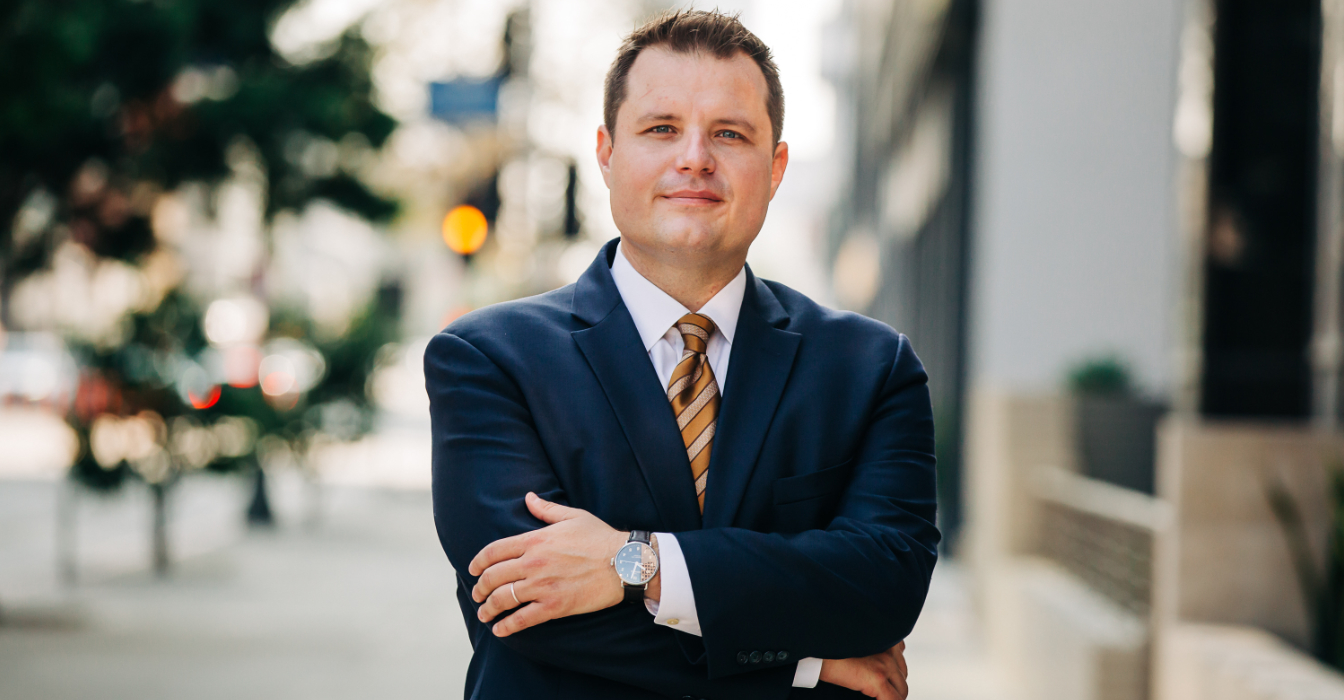
In the last decade, employment lawyer Caleb Marker has relentlessly pursued innovative paths to justice for his clients – reshaping existing law and changing how employment cases are brought along the way.
Marker is a managing partner of national plaintiffs’ firm Zimmerman Reed, which he joined in 2015 as a founder of both its L.A. office and its mass arbitration practice. Marker went on to try the first merits arbitration in the country alleging that a gig economy worker was an employee rather than an independent contractor: a case brought on behalf of an Uber driver seeking employee status. Since then, Marker has represented thousands of gig economy workers – particularly drivers for app-based companies like Uber and Lyft – who are seeking the benefits and protections of employee status in an employment landscape changing at a breakneck pace.
The law was unformed and untested in the area when Marker first pursued these cases, but in the ensuing years, the courts and the legislature have made new decisions – some of which help Marker’s clients, and some of which hurt them. His work in California is especially challenging since the passage of Proposition 22 in 2020, which classified rideshare and delivery drivers for companies like Uber, Lyft and Instacart as a new class of independent contractors rather than employees. While that battle roils in the Golden State, Marker and team are also pursuing justice for workers nationwide, in states including Illinois and Massachusetts.
As those new laws and precedents form, Marker has constantly sought out new and more effective legal pathways – and, in doing so, has shaken the entire arbitration space. Marker is a pioneer in mass arbitrations, where he brings the quality representation expected in a class action and applies it to thousands of individual arbitrations at a time.
“It’s been very rewarding because the clients tend to get much higher recoveries in a mass arbitration than they might as part of a class action,” Marker says. He recalls one client who was experiencing homelessness and had suffered deeply personal losses before receiving a six-figure recovery. “It was life-changing for her,” he says.
Now, the practice has exploded, and Marker is continuing to lead the charge. In 2024, he was appointed co-chair of the American Association for Justice’s new Mass Arbitration Group, which seeks to provide support for and communication with other plaintiffs’ lawyers in the rapidly developing practice.
Currently, Marker is taking on further employment misclassification cases against Amazon, representing the company’s Flex drivers who deliver packages to thousands of doorsteps every day.
“Those cases are a natural extension from the rideshare cases,” Marker says. “It’s a very large company utilizing technology to hire people for day labor, essentially – which is not a new idea, but it’s a new iteration of it.”
Marker and the Zimmerman Reed team have tried dozens of those cases in the last few months, and have hundreds scheduled for adjudication over the next year.
At the same time, Marker is also taking on noteworthy work outside the employment space. Currently, he is representing victims of the catastrophic L.A. fires in January 2025, which forced the evacuation of nearly 200,000 people and caused estimated losses of more than $250B. The tragedy hits home for Marker, a longtime L.A. resident – but it’s not his first wildfire case. In 2018, he began representing victims of the Camp Fire in California’s Butte County, the deadliest wildfire in California history. Marker went to Paradise, Calif. after the fire to inspect the damage firsthand, and has continued to represent victims since.
In other areas, Marker has represented survivors of sexual assault in headline-dominating cases, including one of the survivors in the Larry Nassar sexual abuse scandal at Michigan State, Marker’s alma mater. He also represents survivors in cases against rideshare companies – bridging his work in consumer and employment cases.
It always comes back to employment cases for Marker, who is a member of the Lawdragon 500 Civil Rights and Plaintiff Employment Lawyers.
“Our firm has a lot of autonomy for partners,” he says. “Everybody at our firm chooses to work on the cases they work on because they’re passionate about the case – they’re intellectually curious, or the cases feel righteous and meritorious. But somehow I always end up circling back to employment cases.”
Lawdragon: But you said employment law didn’t initially interest you in law school, did it? Why not?
Caleb Marker: It sounded like human resources, forms, things like that. So, I never studied it in law school, but it has been the majority of the work I’ve done in my career.
LD: What changed? Was it the Uber trial?
CM: I think it’s the people. It’s hearing their stories. I don’t think it’s any one particular case. I think it comes from a sense of fairness. When these laws were passed originally, back in the New Deal era, there was a lot of exploitation, and there was a big rebalancing that occurred where the risk associated with work, financial and physical risk, was shifted to the employer. That was the status quo for a very long time.
In the last few decades, it’s started to shift back away from that. So, the Uber and Lyft cases were interesting to me because while they involved new technology, it was an age-old tale: Are these people employees? The law has evolved, I think, in our favor, but the first cases were very difficult because that law didn’t exist.
LD: What was that like in those early days?
CM: The first case was under a completely different standard of law. The tests were very gray. I felt strongly that rideshare drivers are employees of the company, but the companies had good arguments. They were difficult cases when we brought them originally. Then, after our first cases, the California Supreme Court created a much clearer bright-line test in the Dynamex decision, which made the argument that these drivers are employees much stronger. Then it changed again because Uber, Lyft and DoorDash bankrolled Proposition 22 in California, which created a new class of worker. We’ve continued the fight in different states, but it was a frustrating time because the companies were able to write their own law and fund the campaign to pass it.
LD: To that end, the firm’s motto is, “We never forget who we’re fighting for.” What does that mean to you?
CM: We always want to feel like we’re on the right side of the “v.” I think every lawyer at our firm believes that about every case they’re working on, and that can result in very challenging cases. It doesn’t matter the type of client – we represent workers, consumers, borrowers, businesses, governments – but at the end of the day, we always feel we have the righteous, meritorious argument.
LD: One of the defining issues of your career has been leading the charge in mass arbitration. Tell me about how that developed.
CM: Everything changed in arbitration not long after I became a lawyer. The first half of my career was spent fighting against arbitration – fighting motions to compel and trying to keep cases in court. Then at some point we decided to embrace it. That’s where these Uber, Lyft and Amazon cases have been brought: in arbitration.
Mass arbitration is a very new phenomenon. We were among the first firms to build the practice about a decade ago, and it’s evolved a lot since then.
It doesn’t matter the type of client – we represent workers, consumers, borrowers, businesses, governments – but at the end of the day, we always feel we have the righteous, meritorious argument.
LD: Speaking of which, you have a new role as co-chair of the AAJ’s new Mass Arbitration Group. Tell me about that.
CM: It really came about because the mass arbitration field has expanded considerably, and a lot of other firms have gotten involved in the area. We saw an opportunity to share best practices and make sure that lawyers could help each other in this space, because defense counsel were doing the same. So, the group supports smaller firms that are active in this area and makes sure that everybody is working together to improve the law.
LD: Why is it important for you to uplift other lawyers and increase that communication? How does that help make everyone better?
CM: Small firms have fewer resources than the corporate defense firms. A lot of the people we’re trying to help – solo practitioners or small firms – are starting out, and they can’t afford the investments that we’ve made in this area. We’ve spent millions of dollars investing in technology and staff to build a practice that can operate successfully at scale, and small firms can’t do that. So, we’re trying to take some of the lessons learned and some of the resources we have and share that with others, so they’re able to obtain similar results.
LD: If so much has changed in recent years in terms of the attitude toward arbitrations, where do you see the future of arbitration agreements and mass arbitrations going from here?
CM: I think it’s still early. We’re in the third or fourth inning of it. Companies used to have very generous arbitration agreements, like the agreement at issue in the Concepcion case. Then, once they got what they were asking for in terms of forcing arbitration, they rewrote their agreements and made the arbitration process far more draconian. Courts have often found those agreements to be unconscionable. So, I think we’re still waiting for guidance from appellate courts and the Supreme Court as to what’s permissible. The defense lawyers I talk to say that mass arbitration is difficult, but they prefer it to class actions.
Personally, it’s been very rewarding because the clients can often get much higher recoveries in a mass arbitration than they might in a class action. I’ve had clients obtain settlements that they used to fund the down payment on a home. Because of the way employment and other laws are designed, with liquidated or statutory damages, some of our clients have obtained arbitration awards for three times the amount of money they actually earned while working for the company. If they earned $10,000 working for one company and we recover $30,000, for example, that can be life-changing for the average person.
Mass arbitration is a very new phenomenon. We were among the first firms to build the practice about a decade ago, and it’s evolved a lot since then.
LD: What about other cases on the consumer protection side – which stand out to you?
CM: There’s been this rise of online advertising for wellness companies essentially selling snake oil on social media. These online advertisers are making a lot of claims that are not supported by science, and they are taking advantage of people’s vulnerabilities and insecurities. We’re taking on a lot of those cases in the arbitration space. But right now my focus is really on employment cases for workers, cases for survivors of sexual assault, and the California wildfire litigation as well.
LD: Tell us about the wildfire litigation. Being in L.A., how are these cases particularly impactful for you to work on?
CM: It was personal for me because I love L.A. I’ve been here for 15 years now, and my family evacuated during the fires, which got pretty close to my home, although thankfully we didn’t suffer any significant damage. The Department of Justice has also filed a case against the utility company at issue. It is frustrating because wildfires are made worse by climate change, so it’s a problem that’s going to get worse before it gets better. But it’s satisfying to work on cases where you can help people in your own community.
LD: And what are the next steps in the litigation?
CM: We’re continuing to develop damages. The first trials are scheduled for early 2027, and there’ll be a bellwether process. So, it’s still early. We’re still gathering evidence, and I think everyone’s waiting for the investigating authorities to release their findings on what happened. The DOJ moved pretty quickly here, which was appreciated because their investigations can often take longer.
LD: To that end, are there any other trends that you’re seeing lately?
CM: Mostly that it hasn’t stopped. It’s disheartening that companies will continue to violate the law after losing case after case after case. They can treat it as the cost of doing business instead of doing the right thing. And that signals a need for class actions and government action. We’re in an era where you can’t always count on government enforcement to protect ordinary people, workers and consumers. That’s really highlighted the role of private enforcement.
LD: Then, as far as your role as managing partner within the firm, how do you see yourself as a leader?
CM: The role of a managing partner is to work to define and continually refine firm strategy and vision, and to make sure all the different parts of the firm work together harmoniously. My goal is to always try to figure out what’s next for the firm. It’s about spending a lot of time focusing on what our long-term vision is, and then figuring out what kind of support people need to get there. We have a lot of great lawyers doing really good work and working very hard, so we need to make sure that everybody’s set up for success with the resources we have, while also determining what capabilities we will need down the road.
LD: And then how would you describe your style as an attorney, whether that’s in trial and arbitration or when working with your clients?
CM: I always aspire to develop a professional, respectful working relationship with opposing counsel. I’ve found it benefits my clients’ interests. We litigate against some of the same defense firms routinely, and usually I can find something about the person on the other side that I admire. It makes it easier to litigate the case hard and still resolve it when the time is right.
LD: Finally, what do you find most fulfilling about your practice?
CM: Helping people. It’s that simple. I feel good about the work I do, and there’s always this sort of David versus Goliath satisfaction that comes out of representing a single client against a large corporation. That especially rings true if that person’s had a much more difficult life than I have had, and I’m able to be part of the solution to enforce the law and protect their rights. We’re able to really talk to people, to understand their experiences, how they see their job, how they see the world, and how they’ve been personally impacted.

