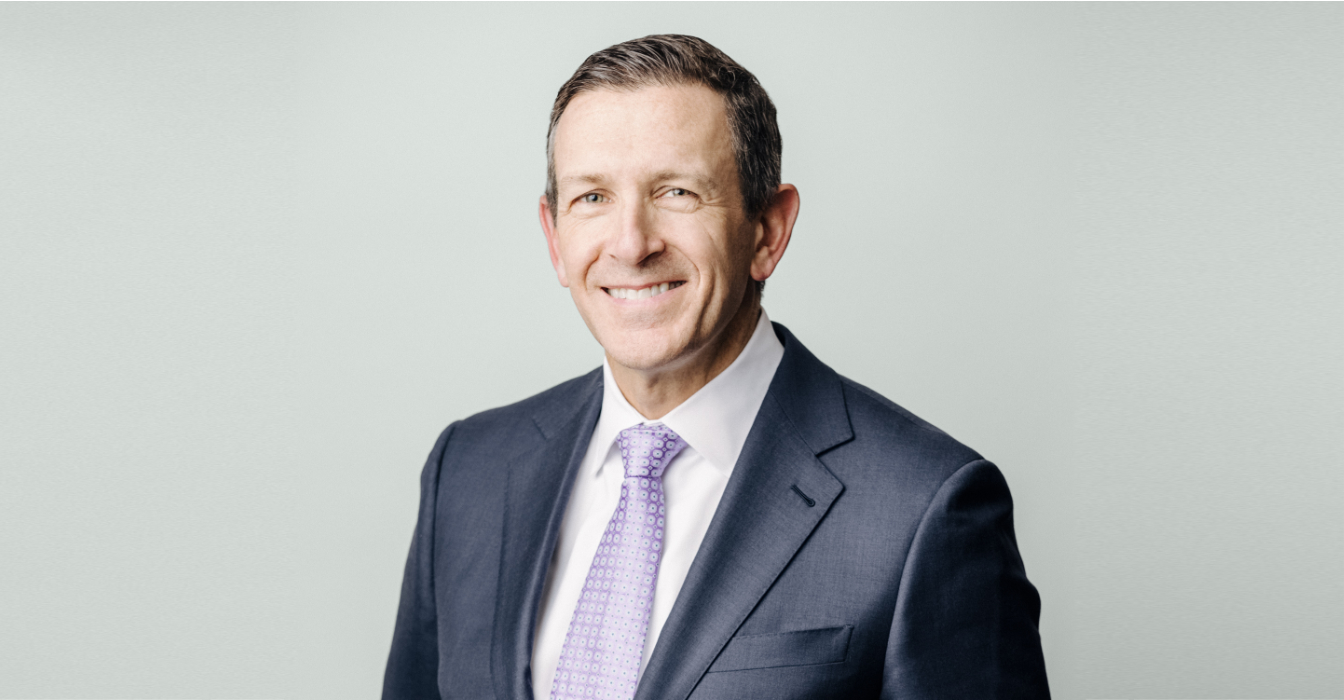
What would Alan do?
This simple question has guided Brian Hermann in his professional decision-making for decades. Alan refers to Alan Kornberg, a renowned restructuring lawyer who founded Paul, Weiss’s restructuring practice and led it for more than 30 years. His kindness, compassion and sensible approach to highly complex situations made an indelible mark on Hermann, now a co-head of the Restructuring & Debt Capital Solutions Group at the firm.
“I learned everything from Alan,” said Hermann. “Most of what I learned, I just learned from observing him. He taught me how to be a good lawyer, how to be courteous and treat people with respect, even if you’re fighting with them, and how to make winning arguments in court and negotiate.”
Starting from his days as a young lawyer under Kornberg’s watchful eye, Hermann has developed his own storied career. He has become not only a restructuring practice leader, but also a trusted industry voice and mentee to many young restructuring lawyers. He has represented both company-side and creditor-side clients across industries nationwide in complex out-of-court restructurings and Chapter 11 cases, as well as complex litigation resulting from Chapter 11 cases. An expert on restructurings for music, media and entertainment companies, he also serves as a key member of Paul, Weiss’s Media & Entertainment Group and its Sports Group.
Hermann’s recent company-side representations include advising Diamond Sports Group in its successful Chapter 11 cases filed in the Bankruptcy Court for the Southern District of Texas; MSG Networks in its successful out-of-court restructuring of more than $800M of funded debt and its media rights agreement with its team partners; NEOTech on financing and lender relationship aspects of its acquisition by Arkview Capital; and Forever 21 in its Chapter 11 case in the Bankruptcy Court in the District of Delaware.
His recent creditor-side representations include advising an ad hoc group of Serta Simmons lenders excluded from a 2020 debt restructuring deal in the significant victory in the appeal of the opinion of the 5th Circuit; an ad hoc group of first lien noteholders of AMC Entertainment in a transaction with the company settling the group’s New York state court lawsuit around a 2024 refinancing transaction; an ad hoc group of DISH Network convertible noteholders in strategic transactions completed by EchoStar, DISH’s parent company; Brookfield Asset Management in the Chapter 11 cases of solar energy developer Pine Gate Renewables, including its acquisition of certain Pine Gate assets via a 363 bankruptcy sale and its role as lender for one of Pine Gate’s three separate debtor-in-possession loans; and certain affiliates of Brookfield Asset Management in their capacities as agents and lenders under a $600M first lien back-leverage loan facility to PosiGen, including in connection with PosiGen’s Chapter 11 cases.
Hermann has been named to several Lawdragon guides, including the 500 Leading Lawyers in America, 500 Leading Global Bankruptcy & Restructuring Lawyers and 500 Leading Global Entertainment, Sports & Media Lawyers. He recently sat down with the outlet to discuss his career and practice.
Lawdragon: What types of opportunities are you currently seeing in restructuring?
Brian Hermann: Where we’re seeing dislocation and opportunities is really in retail and other places that are being disrupted, whether by technology or government changes or regulatory changes. There have also been opportunities in the auto industry because of tariffs on auto parts. Renewables companies have also been impacted by changing laws and have become a lot less viable in their business models as a result.
LD: Do you foresee these opportunities and the market for restructuring changing throughout 2026?
BH: If there is any softness in the economy given higher prices, unemployment ticking up, consumer confidence going down and AI disrupting the economy, we could see a good amount of economic dislocation, and if that happens, more restructurings. But that’s hard to predict.
I just try to be nice, fair and decent to everybody and make sure I impart to people what I’ve learned so they can have a similar experience.
LD: Some of the industries you’ve covered most often in your career have been music, sports, media and entertainment. How did you get involved with those matters?
BH: I was kind of lucky to be honest. The firm used to do work for Warner Music, and when I started, I was placed on one of the music-related restructurings for a well-known international artist. Like any company that goes bankrupt, the artist had too much debt and no money. We got called in to help, and Alan [Kornberg] and I basically treated it like it was any other restructuring, even though it was a personal balance sheet rather than a corporate balance sheet. That experience led to other entertainment-related experiences, and the rest is history.
LD: What do you like most about working on media, sports and entertainment-related restructurings?
BH: It’s not often that you’re working with artists who are in a completely different world than the one we see on a day-to-day basis. You’re dealing with a unique set of issues, personalities and people, and I just kind of like the variety.
LD: Is there a sports- or entertainment-related restructuring you’ve done that stands out to you?
BH: The Diamond Sports Group restructuring was probably the hardest one I’ve done – not because it was the most complex legally, but because we had the challenge of trying to fix the business and manage a bunch of different constituencies in the case.
LD: What other matters have you worked on that are particularly memorable for you?
BH: Another one that stands out was representing the California Public Utilities Commission in the first Chapter 11 case of PG&E Corporation. It was three years of constant fighting, and it was super consequential because it involved the future of the largest utility in California and the largest public utility in U.S. history to file for bankruptcy. There were rolling blackouts in California at the time, and people didn’t have power. It was really at the forefront of deregulation in the power industry and the challenges that came along with it.
We all take it for granted, but power is one of the things you can’t live without. If you’re living in a house where you don’t have power and can’t turn the lights on, put the heat or air conditioning on, or cook, life becomes pretty miserable. To experience that in San Francisco and other parts of California was kind of unthinkable.
LD: You’re now a co-head of the Restructuring & Debt Capital Solutions Group at Paul, Weiss. What do you appreciate most about the firm?
BH: The Restructuring & Debt Capital Solutions Group is unique within Paul, Weiss. We’re a bit more scrappy and entrepreneurial because we have to get a lot of the work on our own rather than off the firm’s platform.
Having said that, a lot of clients like to use us because we’re part of Paul, Weiss. The brand is enormous and the ability to sell other practice areas is easy. It’s easy for me to call clients and refer them to our litigation or M&A partners, for example, because of how great those practices are. The other great thing about Paul, Weiss is that it’s super collaborative and a true partnership, so people are willing to help each other. It doesn’t matter whether it’s my client or someone else’s – we just put a team together and go do it. In that sense, it’s the best platform I can imagine.
The great thing about Paul, Weiss is that it’s super collaborative and a true partnership, so people are willing to help each other. It doesn’t matter whether it’s my client or someone else’s – we just put a team together and go do it.
LD: Given your role at the firm, I’m sure you’ve developed some philosophies around leadership. How would you describe your leadership style?
BH: I probably tend to be more hands-off than most leaders, but I like to think we set a pretty good direction for the practice in terms of our goals and how best to achieve them. That’s very clearly communicated to our partners. It’s a very collaborative style, not a top-down kind of mandate, where we all think about what makes sense for the group and figure out the best way to accomplish it. I really like to put people in position to succeed.
LD: How do you work to put people in position to succeed?
BH: I had the greatest mentor anybody could have in Alan Kornberg, who put me in a position to succeed by letting me play to my strengths as a lawyer. I make an effort to model that behavior with younger partners and play to people’s strengths. I know the whole group and what people are best at and try to put them on matters and with clients where I know they’re going to do well. From there, I let people learn and grow and try not to get in their way.
LD: How did having Alan as a mentor impact your own approach to mentoring?
BH: I always try to ask how Alan would deal with an associate or another partner or how he would approach a situation with other people. Then I try to emulate what he would do.
Fortunately, it kind of comes naturally to me because he and I think about things very similarly. I think I have a similar compassion and empathy, so it’s not like I’m straining to do it or it’s unnatural. I just try to be nice, fair and decent to everybody and make sure I impart to people what I’ve learned so they can have a similar experience.
LD: What advice can you give to young restructuring lawyers?
BH: If you want to be a good lawyer, the key is to work hard, develop good lawyering skills and pay attention to detail. Even if you think it doesn’t matter, proofread the email before you send it or read the document again to make sure the comma is in the right place or see if you can say something a little bit better or ensure you’ve captured what a provision really says. When you have that discipline, that will pay dividends throughout your career.
For young lawyers, it’s really just about developing good legal skills, even the most basic skills, observing as much as possible, being a sponge and trying to take on as many different kinds of matters as you can so you see the variety of the things that we do. Once you have that foundation, the job, while it never becomes easy, becomes easier.
I always tell people that at every stage of your career, you shouldn’t look at the person who is 30 years older than you, but the person who is five years ahead of you. When you look at the person who is five years ahead of you, ask yourself if you want to be that person. If the answer is yes, keep going. If the answer is no, you might want to find something else, because it becomes harder and harder as you get older to make a career out of something if you don’t like it. If you do things in bite sizes like that, then you can consistently strive to get to the next level. Before you know it, you’ve got all the building blocks necessary to be successful. If you want to be a lawyer for your career, you’ll get there if you follow that path.

