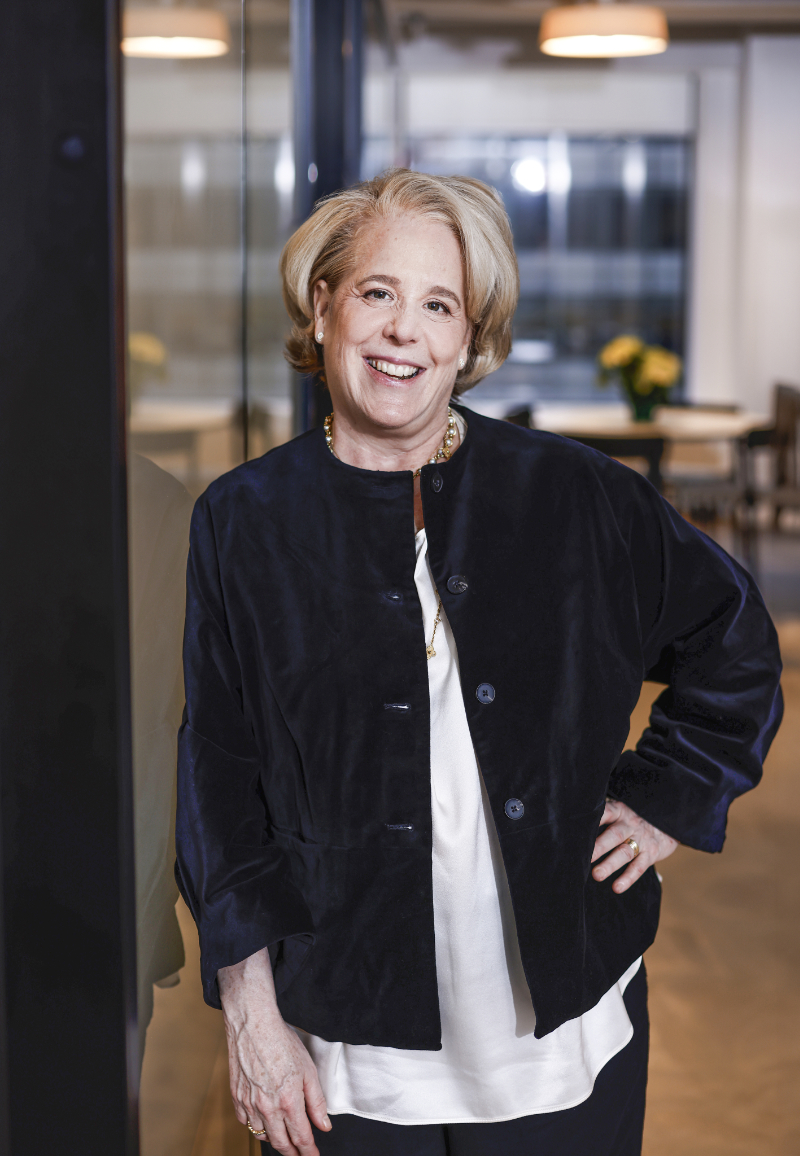
Late last December, while most of New York was winding down for the holidays, Robbie Kaplan and the Kaplan Martin team were just getting started. Minutes earlier, only an hour before the court in the Southern District of New York was set to close for Christmas, the U.S. Department of State announced on X: “WE’VE SANCTIONED: Imran Ahmed” for being part of the “censorship-NGO ecosystem.” Ahmed is the founder of the Center for Countering Digital Hate (CCDH) – a nonprofit that researches online hate, misinformation, and child exploitation, and pushes for greater transparency and accountability from Big Tech platforms – as well as one of Kaplan's clients. In retaliation for his constitutionally-protected speech, Ahmed, a British-born lawful permanent resident of the United States (with an American wife and two American daughters), faced immediate detention or removal.
On Christmas Eve, Kaplan and her colleagues filed an emergency complaint on behalf of their client. “We did not sleep much,” Kaplan recalls. “The team worked overnight and somehow got it done. It was exceptional work – I honestly don’t know if it would have been possible anywhere else.”
Then, minutes after midnight on Christmas morning, they had the answer they were hoping for: a temporary restraining order that ensured Ahmed would remain in the United States, free with his family, while the court considered the merits of his constitutional claims. It also signified something more: a high-profile challenge to the use of government power to punish speech protected by the First Amendment.
It was not the first time Kaplan had faced down the Trump administration at a moment of crisis, and it would not be the last. Kaplan and her team still represent Ahmed, as they fend off the prospect of federal action against him and defend the fundamental constitutional principles at issue in his case. This September, the district court issued an order, noting that “without a hint of irony, the Secretary of State determined that rendering Mr. Ahmed deportable on account of his lobbying and advocacy efforts was necessary to protect American ‘freedom of expression’” and acknowledged that Ahmed “very well may have valid causes of action.” However, she concluded that the district court did not have jurisdiction. Kaplan's team immediately filed emergency motions with both the 2nd Circuit and the district court, winning another stay in the district court pending resolution by the 2nd Circuit.
Ahmed’s case is, in every sense, a classic Kaplan Martin case – urgent, exacting and built for the moment. Kaplan has assembled the kind of elite litigation team that clients turn to during existential moments – a tireless Seal Team Six that does everything it takes to win, including working around the clock to devise the most effective and creative strategy to succeed.
That grit has run through Kaplan's entire career. She pursues ambitious cases that shape the law – from United States v. Windsor, the landmark Supreme Court victory that gutted the Defense of Marriage Act paving the way for nationwide marriage equality, to the $26M civil verdict against white supremacist organizers after the violent Unite the Right rally in Charlottesville. More recently, in the E. Jean Carroll cases, she successfully defeated a series of appeals by President Donald Trump which sought to overturn two unanimous federal jury verdicts against him.
Trained as an elite commercial litigator with the heart of a street fighter, Kaplan today operates on equally high-pressure terrain, including litigating more than a dozen lawsuits to preserve New York’s congestion pricing program. Whether the stakes are personal, financial, societal or constitutional, the throughline is always the same: Kaplan takes on powerful adversaries, builds records that hold up on appeal and delivers victories on behalf of her clients.
It’s impossible to fully convey E. Jean Carroll’s bravery or what an extraordinary person she is. She personifies the courage it takes to stand up and fight back, even against the most powerful person in the world.
Lawdragon: Congratulations on your firm’s success, as well as your individual recognitions from The American Lawyer, New York Law Journal, Financial Times, Forbes and right here at Lawdragon! Kaplan Martin is winning hugely impactful cases.
Roberta Kaplan: Thank you. We are. Especially today, we need to do that. The stakes are too high and the consequences too dire for lawyers to sit on the sidelines.
LD: Was that your vision for Kaplan Martin?
RK: When I left Paul, Weiss in 2017, I wanted to build a civil litigation firm that did genuinely interesting work – a true generalist practice with many types of clients – and to do it the way I’d been taught: at the highest level, creatively, always looking for new ways to guide clients through major challenges.
That’s what Kaplan Martin is all about. With my incredible partner and old friend Tim Martin, we built something that is just different. We’re a firm of exceptionally smart lawyers who have worked together for years, share the same values, and genuinely admire and like each other a lot. Two of the best senior associates from my old firm came with me and are now partners at Kaplan Martin. And we have truly ingenious counsel and associates for whom the sky is the limit.
We also have exactly the mix of work I had hoped for. We have incredibly meaningful public interest work alongside high-stakes commercial litigation and everything in between. Our phones keep ringing because of the important work we do, the way we do it, and what we accomplish.
There’s not a day that I don’t look forward to coming into the office. Since litigation is inherently stressful, it makes no sense to do it if you don’t enjoy it and you don’t enjoy the people on your team. That’s what we have at Kaplan Martin.
LD: Where does the E. Jean Carroll litigation stand? Those verdicts were so significant.
RK: I sincerely hope people see it that way. Two separate juries – unanimously – agreed with E. Jean. The first found that Donald Trump sexually abused and defamed her; the second found that he continued to defame her in ways that caused her real harm. Unfortunately, those facts can get lost in today’s chaotic media environment.
Procedurally, the first, $5M verdict is now final and cannot be challenged in any court, since the Supreme Court declined to hear the case, twice. President Trump was ordered to, and has now paid, E. Jean $5M plus interest.
Trump also appealed the second verdict – the $83M based on defamatory statements he made about E. Jean while President – to the 2nd Circuit and lost. He then sought rehearing en banc, which the court declined. And now he is again seeking review by the Supreme Court.
It’s been a long road for E. Jean, who is 82. But Trump’s endless appeals will not deter her. And we will never stop fighting on her behalf.
LD: There’s been buzz about the E. Jean documentary.
RK: Yes. It’s a wonderful documentary called "Ask E. Jean" about E. Jean’s amazing life and career that premiered at Telluride. It really captures who she is – her charm, charisma, eccentricity and brilliance. The film had serious challenges finding distribution, which I think says something about the moment we’re in – people are wary of stepping into anything controversial right now. But the film was picked up, with theatrical showings in 90 cities and 30 states. It’s now available for streaming on Kinema. E. Jean also wrote an excellent and very funny memoir, called "Not My Type: One Woman vs. a President," about her cases against Trump, which has got to be the only truly laugh-out-loud funny book about trials for defamation and sexual assault. She is currently writing what I’m sure will be another both hilarious yet sobering book about all the ways that the world as we know it could end.
I’m not usually at a loss for words, but it’s impossible to fully convey E. Jean’s bravery or what an extraordinary person she is. She personifies the courage it takes to stand up and fight back, even against the most powerful person in the world.
LD: You’re litigating another very high-profile matter – defending New York’s congestion pricing program. What has that fight looked like?
RK: We are so honored to represent the Metropolitan Transportation Authority (MTA) and the Triborough Bridge and Tunnel Authority (TBTA) in many lawsuits across federal and state courts, aimed at stopping the program. There have been more than a dozen different efforts to enjoin the program. We’ve been lead counsel both as plaintiff and defendant to preserve the program and its funding.
The underlying lawsuit was dismissed with prejudice, but that cannot undo the emotional costs to Jay-Z and his family – or the more than $150M in economic losses.
To date, we’ve beaten back all the efforts to impede congestion pricing. Courts have consistently allowed it to proceed and upheld its legal foundation, even as the noise continues. At one point, the President posted on Truth Social that he was going to “shut it down.” While I generally don’t post anything on social media, I have to admit I felt like saying, “There’s a court order in place. Mr. President, you can’t really do that right now.”
We have also seen that congestion pricing works. People resist it at first, and then they come to recognize its benefits: less traffic, better flow, and a dedicated revenue stream for critically-needed transit projects, not to mention improvements in air quality. In its first year, New York’s program raised over $550M in revenue, which is being used to rebuild and repair NYC’s subway system which really needs it. It’s not just about traffic – it’s about the long-term viability of an aging subway system that millions rely upon every day.
LD: Tell us about your other clients, Robbie.
RK: We are representing Kituwah, the investment arm of the Eastern Band of Cherokee Indians and its CEO in a dispute about the breakup of the Sports Illustrated-branded resorts venture. With more than 25 claims that involve intellectual property, defamation, breach of contract and an alleged RICO conspiracy, the matter is an example of massive multi-district litigation that a Big Law firm with an army of lawyers would typically handle. But this is exactly the work we excel at, and we are delivering results with a far leaner team than that.
LD: Anything else that has been in the headlines recently?
RK: We filed a lawsuit on behalf of Oona Sperr against Texas oil billionaire Sid Bass. At its core, it's a case about broken promises. Oona spent more than a decade as Sid’s partner, giving up her own career and devoting herself to the life they built together. She managed their homes, cared for him, and organized her life around his repeated promises that she would share in their property and be taken care of for the rest of her life. Sid honored and reaffirmed those commitments for years, then abruptly ejected Oona, who is 64, from their home and their shared life. Another woman, Althea Viafora Kress, entered his life and, we allege, induced him to break his promises to our client. We are seeking to recover what Sid promised her.
LD: Any other high-profile clients to share?
RK: Well, yes – there’s another big one. I’m honored to represent Jay-Z, who for a short period faced false sexual assault claims. You can imagine what that did to him and his family. I am a parent, and I cannot imagine having to sit down with my child and explain why someone had publicly accused me of something so horrific. The underlying lawsuit was dismissed with prejudice, but that cannot undo the emotional costs to Jay-Z and his family – or the more than $150M in economic losses.
We’ve been representing Jay-Z in his ongoing lawsuits against several attorneys who we allege were behind false demand letters and a complaint aimed at lining their own pockets. It’s a good example of the legal profession missing the mark when the motivations are wrong. My partners Ellen, Chris and I, along with co-counsel, are all proud to work on Jay-Z’s behalf to set the record straight, once and for all.
LD: Do you think the role of lawyers has shifted since Trump took office again?
RK: No question. One of the strongest pillars of democracy from the first Trump administration and continuing through today has been the courts. They’ve continued to step in to enforce the law and the Constitution. You’re seeing that in the lower courts, in the Circuit courts, and even at the Supreme Court, particularly when the stakes are highest like the threats to mail-in voting. I expect we’re going to see a lot more of that as we approach the midterm elections.
One of the strongest pillars of democracy from the first Trump administration and continuing through today has been the courts. They’ve continued to step in to enforce the law and the Constitution.
Unfortunately, not every part of our society has stepped up the way people might have expected or hoped. But the judges have. The Founders got that right – giving federal judges lifetime tenure was a brilliant idea. They’ve shown real courage and intelligence, even in the face of extremely serious threats to their own personal safety. And for them to do that important work, they need truly committed lawyers building well-reasoned arguments they can rule on. It’s especially clear when you look at other institutions people expected to step up; I’m sad to say I don’t think they have done so in the same way.
I was a Russian history major in college, and one of my professors, Richard Pipes, an eminent historian, had a theory about why Russian governments – whether under the tzars, the Soviets or now Putin – tended to take the same form over time. His view was that it came down to the absence of independent institutions and a real civil society.
As he explained, there was never an independent church in Russia. Similarly, even the aristocracy wasn’t independent; your status could change in a minute at the whim of the Tsar. And there weren’t independent professions – like lawyers, doctors or journalists – the way we have them here in the United States.
In some ways, this moment feels like a real test of Professor Pipes’ hypothesis and the strength of our own civil society here in the United States. It’s paramount, of course, for lawyers to defend their clients. But we also have a role in defending the rule of law and the Constitution. And that matters right now, probably now more than ever.
LD: What drew you to the law?
RK: When I was a little kid, I’m told that I liked to talk a lot. At a certain point, I realized that as a lawyer you could actually get paid to talk, and I thought: "That's the job for me." Then, in high school, Sandra Day O'Connor was the first woman appointed to the Supreme Court, and that galvanized my thinking about my future career. I realized there was a real opportunity for me and other women like me to succeed in the law.
LD: Where do you look for inspiration?
RK: It's going to get sappy, but I care very much about the world that my son is living in, and God-willing, his children will live in. What matters to me is that he is able to live in the kind of world that I was able to live in, even with all the challenges, and that he won’t be living in some kind of techno-totalitarian state right out of a science fiction novel. Believe it or not, I consider myself to be very religious. I really believe that the whole point of our finite time on this planet is tikkun olam, or repairing the world.
The best way my colleagues and I can do our part in repairing the world is by standing up in court for what is right. That’s what I believe to be the whole point of our finite time on this planet and what Kaplan Martin was built to do. We will keep on doing our part to help to repair the world no matter what.

