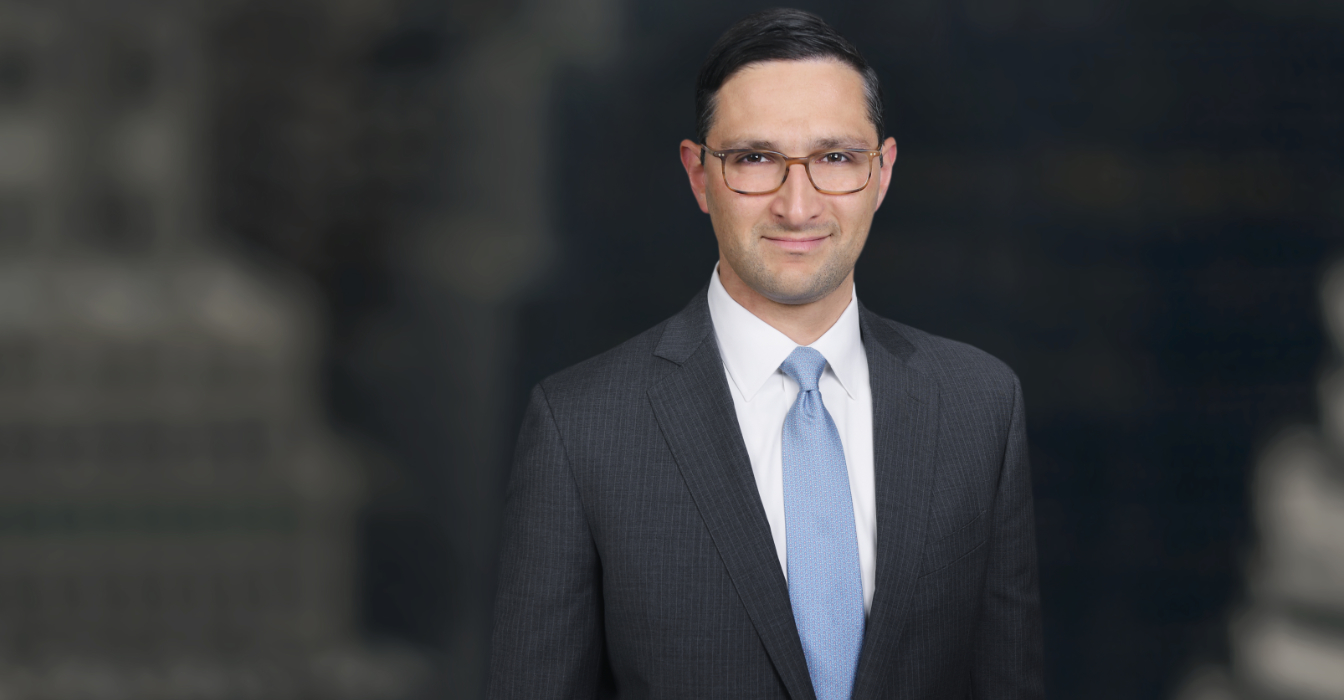
Justin D’Aloia, a class-action attorney at Pomerantz specializing in securities fraud cases, secured a $172M settlement in April for investors in a lawsuit against Danaher Corporation. The settlement, in Hawkins v. Danaher Corp., was the largest ever for securities fraud in the District of Columbia Circuit.
Contributing to D'Aloia's legal success are his comprehensive investigations that uncover confidential witnesses whose testimony helps overcome the increasingly high barriers imposed by the law and courts.
A New Jersey native, D’Aloia earned a B.S. in economics from Rutgers University and received his J.D. from Fordham University School of Law, where he was editor-in-chief of the Fordham International Law Journal.
Lawdragon: Before joining Pomerantz, you were on the defense side of securities cases, right?
Justin D’Aloia: Yes, that’s right. I spent 10 or 11 years at Weil, Gotshal & Manges. I started as an associate, I was promoted to counsel, and I eventually made the jump to Pomerantz in 2022.
LD: What did you think about your time at Weil?
JD: I had a great experience at Weil and learned a tremendous amount there. We essentially litigated cases through trial so I learned about all stages of litigation, and effective strategies to use at each stage, during my time there.
On the defense side, even as a senior associate or counsel or partner, you're still working under two or three layers of more senior attorneys. When you have large class actions with clients that big, they want the most senior lawyers going into the courtroom and arguing. I just wanted to do a little more myself.
I thought doing plaintiffs’ work would not only allow me to spend more time in court, but also give me the ability to flex my creative muscle more. On the plaintiff side you get to define the course of litigation, instead of responding to plaintiffs’ claims, as you do on the defense side.
LD: What made you choose Pomerantz?
JD: Pomerantz is a name brand in the business, and so we came across them all the time.
I met with Jeremy [Lieberman], the managing partner here, with whom I was immediately impressed. I spoke to some of my colleagues at Weil, including a senior partner there who had a large, multi-year class action against Jeremy, and who sang his praises. So I knew that, between that recommendation and my own gut feeling, it was the right decision.
LD: Can you tell me about the Danaher case?
JD: Danaher owns 15 or 20 businesses. In recent years, it has shifted its focus to businesses that operate in the life-sciences space.
One group of companies, known as its “bioprocessing business,” manufactured the equipment that pharmaceutical companies used to make drugs. And that business experienced a “Covid bump,” for lack of a better word, during the peak of the pandemic when everyone was searching for a vaccine.
As the pandemic subsided in 2022 and 2023, the executives kept assuring investors that the bioprocessing business is thriving, we don’t see any change in customer sentiment, and we’re going to do even better than we’ve done in past years.
The CEO got on the call and said that he “made up the projections” that he just gave on the public earnings call.
LD: Was that true?
JD: In reality, things were kind of unravelling behind the scenes due to a confluence of factors. The most significant fact, which we included in our complaint, came from our investigation. We spoke with a former employee who was asked by an executive to sit in on an executive call immediately after the public investor-facing earnings call because the executive was out on maternity leave.
No one else on the call knew that this lower-level employee was sitting in for this executive. And, according to this witness, the CEO got on the call and said that he “made up the projections” that he just gave on the public earnings call because he didn’t like the ones he got from management.
LD: That’s a pretty big deal.
JD: That’s just classic securities fraud, right? It’s like an admission that what I said was made up and false. That is a form of evidence you so rarely see in fraud cases. So, I think that was really compelling and persuaded the court that this was a meaningful case.
LD: How did you ever find that witness?
JD: I think it would be fair to call them a whistleblower, but they didn’t exactly come forward or reach out to us. We found them through raw investigative work. We have an investigative team; they’re former investigators from 60 Minutes and a number of other major news and media publications.
They identified the former employee who had these explosive allegations. I thought the allegations were so important that we went back and verified them with the witness. I found their account to be very credible, and so, we decided to move forward with it.
LD: Did finding that witness make the case a slam dunk?
JD: Since the late ‘90s, the bar for alleging securities fraud claims has become so high. It’s subject to heightened pleading standards. Finding former employees who can provide non-public information in order to buttress claims is almost standard process. But this one was really powerful.
LD: Can you tell me more about the bar you had to overcome?
JD: A lot of the statements at issue in our case involved projections about what the company anticipated in future periods. Those are not only subject to heightened pleading standards, they are also potentially subject to a “safe harbor” in the federal securities laws, which basically protect forward-looking statements unless they meet very onerous exceptions. So we spent a considerable amount of time researching the law on that issue, and framed the claims accordingly.
LD: Did other firms make claims against Danaher?
JD: Because of the difficulties I just mentioned, especially those relating to forward-looking statements, no other plaintiffs came forward to be selected as lead plaintiff and no other law firms moved to be selected as lead counsel on behalf of any plaintiff.
We were the only firm that was willing to roll up our sleeves, put in the work, and take this case on.
LD: What did you do to overcome those issues?
JD: As you can probably imagine from casual conversation, many statements that talk about prospective events may contain parts that speak about the future and parts that speak about the present, so you really have to go through the defendants’ statements and pull out what’s forward-looking and what’s present tense. We took care in our court papers to carefully explain the law on this topic and dissect the statements at issue.
The court took a close look at the statements we claimed were misleading and agreed with us that many of them contained discrete representations about present demand. So, even if, hypothetically, the forward-looking aspects of those statements may be protected by safe harbor, those describing current demand were not protected.
The court also found that we met the exceptions for safe harbor for the forward-looking statements that the CEO made on the public call right before the internal call where he scolded managers for submitting unfavorable forecasts.
LD: That was a major ruling. How significant was the settlement that resulted?
JD: The settlement was for $172.5 million, which is the largest-ever securities fraud recovery in the D.C. Circuit.
We were the only firm that was willing to roll up our sleeves, put in the work, and take this case on.
It’s especially significant for investors because Danaher isn’t just a startup company with a small group of speculative investors. This was an established, well-known, widely held company, whose stock was owned by some of the biggest index funds and other institutional clients that people around the country rely on through their retirement funds and other investments. And so, this settlement is something that has an important impact for people nationwide.
It really speaks volumes about the risks we took in tackling a matter with such challenges. And it’s nice to be rewarded for taking on such a challenging case.
LD: You’re involved in cases dealing with the health dangers from lead-sheathed copper telephone cables against AT&T and Lumen. Where do they stand?
JD: They’re both ongoing, but they’re in very different procedural postures.
Lumen was initially dismissed by the district court with prejudice, but without any explanation for why it was dismissed with prejudice.
We appealed to the 5th Circuit, and the 5th Circuit agreed to send it back to the district court. So, we are continue to litigate in the district court, and filed a new amended complaint. We’re briefing another motion to dismiss in that case.
LD: How about the AT&T case?
JD: AT&T is a little different in that AT&T’s predecessor was the ultimate source of all these lead-lined cables throughout the country.
Once AT&T decided to abandon these cables as they switched over to fiber, the cables were just sitting there, indefinitely, decaying away under changing environmental conditions.
LD: What danger do these cables cause?
JD: Everyone knows lead is toxic. Everyone signs lead paint disclosures when they buy or sell a house. It’s common knowledge. We said in our initial complaints that the executives formed a plan to reclaim copper cables for their salvage value when they decided to switch over to fiber. But, when they did so, they left all the lead-covered ones in place.
LD: The case was almost dismissed, right?
JD: The court sustained about 25 of the misstatements by AT&T that we challenged in our initial pleading, but it said that the allegation of scienter was borderline. The judge dismissed it without prejudice but granted us permission to re-plead with additional facts to get it over the line.
We filed an amended complaint soon after, but we continued to investigate to see if there was anything else out there that we missed. We knew a decision must have been made consciously to leave the lead cables behind and reclaim all others.
LD: What did you find?
JD: We came across several former employees who gave us compelling new information. Among other things, we learned that there were reports that were sent out to every executive on the team, up to and including the CEO.
And those reports literally said, to the precise metric, how much lead cable was left in place instead of being reclaimed.
That was the smoking gun that we were looking for. It corroborated the inference that we initially made when we filed the first complaint.
LD: What did you do with that?
JD: We filed a third amended complaint in response to the motion to dismiss, which is technically allowed under the federal rules.
That was the smoking gun that we were looking for. It corroborated the inference that we initially made when we filed the first complaint.
Rather than address the allegations, AT&T moved to strike the new complaint. There was a slew of emergency motions and, ultimately, just a few months ago, the court issued a decision granting us leave to file that third amended complaint and denying the defendants’ pending motion to dismiss as moot.
Defendants filed a motion to dismiss. We’ll see where that goes, but I think it’s a very promising case.
LD: What can you tell me about the consolidated securities fraud class action against B. Riley Financial?
JD: That’s a fascinating case and has an interesting backstory on a personal level.
I was in California when one of my partners asked if I could attend a lead plaintiff hearing for him. That’s the court hearing where different law firms argue in favor of their client being appointed lead plaintiff, meaning they will then be lead counsel. So, I said sure. And after I agreed, he tells me it’s a contested hearing, and there are four others vying for lead plaintiff applications.
I went to the hearing and argued for our client. Ultimately, our client was selected as the lead plaintiff. And, of course, I was assigned the case once we received that decision.
LD: What is the case about?
JD: This is also a classic case of securities fraud in that there was an extreme concentration of investments by an investment bank with one particular client that was never disclosed. In fact, what was disclosed publicly was that the investments were diversified, when in reality a significant amount of the investment bank’s own balance sheet was exposed with this one person.
And it turns out this person was at the center of a massive $400M fraud that led to the collapse of a hedge fund. He was also the CEO of a company that B. Riley was heavily invested in.
When he was convicted of fraud, that impacted the company that he ran, which, in turn, impacted B. Riley’s equity position in those companies. This has completely decimated its balance sheet. The stock went from a high of about $50 down to $2. So, this is a fascinating securities fraud case, and it was very fortuitous the way I became involved in it, but I’m really glad that I am leading the charge now.
LD: Any other cases we should keep an eye on?
JD: The one I would mention is a case against an AI company called SoundHound in the Northern District of California. AI is everywhere these days and we’re just about to enter discovery.
Speaking of AI, it recently became a contested issue in the Danaher case.
LD: How did that happen?
JD: When we file our motions to approve the settlement and approve our application for attorney’s fees and expenses, like we do in every case where we reach a settlement, usually everyone says, “Great job, thanks for getting us a recovery.” But we got an objection in the Danaher case.
We started doing some research and we saw that the person who filed the objection filed almost identical objections in three or four other recent securities cases. That raised an eyebrow, so we took a closer look at what the objection said, and two things struck us:
One, they didn’t read like a human wrote them. They were replete with bullet points and equivocal statements, like classic AI.
Two, in every single one of the cases where this individual filed objections, they bought and sold all their shares within a day and asked for an “award” for filing the objections. In other words, they weren’t impacted by the alleged fraud, so they’re not even a member of this class, but they’re filing these frivolous objections to receive a quick payout.
We ran an analysis with an AI detection tool, and it turns out that all the objections this individual submitted recently were generated by AI to a 100 percent probability of certainty. In contrast, our responding papers generated a 0 percent probability of being generated by AI.
LD: Had you seen anything like that before?
JD: Usually, we’re dealing with large defense firms, some of the best in the country. And I’m sure they have their own AI tools, but I’m also fairly certain that they vet anything before they submit it to the court.
These were just completely unadorned generative AI briefs. We obviously responded to them, but they were just riddled with errors. Unfortunately, I think it’s a sign of what’s to come.
