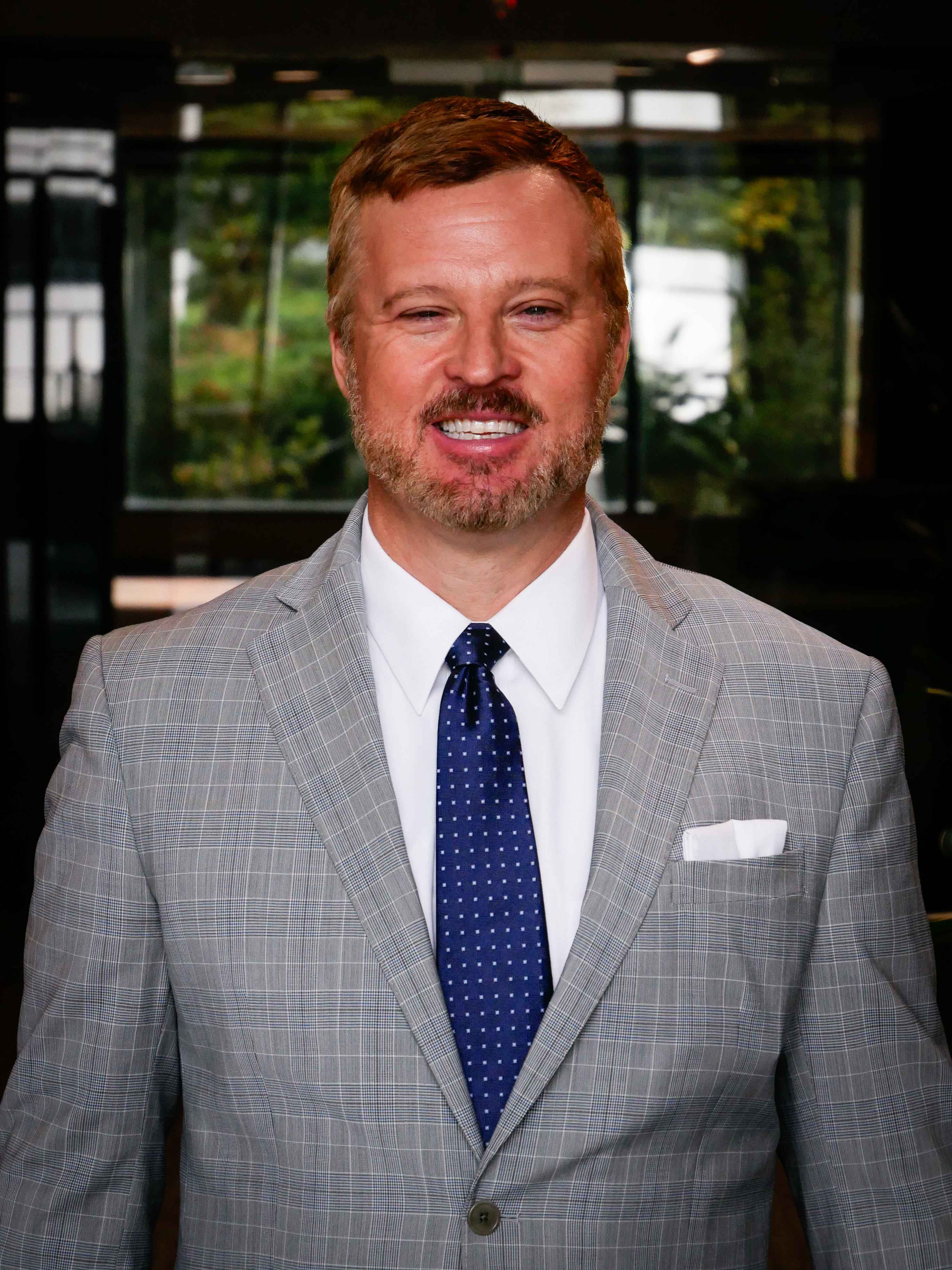
It’s a locally known fact that the first thing you ask someone from St. Louis is, “Where did you go to high school?”
Kirk Stange, a St. Louis-area native (who went to Eureka High), has learned the “Where’d you go to high school” of 30 cities across Missouri and nationwide. He has built his firm, Stange Law Firm, from the ground up to become a recognized name in family law. Starting in St. Louis nearly 20 years ago, the firm now boasts 30 offices spanning ten states. He’s always built from scratch in each city, learning local customs and personality and folding them into a unified, firm-wide mission. With the tagline, “Here to help you rebuild your life,” the firm aids clients through dissolution of marriage, child and spousal support arrangements, property division for high-net-worth individuals and more.
With Stange’s affinity for effective local marketing, the firm is continuing to grow. They expanded into Houston and Austin in Texas and Louisville and Lexington in Kentucky last year; this past February, they added on Nashville.
But starting a franchise firm wasn’t always Stange’s plan. Initially, he received his history teaching certificate for 7th-12th graders. His business management experience, meanwhile, came from Six Flags, an amusement park just outside St. Louis. He worked there starting as a Log Flume ride supervisor in 1991 to managing a third of the park in 1997, the summer before law school.
Though unexpected, both experiences have proved pivotal for Stange’s long-term success: Managing at Six Flags helped him learn how to guide different kinds of people, and his teaching degree allows him to educate clients, coach his employees, and keep law firm managers and family law lawyers abreast of his findings through CLEs and prolific blog-writing. A thought leader, he maintains both a family law blog, familylawheadquarters.com and a firm management blog, lawfirmpracticemanagementadvice.com, where he covers business management, marketing and technology.
Stange is a member of the Lawdragon 500 Leading Family Lawyers in recognition of both his prowess in court and his firm leadership.
Lawdragon: You have built your name in family law, but that wasn’t your original intention when you became a lawyer, right?
Kirk Stange: That's right. I went to law school hoping to do constitutional law, civil rights. I was interested in politics at that time, but I thought I might get to something more involved in those areas. Family law was not what I anticipated.
LD: Tell me about that transition. It was while you were at a small law firm, right?
KS: That's right. I worked at a very small firm in West St. Louis County. The three gentlemen there were all politically active, which is why I went to work there, in part. But one of the partners there did family law, and he went out on medical leave for a while. They had me handle his cases while he was out, and that's how family law began. Before I knew it, people were referring other family law clients to me, and it just built on itself.
LD: And are there any matters you’ve handled that stand out?
KS: I've had lots of cases where the fact patterns blow your mind. Some of the toughest cases I've had to deal with involved allegations of sexual abuse, whether it was my client raising it against the other party, or the other party raising it against my client. Those are horrible cases, but they happen in family law. One time I represented a dad in a custody case and the mom tried to hire a hitman to kill my client in the middle of the case.
LD: Wow. I don't think I've heard something quite like that happening in a case.
KS: Yeah. She ended up going to prison. The hitman she was trying to hire was an undercover cop. So that was a shocking case. I remember having a case one time where the opposing party committed suicide in the middle of the case.
This is a heavy area of the law. I think a lot of lawyers are really good lawyers conceptually, but they can't practice in this area of law because these kinds of cases. This is the part that, early in my career, had me thinking, "Do I really want to do this?” But there was a huge need. People need a good lawyer to get them through these times. Not to get too religious, but I’m a big believer that God has a plan. Things happen for a reason in life. And for whatever reason, this is what I was supposed to do, even though it wasn't the original plan that I had for myself.
LD: What characteristics do you think make someone a good family lawyer?
KS: I read an article by a family law lawyer early in my career, when I was struggling with this practice. The hardest piece about this area of the law is in a way it can feel like a circular firing squad. Your clients can be mad at you. The other attorney can be giving you trouble. And judges can be impatient. But in the article, the lawyer referenced what she thought were the two most important traits of a successful family lawyer – not from a litigation perspective, but from a mindset perspective. One, having empathy for your clients is key. You have to be able to listen to your clients, mirror their concerns back to them. As attorneys, we're referred to as counselors too. But then the other piece, which is equally as important, is boundaries. You have to be able to emotionally separate. It’s challenging, but you can't live vicariously through your clients. You do have to set reasonable limits. Empathy and boundaries are what gets attorneys through these cases. That combination can make somebody last for a long time. So I always kind of joke, it's like "Phantom of the Opera." It's the two faces you have to show your client.
LD: Are there any misconceptions, either from the legal industry or from clients, that people have about family law that you see most often?
KS: Oh man, there are so many. I think a lot of people oversimplify the process. They think, "Well, I just want a divorce. This ought to be easy. Why does it take so long?" The reality is, in a divorce, two people may want the divorce, so that makes it uncontested. But you still have to have an agreement on the disposition of the case in order to resolve it. You have to divide all the marital property and debt. You have to deal with child custody, and on that you have to agree not just on terms, but days of the week and a parenting plan and specifics, child support, spousal support, attorney fees. In a lot of cases, people agree on 70, 80 percent of those issues, but they disagree on 10, 20, 30 percent of that, and that hangs up the whole case. And it's a backed-up court system.
LD: That makes sense. Focusing on your firm specifically, next year is your 20th anniversary. Does the firm look now how you expected when you started?
KS: No. It's been a wild ride because it's not anything I ever really expected, but it took off. If you talked to me 30 years ago, I would've never contemplated it.
In a lot of cases, people agree on 70, 80 percent of those issues, but they disagree on 10, 20, 30 percent of that, and that hangs up the whole case.
LD: Talking about the growth of the firm, what made you want to create something different in family law by expanding?
KS: It started originally on a smaller scale just in the St. Louis area. We opened in St. Louis County, then I put an office in St. Charles County, Missouri. And then I put one down in Jefferson County, Missouri. And what I learned from some of this early expansion, was at the time, not many firms had a good webpage that could compete. Our webpage will shoot to the top of the search results and that led to clients. Eventually I had an office in every county surrounding St. Louis County. And then I was like, well, there's nowhere else to go here.
LD: Got to change states. How do you choose where to grow now that you're up to 30 offices in ten states?
KS: There are a lot of components to it. A lot of it is geographically contiguous, so that makes it easier to manage. But Texas, to me, was a different thing. That was more a statement opening. People say, "Well, you're Midwest firm." And I'm like, "Well, let's not be just in the Midwest anymore." I like Texas, too. I actually own a condo in Galveston.
LD: People might think, oh, well, this is just about me and my wife or me and my husband. I don't need a whole firm network. But what are the advantages clients see from the model you’ve created?
KS: People don't like to travel long distances for a lawyer. So, having a local office with a local attorney makes it very convenient for them. If you look at Walgreens or CVS, they're everywhere, right? It’s convenient. So having a local office with a local attorney, in my mind, was similar to that. Other people would always ask, "Well, do you buy up other firms?" I've never bought another firm.
LD: Why is that?
KS: One, buying up another firm would cost some bucks. I'd rather take that money and put it in the marketing than buying up other firms. Two, other firms do things differently. So if you buy them up and you want them to change and do things your way, to me, that seemed challenging. But we’re different that way.
I also hear a lot about firms expanding with offices that are more like unstaffed satellites. Appointment-only kind of offices. The unique thing about our firm is that our offices are all full-time with one exception at this point, which is the one in Ellisville, Missouri, West St. Louis County. Every other office is full-time staffed.
LD: From a leadership perspective, how do you establish those same principles and culture across so many offices?
KS: That's one of the most challenging pieces. When I was a Six Flags supervisor, I was supposed to make a certain number of rounds each day. You go to all your rides once, that's one round. You go to a second time, that's a second round. I've got other partners and directors and we make rounds. We have to get to these offices. It's challenging with as many offices as we have, but making rounds is one way.
We also do a lot of meetings at our firm. We have attorney meetings on Zoom every week. We do a firm meeting once a month. I also have every attorney do a weekly pulse check with a more senior attorney at the firm. So every attorney does a weekly meeting with a more experienced attorney to go through their cases with them, to give them guidance and supervision. Of course, at times the culture could be different by office a little bit.
LD: That makes sense geographically and personality-wise. But is there a defining set of principles or an ethos for the firm?
KS: Well, our catchphrase, which we have in all of our ads, it's, "Here to help you rebuild your life." So our goal has got to be helping clients rebuild their life. So first and foremost, the clients have to come first. Without that, no business is going to do well.
LD: Can you tell me about some trends that you're seeing in family law?
KS: Paternity cases are one. Four out of 10 kids are born out of wedlock in the United States. When these relationships split, then you end up with custody and support cases. Next to divorce, they're by far the most common types of cases we deal with. You don't deal with property and debt division and you don't deal with spousal maintenance or alimony, but otherwise the procedure and the process compared to a divorce is remarkably similar.
The clients have to come first. Without that, no business is going to do well.
There's also been a wave of shared parenting coming more to the forefront. Early in my career, it would be more like a custodial parent and then the other parent would have every other weekend, and a night during the week, and some summer and holiday time. Missouri, now, has a presumption of equal parenting, and you see more and more states going there.
Early in my career, I would hear the psychological research shows it's better for kids to live in one home and not have to go back and forth in a suitcase. But now, the psychological research shows it's best when kids have both their parents in their lives, so 50/50 custody is actually better, and it results in less conflict. So that is a trend that is gradually sweeping across the country, which is definitely something very different from when I first started doing family law.
LD: Are there any changes you’re advocating for in family law?
KS: Spousal maintenance is an interesting topic area. Some states call it alimony; some states call it spousal maintenance. What I see more and more states doing is they have formulas for maintenance. I actually like it. So they'll look at the length of the marriage, the income of the parties and then they can sort of objectively compute maintenance and the length of time it'll need to be paid. I think that creates more certainty for people, results in less litigation and it's generally a better system. In Missouri, it's the Wild West of maintenance still.
LD: Interesting. And looking back on now nearly 20 years of the firm, what have you found most fulfilling about building this practice?
KS: When I hear stories from former clients and people that say we help them through difficult times, obviously that's key and the most important piece. But a close second to me is that I've had some employees who worked for me for a long time. The fact that they've had a fulfilling career at our firm and support their family off it, and they have a good life based on what we build – that brings joy to me, too. If it wasn't for a lot of these people around me who stuck with me for a long, long time, through difficult and challenging times, this firm wouldn't be what it is.
