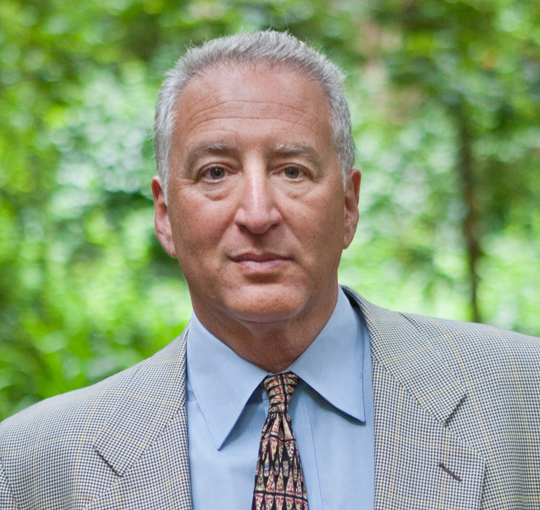
When looking at the history of modern environmental law, one name comes up again and again: Victor "Vic" Sher.
Since the 1980s, Sher has leveraged his legal expertise to tackle some of the biggest threats to the environment and to champion communities impacted by those threats. Along the way, he has taken on some of the world’s most powerful corporations – and biggest law firms – and won.
He has led groundbreaking forest protection lawsuits. He was a member of the trial team in the first MTBE water contamination case to go to trial, utilizing an innovative products liability law strategy. And, in the last decade, his firm has represented states, tribes, and local governments suing fossil fuel giants, alleging that the companies have known for decades their products led to harmful effects on the environment and failed to either mitigate those harms or warn consumers about them. The lawsuits claim that this “campaign of deception” led to climate-change-induced harms that place enormous financial burdens on the communities impacted by them.
While Sher has pioneered these approaches in court, he doesn’t think of them as outside-the-box.
“I don’t view our work as being steeped in novelty. Our cases are firmly based in traditional elements,” says Sher. “We simply apply established legal principals to new factual circumstances.”
The defense response has been that “‘this is stretching the law beyond where it was ever intended to go,'" Sher says.
To that end, Judge Jeffrey P. Crabtree, who rejected motions to dismiss the City and County of Honolulu’s climate deception lawsuit, commented on the perceived novelty of the legal claims.
“Here, the causes of action may seem new, but in fact are common. They just seem new – due to the unprecedented allegations involving causes and effects of fossil fuels and climate change,” he wrote. “Common law historically tries to adapt to such new circumstances.”
Across the board, defendants – multi-hundred-billion-dollar household names like Exxon Mobil, BP and Shell – have vehemently refuted the climate deception claims in court. Sher has also faced intense political pushback, particularly in the current administration, with President Trump issuing an executive order calling climate deception lawsuits a threat to national security.
Sher is unintimidated.
“I’ve always believed that the courts are one of the last level playing fields, if not the only one left, available to communities against huge multi-national corporations,” says Sher.
Along with co-founder Matt Edling, Sher has been building out a team to compete and win on that playing field. In the 10 years since its founding, Sher Edling’s climate docket has grown such that one in every four Americans now lives in a jurisdiction that has brought a climate deception lawsuit. His clients include nine states, the District of Columbia, two Native American tribes, and cities spanning four more states – and that’s just the climate docket. On the water side, his firm represents water districts and authorities nationwide, pursuing cleanup funds for water supplies contaminated with compounds like 1,4-dioxane, PCB’s and PFAS.
Sher and his firm have changed the shape of environmental law by applying established law to of-the-moment claims. The only question is where the law – and the firm – is headed next.
FROM OWLS TO PUBLIC WATER SUPPLIES
Sher’s career first gained national prominence with the northern spotted owl, a vital indicator species of the health of ancient forests in the Pacific Northwest. Starting in the late 1980s and early 1990s, Sher worked with the Sierra Club Legal Defense Fund (now known as Earthjustice – a name adopted during Sher’s turn as President of the organization from 1994-1997). Earthjustice was then, and is still, the largest nonprofit public interest environmental law group in the world.
The spotted owl cases fundamentally changed the federal government’s approach to managing biodiversity on federal lands, including by dramatically limiting logging on public lands in the temperate rainforests of Oregon and Washington. Sher’s work was heralded as among the most significant public lands cases in U.S. history.
The fight wasn’t easy. Sher was up against a multimillion-dollar PR campaign by the timber industry to frame the cases as protecting owls over American jobs, rather than about ecosystem health. These campaigns, he says, motivated political interference with court processes.
“As you gain traction in court, large economic interests who are threatened will look to legislative schemes to try to protect themselves,” he says. It’s an approach he says still affects his cases today – with an increasing scale and diversity of tactics.
Upon leaving the nonprofit sector, Sher focused on groundbreaking water contamination litigation, using a products liability legal theory to sue manufacturers of products containing harmful chemical compounds that spread to the groundwater that supplies homes and businesses. Some of his initial cases centered around DBCP – a chemical used to control nematodes in crops that is persistent and mobile in groundwater and also “one of the most effective testicular cancer-causing agents ever known,” Sher says.
Then, in a turning point for his career, Sher sued Exxon Corp., Chevron, Shell and other large oil companies on behalf of the South Lake Tahoe Public Utility district. Sher argued that the companies’ gasoline, blended with additive MTBE, contaminated the district’s drinking water and therefore constituted a defective product. The claim was original: Instead of centering on liability for leaking tanks, Sher’s claim focused on the production and marketing of the gasoline itself. The companies settled for $69M in 2001, after a jury trial against Shell that led to a verdict finding the company acted with malice.
'I don’t view our work as being steeped in novelty. Our cases are firmly based in traditional elements,' says Sher. 'We simply apply established legal principals to new factual circumstances.'
By 2003, Sher began his own law firm, San Francisco-based Sher Leff, focused exclusively on representing state and local governments and public water providers through this now-proven defective product model.
“For a compelling case, you need three things: A serious injury to a plaintiff, a strong, science-based connection between the defendants’ conduct and that injury and a compelling story of knowledge and culpability,” Sher explains. The MTBE cases were so successful because they clearly contained all of those elements – backed by unassailable legal theory.
“You build the cases to be middle-of-the-runway, traditional legal claims,” Sher explains.
Combining those traditional claims with an innovative perspective allowed Sher to build a leading water practice nationally. He was designated national co-counsel for plaintiffs in a multi-district MTBE litigation; his clients in the MDL ultimately recovered more than $100M as part of a nationwide settlement. In 2008, the City of New York asked him to serve as lead trial counsel in its case against ExxonMobil and other oil corporations over city wells in Queens contaminated with MTBE. After a four-month jury trial, Sher and his legal team secured a landmark $104.7M jury verdict against Exxon, with a total recovery of more than $125M, a result affirmed on appeal.
When Sher joined up with partner Matt Edling in 2016 to found his current firm, Sher Edling, water contamination remained a central focus of the firm – and still is today. In 2025, the firm’s attorneys secured more than $400M in historic settlements for their water provider clients with the 3M Company, DuPont and others as part of the national In re: Aqueous Film-Forming Foams Products Liability Litigation (the “AFFF MDL”), which concerns a firefighting foam containing PFAS. The litigation is one of the largest contamination MDLs in the country.
THE CLIMATE “CAMPAIGN OF DECEPTION”
While water contamination is a large and growing part of the firm’s practice, just a year into the firm’s life, Sher and team began filing the first groundbreaking climate-deception lawsuits on behalf of public entities. In these suits, Sher was no longer alleging that corporations were creating defective products, but rather that they failed to warn about and proactively distorted the direct link between the use of fossil fuel products and climate change, which has cost state and local governments dearly in harmful impacts from storms, rising sea levels, public health threats and more.
That failure to warn is the central tenet of the “campaign of deception” that lies at the heart of all Sher’s climate deception cases. Supporting Sher in City and County of Honolulu v. Sunoco LP, expert Dr. Naomi Oreskes, Professor of the History of Science and Affiliated Professor of Earth and Planetary Sciences at Harvard, declared:
“The fossil fuel industry and its allies and surrogates created an organized campaign to foster and sustain doubt about anthropogenic global warming and prevent meaningful action. They did this by influencing consumers and the general public. It is my expert opinion that Defendants have participated in this campaign for more than the last half century, and that their behavior continues today.”
Oreskes goes on to argue that fossil fuel companies “developed a sophisticated understanding of the link between emissions from their products, atmospheric carbon dioxide concentrations, and potentially dire climate-related impacts” as early as 1965. Yet, she says, the corporations never publicly acknowledged the consequences of fossil fuel dominance.
“The company has to issue warnings commensurate with the risks,” Sher says. “Their knowledge of the risks goes back to the mid-‘60s, and they never warned.”
The Honolulu case, which began in 2020, follows that now-familiar model for Sher’s climate-change cases. His successful argument before the Supreme Court of Hawai‘i established City & County of Honolulu et al. v. Sunoco LP et al. as the first tort-based climate deception case in history to prevail on motions dismiss all the way up to and through a state supreme court. Defendants sought review from the Supreme Court of the United States but were denied in January 2025. At the start of this year, the state trial court denied the defendants’ motions for summary judgement and allowed the suit to continue.
“These cases are not about solving climate change and they’re not about climate change policy,” Sher emphasizes, referencing an opposing position that has come up in other cases. “They’re about obtaining the resources for communities to survive a warming world that is worse because of the failure to warn and wrongful promotion and marketing by these companies.”
In other current cases, in 2023 Sher Edling began representing two Native American tribes, the Makah Indian Tribe and the Shoalwater Bay Indian Tribe, both located in coastal northern Washington. As storms and rising sea levels increase rapidly in the area, both tribes have been forced to move homes and infrastructure now at risk of flooding – conditions which the legal team alleges stem from global warming driven by deceptive practices from major oil companies.
Timothy J. Greene Sr., Makah Tribal Council Chairman at the time, declared, ““We are seeing the effects of the climate crisis on our people, our land, and our resources. The costs and consequences to us are overwhelming. We intend to hold these companies accountable for hiding the truth about climate change and the effects of burning fossil fuels. And we aim to force them to help pay for the high costs of surviving the catastrophe caused by the climate crisis.”
[These cases] about obtaining the resources for communities to survive a warming world.
Then-Shoalwater Bay Chairwoman Charlene Nelson added, “These oil companies knew their products were dangerous, yet they did nothing to mitigate those dangers or warn any of us about them, for decades. Now we are facing hundreds of millions of dollars in costs to relocate our community to higher ground and protect our people, our property, and our heritage. These companies need to be held accountable for that.”
PREPARING FOR THE LONG-HAUL
In court, Sher has argued that these lawsuits do not interfere with energy production, but instead center on deceptive corporate practices – comparing them to landmark lawsuits against the tobacco industry.
Those arguments have not always succeeded; some cases have been dismissed. But Sher is accustomed to political and legal resistance, going as far back as that early litigation surrounding the spotted owl with Earthjustice. He is prepared to fight for the long-haul, with patience and tenacity that has carried through all his work.
“[Both water and climate cases] are against defendants who are large and well-resourced, who have an infinite number of lawyers working for them,” Sher explains. “So, the arc of those cases is slow because they will throw every possible impediment out there.”
Sher credits the team that surrounds him, saying he perseveres due to his choice of his colleagues and building strong relationships with his clients.
When asked what makes his work most fulfilling, Sher says the answer is twofold: One part, working on cases that matter. The other, working with people who share a sense of community and purpose.
Ten years in, Sher says that his current firm is the best team of lawyers he’s yet assembled in his legal career.
“We are proud to have secured more than $1B in relief for our clients so far,” says Sher. “But we have our work cut out for us as we enter our second decade at Sher Edling. Corporate power and influence are increasing, at the very time that traditional safeguards for the environment, public health, and community resilience are being dismantled. It’s our job as mission-driven lawyers to help reset that imbalance in our communities. We are ready for that fight.”
That spirit will be needed as Sher continues his commitment to protect people and the planet. As he has shown time and time again, his determination, innovation and record of success make this environmental litigator one challenge profit-driven corporations struggle to overcome.
