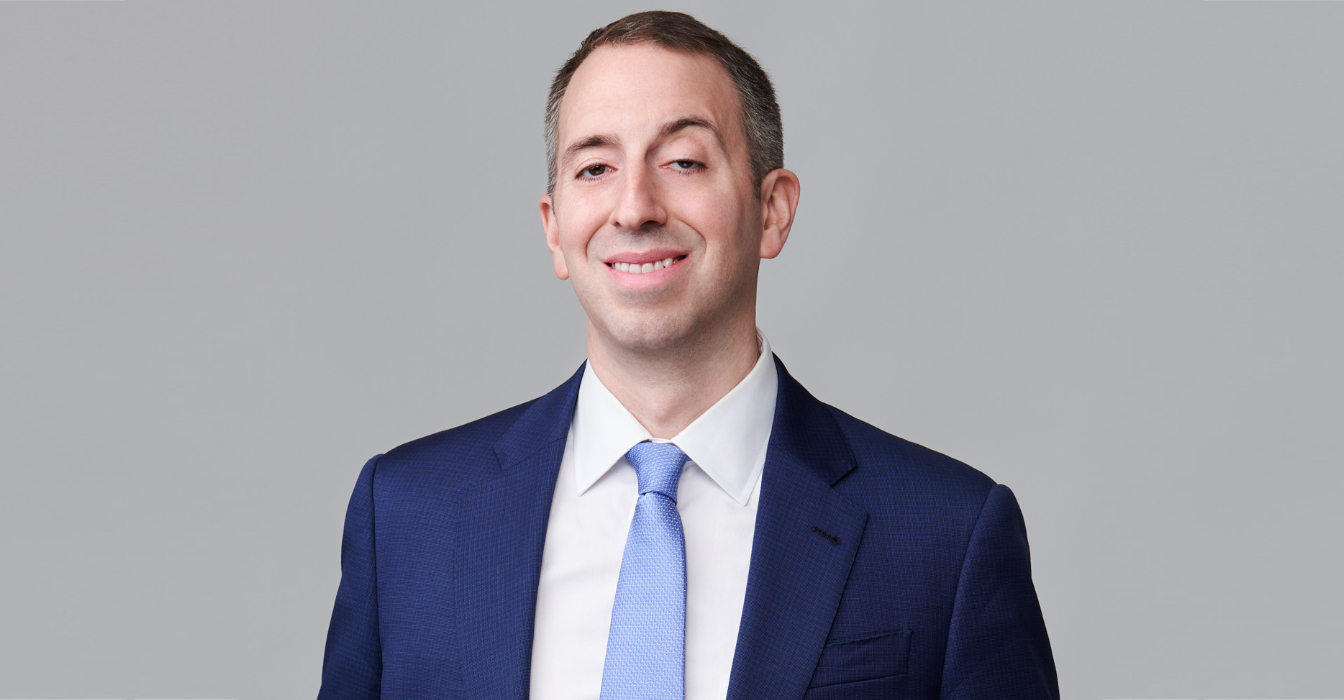
As head of Burford Capital’s U.S. commercial investment team and a member of Burford’s Commitments Committee, Evan Meyerson has had a front-row seat from which to view the growth of the legal finance industry. Burford is the leading litigation funding provider globally, having committed to more than $12B in investments since founding.
“We have told our shareholders that by 2030, we want to double the size of our business. And to do that, we are in growth mode,” Meyerson says.
Meyerson has been an integral part of that growth since joining Burford in 2019. He began as an underwriter on the U.S. Commercial investments team and later became head of the group, while also recently being appointed to Burford’s Commitments Committee, which has final authority over approving all of the firm’s investments. Prior to Burford, he worked in venture capital at Bain Capital and practiced commercial litigation at Sullivan & Cromwell and Paul, Weiss.
Legal finance combines “a risk-taking entrepreneurial environment with what I really liked about legal practice,” he notes. Now, he brings that first-hand knowledge of legal claims to his work with leading law firms and corporations, helping them de-risk matters and realize the full value of their claims.
Meyerson’s U.S. Commercial team brings together a unique combination of elite experience across law and finance, including former partners and lawyers from leading firms such as Wachtell, Debevoise, Davis Polk and Mayer Brown, alongside professionals with backgrounds at major financial institutions and asset managers including Goldman Sachs and Fortress Investment Group. The result is a rare blend of litigation, underwriting and investment expertise.
As part of its continued growth, Burford has recently expanded the team with four new hires: Vanessa Biondo, Sam Kwak, Kanika Shah and Stephanie Southwick. Each brings experience from prominent law firms or financial institutions active in legal finance, further strengthening the team’s underwriting capabilities in the U.S. market.
Meyerson recently spoke to Lawdragon about his career and perspective on the litigation finance industry.
Lawdragon: What brought you to becoming a lawyer after your time as an analyst, and then to litigation funding?
Evan Meyerson: I started my career out of college at the venture capital arm of Bain Capital. I was hired to focus on sourcing early and growth-stage technology companies. I loved my time there, but I always had in the back of my mind that I would end up applying to law school. I was exposed to law early on through my family and had long thought that my academic interests and career aspirations would align with being a lawyer. I was fortunate enough to get into Harvard for law school and had the opportunity to clerk after law school for a federal judge in Washington, D.C. And again, thinking about where my interests might lie, it was also in my mind that being a litigator would make more sense for me than being a transactional attorney.
So, I first joined Sullivan & Cromwell in their generalist litigation department. Then after my clerkship, I went to Paul, Weiss where there were certain aspects of practicing as a litigator that I really enjoyed. But I came to the realization that I didn't love all of it. And if you don't love all of it, it is a very hard career to dedicate your life to.
In many ways, I came to litigation finance somewhat unexpectedly. It was not a product or a concept that was very present at Paul, Weiss at the time. But through a series of fortuitous events, I was exposed to some of the firms in New York that were thinking about using legal finance. And working in legal finance struck me as a unique way to combine the things I really liked before law school, such as being in a risk-taking, entrepreneurial environment, with the things I really liked about legal practice, namely, thinking about the strategy of litigation, reverse engineering what the most likely outcome was for a given dispute and thinking about how that would affect the way you represent your client. As I learned more about legal finance, it became clear that Burford was the most compelling place to do it.
LD: What was compelling about it?
EM: I had the opportunity to survey the landscape, interviewing with a few other capital providers in our space. Burford stood out to me for several reasons. One was the scale of its business in a still relatively new asset class. It was, and still is, the largest business in the world focused primarily on providing capital to law firms and corporate entities backed by their litigation claims. I was also so impressed by the people at Burford, and I thought the combination of a highly accomplished team and Burford’s singular track record in the industry would be a great place to start my career in litigation finance.
Working in legal finance struck me as a unique way to combine the things I really liked before law school, such as being in a risk-taking, entrepreneurial environment, with the things I really liked about legal practice.
LD: How does your background serve you in your career now and how does it serve the new team members who are coming on board that have that diversity of experience?
EM: The years I spent in law school, then as a U.S. district court law clerk, and as a practicing commercial litigator very much form the building blocks of my investment screen, from how to assess the merits of a given litigation to having an instinct for when – and for how much – meritorious disputes might resolve before trial, and so on. Litigation funding combines various skillsets. We look for people who can think about the business of law and are able to assess legal risk. Our goal is to think through all of the ways in which our counterparties – how we refer to our clients – might win or lose a given matter or portfolio of matters, assess and price that risk, and provide a capital structure that is optimized to support the goals of all parties involved in that particular deal, while pricing it in a way that makes sense for Burford’s shareholders.
LD: What drove the decision to take on these new senior team members?
EM: We have told our shareholders that by 2030, we want to double the size of our business. And to do that, we are in growth mode. Our U.S. commercial business has long been a meaningful part of our growth story, and we expect that to continue to be true over the next half decade.
LD: How have you seen both the firm and the industry grow and change over the last seven years, and particularly in the last couple years?
EM: There have been a number of very meaningful transitions in our business. For example, when litigation funding first became part of the public consciousness, there was a sense that what we did was support David versus Goliath disputes, or a party that desperately needed capital and was harmed by someone who didn't need capital at all. And to level the playing field, we would provide a capital source to allow access to justice. To be clear, we still do that today. But what we've seen over the last many years is increasing recognition among both law firms and large corporate entities that, one, a legal claim is an asset, and two, the financing solutions that Burford provides are just another form of corporate finance, but for legal assets. Our financing products can be an exceedingly valuable tool for both very solvent companies as well as those who are struggling, because it becomes a question of opportunity cost and the transfer of risk.
Providing an example, let’s say that a company spends all its time making a product of some kind. When it is harmed and has a viable and valuable legal claim, does it not pursue that claim because it's not part of the core business and it's going to cost it money? Or does it seek outside capital to help preserve the upside of a successful result with that meritorious claim while not repurposing enormous amounts of internal resources to pursue that result? More and more, companies are seeing the tangible value of the latter option.
Our financing products can be an exceedingly valuable tool for both very solvent companies as well as those who are struggling, because it becomes a question of opportunity cost and the transfer of risk.
Additionally, both boutique and large law firms are looking to expand their revenue sources by representing their existing clients as plaintiffs, either on a full contingency or a partial contingency. These firms are recognizing that they still need to keep the lights on, pay associates and seek growth and advancement – especially today, as it relates to technology and AI – but there's still great uncertainty as to how long cases will take to resolve. So firms are bringing in outside capital to manage duration risk, among others.
LD: Interesting. What sorts of financing does Burford provide?
EM: To start with, we focus on funding large commercial litigation matters, and in doing so, we have two main offerings. One is if a business or law firm has a claim or group of claims, Burford can help cover some of the fees and expenses that are required to pursue those claims. Separately, Burford offers monetization solutions, converting the future value of legal claims into immediate cash to realize portions of that value before a final judgment or award. A corporate entity can use the capital from a monetization however it sees fit – for example, to manage balance sheet exposure by reducing upfront legal costs, limiting financial risk, helping to reduce earnings volatility and preserving capital. And a law firm can partially de-risk contingency matters and smooth out revenue for the firm.
LD: How educated do you think law firms and large corporations are about these options?
EM: We try to make sure that we're in front of the firms and companies that have these opportunities so that we can show them why this makes sense. The hardest part of our process is executing a first deal with a law firm or corporate client; once they’ve transacted in our space, the chances of a second deal are very high. We do a lot of repeat business because when our counterparties see the value of what we have provided, they want to work with us again and again.
LD: Can you give me an example of a law firm or company that has recognized, “Oh, this can really change things for us?”
EM: One of our most active deals today is with an Am Law 200 law firm that for a long time prided itself on its ability to handle unconventional cases, and provide creative plaintiff-side solutions for clients. But as victims of their own success in many ways, they had grown to a size where waiting for contingency outcomes didn't quite make sense for the business model anymore. They had built this great brand as being the go-to place for tough situations, and they had a reputation for taking risks, but they could not continue to expand their scale and talent base while shouldering the full burden of that risk themselves. And so, they came to us. We committed $100M to this firm across a portfolio of cases, where we would fund a percentage of their fees and expenses so they in turn could offer to handle these matters for their clients and feel comfortable taking on that risk while sharing in the upside with Burford.
LD: What are you seeing right now as far as trends in the litigation finance space?
EM: Large corporations, particularly in the United States, are coming to understand that their affirmative legal claims truly are assets of real value, even if contingent future value. That makes those companies both more interested in and more understanding of the product we provide and the benefits it delivers. It also means the legal market that has typically represented them on the defense side is starting to adapt so they can maintain their relationship with these clients that are more inclined to pursue affirmative litigation than ever before. You see defense-oriented law firms thinking about how it can work for their slightly more risk-averse, billable hour-driven business models to take on plaintiff-side work for institutional clients. That's a major growth area for us.
The legal market that has typically represented [large corporations] on the defense side is starting to adapt so they can maintain their relationship with these clients that are more inclined to pursue affirmative litigation than ever before.
LD: Are you seeing any shifts in the types of claims that you're underwriting lately?
EM: What we focus on are large disputes involving corporate actors by and large and, within the corporate and commercial world, we continue to see a diversity of claims, whether they be breach of contract, antitrust, copyright, trade secret and other soft IP, non-patent matters. Our patent team, led by my colleague Katharine Wolanyk, is extremely busy as well.
LD: How would you describe your leadership style?
EM: I would describe my leadership style as player/coach. I am still actively involved in many of the same things my team is involved in on a daily basis, and they know that. We have a team-oriented system where even the one running the deal is getting their hands dirty, hustling to execute in the same way everyone else is. And I’ve found that a do-as-I-do approach can create an important level of trust among your teammates.
LD: What do you find most fulfilling about your work?
EM: I’ve been fortunate to find a professional path that suits all of my interests. It combines the things I liked most about being a practicing lawyer while cutting out the things I liked least, and the things I liked most about being an investor while allowing me to shape a cutting-edge asset class. I’m also able to work with a talented and motivated team at an organization that is the largest player in our space but culturally still feels like a small company more than a big one. And we’re part of what I would describe as still the early innings of a high growth industry. I do genuinely think we are all at a great inflection point for our business and it's fun to be part of the organization leading that charge.

