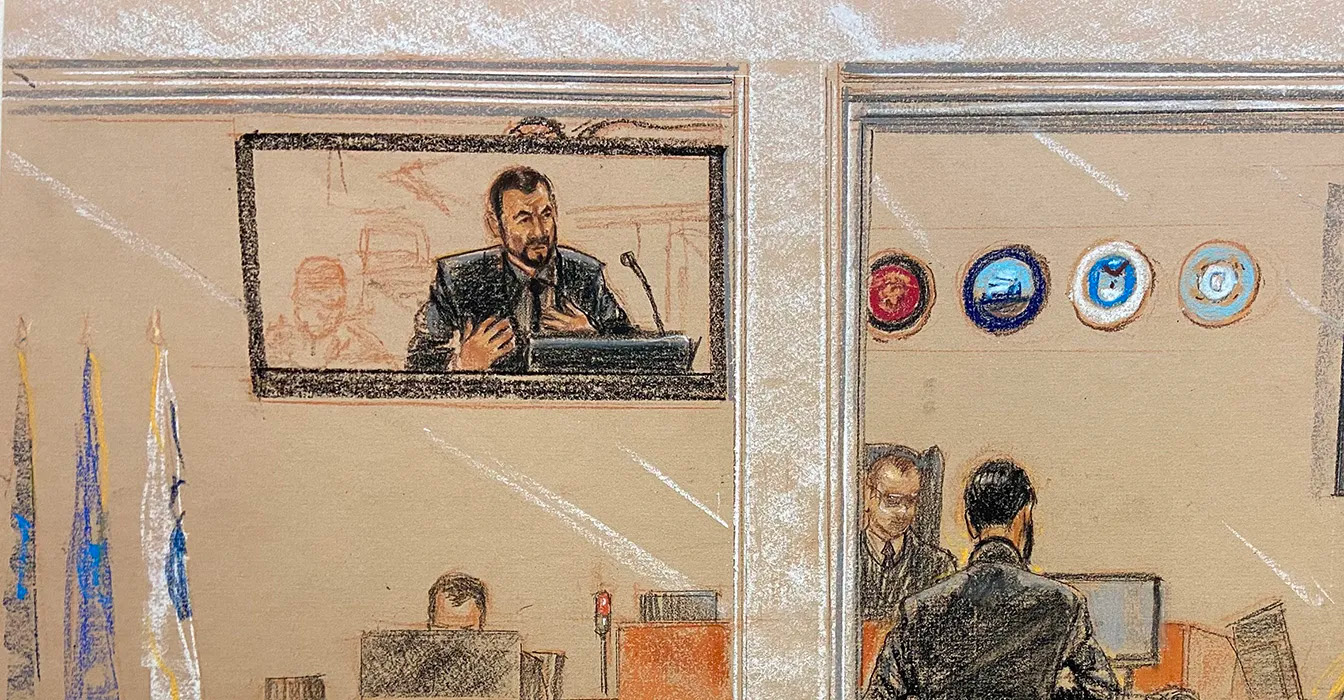
The prosecution team in the Sept. 11 military commission has suffered another loss in the years-long battle seeking to admit confessions the defendants gave to FBI agents on Guantanamo Bay nearly 20 years ago.
The trial judge, Air Force Lt. Col. Michael Schrama, ruled on Friday that the government failed to establish that Mustafa al Hawsawi gave voluntary statements to the FBI in January 2007 following his prior three-plus years in CIA custody – marking the third defendant whose statements have been ordered suppressed in the case.
Schrama made a similar ruling in favor of the accused plot mastermind, Khalid Shaikh Mohammad, on Aug. 28, citing his “extraordinary physical and mental abuse” by the CIA. The judge’s predecessor on the case, Air Force Col. Matthew McCall, last year suppressed the statements given to the FBI by Mohammad’s nephew, Ammar al Baluchi.
Schrama is expected to rule on the confessions of the fourth remaining defendant, Walid bin Attash, in the coming weeks. The next pretrial session is scheduled to last for two weeks beginning Dec. 7.
Walter Ruiz, the lead lawyer for al Hawsawi, did not immediately provide comment on the ruling, which was first reported Friday by The New York Times and not yet public. Defense lawyers have long claimed that the CIA tortured and conditioned their clients into cooperating with their interrogators. Prosecutors have insisted that the FBI-led sessions commencing in January 2007 were sufficiently attenuated from the prior CIA coercion, even though the agents provided neither Miranda warnings nor access to counsel.
Schrama rejected the prosecution's contention that changed circumstances at the Guantanamo Bay detention facility – including visits by delegates of the International Committee of the Red Cross – were sufficient.
“Mere ICRC visits are insufficient to dispel the impact of years of isolation from family and other detainees while simultaneously being made completely vulnerable to government captors who are, demonstrably, willing to employ abuse and operant conditioning to obtain cooperation,” Schrama wrote, according to a lawyer who has seen the ruling.
Schrama also wrote that the prosecution had the legal burden of establishing that the FBI interviews “were not inherently coercive in their own right,” even if he accepted the argument that the taint of the CIA program had dissipated by January 2007. In this evaluation, Schrama concluded, the prosecution failed to establish voluntariness by a preponderance of the evidence.
The prosecution appealed McCall’s April 2025 order suppressing statements by al Baluchi to the U.S. Court of Military Commission Review, which has yet to issue a ruling. However, prosecutors opted not to appeal Schrama’s recent ruling suppressing statements by Mohammad, which came just days after the judge set a June 2028 trial date. Navy Rear Adm. Aaron Rugh, the chief prosecutor, did not immediately comment on whether his office would appeal Friday’s ruling.
Al Hawsawi is alleged to have provided money and other forms of assistance to some of the 9/11 hijackers. After he was captured in March 2003, he spent several months at a notorious black site referred to as Location 2, or Cobalt, where he was subjected to the CIA’s so-called “enhanced interrogation techniques.” Ruiz has argued in court that al Hawsawi’s torture included sodomy and rape through an unnecessary rectal exam that left him with permanent damage.
The CIA later transferred al Hawsawi to a portion of the Guantanamo Bay detention facility that it used as a black site between 2003 and 2004. The government has acknowledged that this is the same location where the FBI conducted its reinterrogations of the 9/11 suspects in January 2007. In his closing arguments in defense of the al Hawsawi FBI statements, in May, one of the prosecutors, Army Col. Joshua Bearden, told Schrama that none of the enhanced measures had been used on al Hawsawi during his first stay on Guantanamo.
Another of the five original defendants in the case, Ramzi bin al Shibh, was also earlier held at the CIA black site on Guantanamo Bay. Bin al Shibh is currently severed from the 9/11 prosecution over a finding that he lacks the mental competency to stand trial.
About the author: John Ryan (john@lawdragon.com) is a co-founder and editor at Lawdragon, where he helps oversee print and web content. John's coverage of proceedings on Guantanamo Bay has earned three New York Press Club Awards and his book on the case, "America's Trial: Torture and the 9/11 Case on Guantanamo Bay," came out last year.

