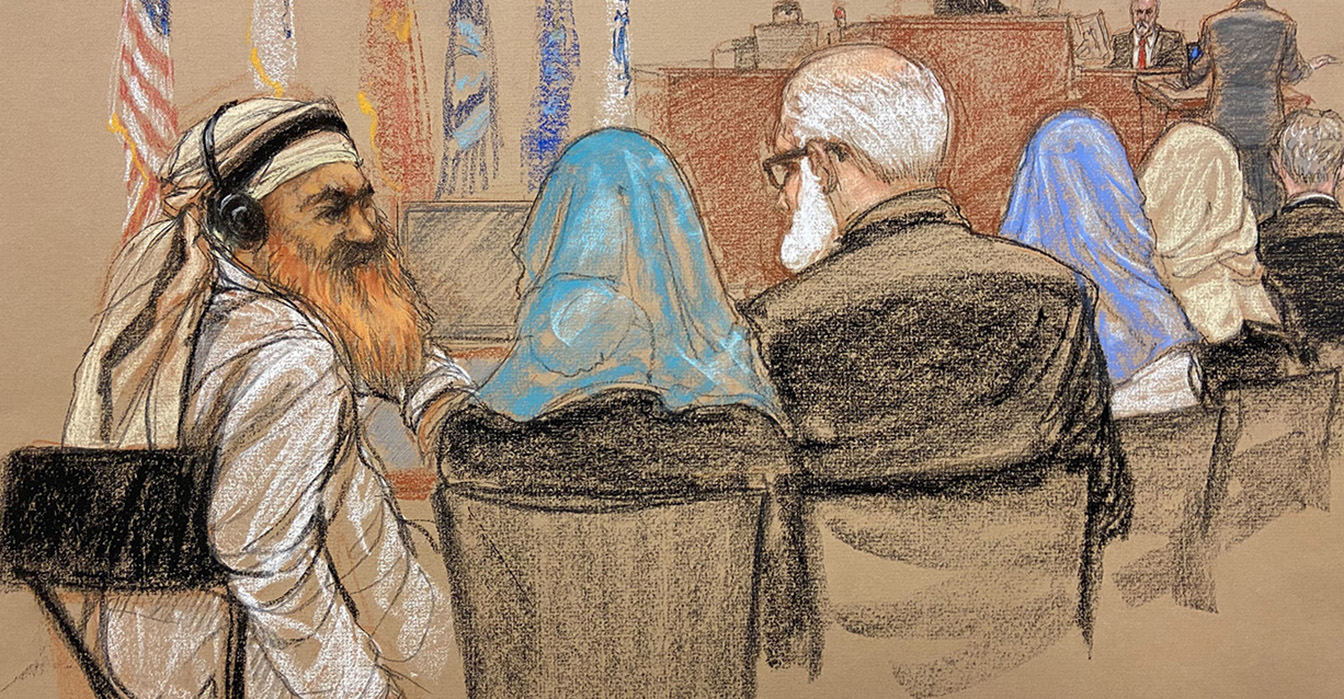
In a long-awaited and potentially critical ruling, the trial judge in the Sept. 11 military commission has suppressed confessions made by the accused mastermind of the plot, Khalid Shaikh Mohammad.
"KSM," as he is referred to, made the statements to FBI agents on Guantanamo Bay four months after he arrived from CIA black sites where he was subjected to widely documented physical and psychological abuse.
On Friday, Air Force Lt. Col. Michael Schrama ruled that the prosecution failed to establish by a preponderance of the evidence that Mohammad’s statements to the FBI were voluntary. He found the January 2007 FBI interview sessions – which he noted took place in a former CIA black site on Guantanamo Bay – “did not represent a genuine break from his past treatment.”
“The Commission finds that this environmental continuity effectively maintained the coercive psychological pressure established by the CIA,” Schrama wrote.
He described Mohammad’s treatment by the CIA over three-plus years as “extraordinary physical and mental abuse.”
“This treatment included at least 183 instances of waterboarding, prolonged standing sleep deprivation, nudity, rectal rehydration, and explicit threats to murder his child,” Schrama wrote.
The ruling is a major setback for the government's plans to use FBI-elicited confessions at trial. It is not the first.
Schrama’s predecessor on the case, Air Force Col. Matthew McCall, last year suppressed the confessions made to the FBI by Mohammad's co-defendant and nephew, Ammar al Baluchi. The prosecution of Mohammad and two other co-defendants, Walid bin Attash and Mustafa al Hawsawi, for the largest mass murder committed on U.S. soil has lagged behind al Baluchi’s because they attempted to exit the pretrial litigation and plead guilty, only to have the government withdraw from the deals.
Schrama presided over his first hearing in the convoluted case in December. In May, he heard closing arguments for the dwindling number of prosecutions in which the defense is seeking to suppress allegedly coerced statements in May. He is expected to rule on bin Attash’s and al Hawsawi’s motions to suppress in the coming weeks. (One of the five original defendants, Ramzi bin al Shibh, has been severed from the case after a finding of mental incompetency.)
The chief prosecutor for the military commissions, Navy Rear Adm. Aaron Rugh, said in an email to reporters on Friday that his office was reviewing Schrama’s ruling and “will make a decision on whether to appeal in the near future.”
That decision will impact the long and difficult road to trial for the 9/11 accused as the 25th anniversary of the attacks draws near. The defendants were arraigned in May 2012. Earlier this week, Schrama set a trial date for June 2028. Should the government appeal Schrama's ruling, that deadline would become an impossibility, as a practical matter.
Schrama put the prosecution of al Baluchi on hold after the prosecution appealed his suppression ruling – issued by McCall back in April 2025 – to the U.S. Court of Military Commission Review. A three-judge panel heard oral arguments in February and could issue a decision at any time. A separate review panel last year upheld the suppression ruling in the military commission against Abd al Rahim al Nashiri, accused in a different case of planning the USS Cole attack.
The Commission finds that this environmental continuity effectively maintained the coercive psychological pressure established by the CIA,” Schrama wrote.
The prosecution team has long acknowledged that the CIA's treatment of the 9/11 defendants constituted legal "coercion" that elicited inadmissible statements. However, prosecutors claimed the FBI sessions were sufficiently attenuated from the prior coercion and were made voluntarily.
The lead prosecutor on the case, Clay Trivett, told Schrama in May that the statements Mohammad gave to the FBI in January 2007 were “the qualitatively best” that the government had in its case against him. Trivett argued that FBI personnel repeatedly warned Mohammad that he did not have to participate in the sessions. Mohammad largely dictated the duration and pace of the interviews, Trivett claimed, deciding to end them before the FBI had completed the ground it wished to cover.
In his ruling, Schrama found the FBI failed to give Mohammad Miranda warnings or any warning informing him “that the statements he had previously made under coercion to the CIA could not be used against him.”
In his ruling last year, McCall concluded that al Baluchi’s CIA treatment amounted to torture. Schrama did not teach that conclusion, instead describing “extraordinary” abuse Mohammad endured during his time in CIA captivity.
Mohammad, bin Attash and al Hawsawi continue efforts to revive their plea agreements. The U.S. Court of Appeals for the D.C. Circuit ruled last year that the government could legally withdraw from the deals. However, the teams have filed challenges to the U.S. Supreme Court, which has not decided whether to hear the dispute.
About the author: John Ryan (john@lawdragon.com) is a co-founder and editor at Lawdragon, where he helps oversee print and web content. John's coverage of proceedings on Guantanamo Bay has earned three New York Press Club Awards and his book on the case, "America's Trial: Torture and the 9/11 Case on Guantanamo Bay," came out last year.

