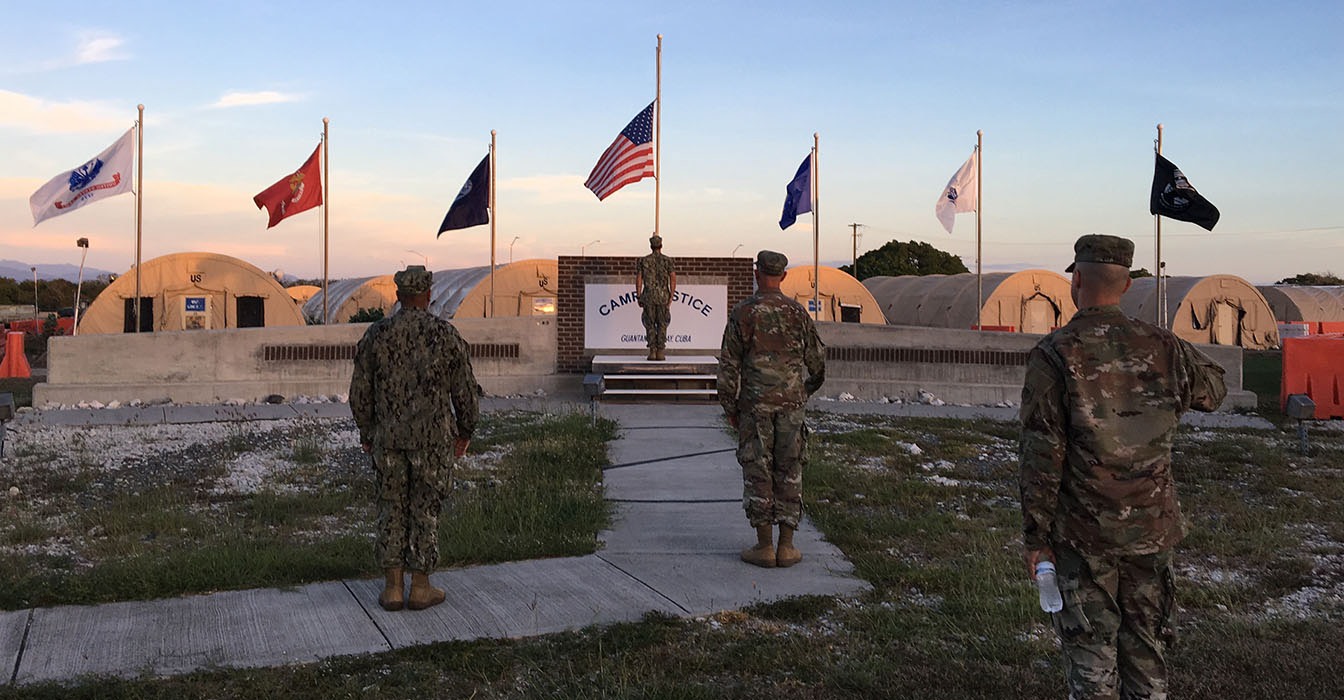
A military judge has suppressed the final confession the government sought to introduce in the Sept. 11 military commission, finding that the defendant did not give voluntary statements to the FBI on Guantanamo Bay following his years of abuse and coercion by the CIA.
That brings to five the number of confessions by Guantanamo detainees previously subjected to the CIA's so-called "enhanced interrogation techniques" that the government has lost as evidence of their guilt at any future trials. There have been no rulings in support of the government's position despite years of advocacy seeking to sanitize the effects of the CIA's brutal, incommunicado detention.
Air Force Lt. Col. Michael Schrama on Wednesday suppressed statements made to the FBI by defendant Walid bin Attash, which followed his rulings for Mustafa al Hawsawi last week and Khalid Shaikh Mohammad in August. Defendant Ammar al Baluchi had his statements suppressed by the prior judge last year.
All four defendants spoke to the FBI in January 2007, about four months after their arrival on Guantanamo Bay from CIA black sites. FBI and Naval investigative agents also interviewed bin Attash again in October 2007 and February 2008. During closing arguments on the confessions' admissibility in May, the lead prosecutor, Clay Trivett, characterized the government’s “voluntariness” case for bin Attash as “over the top.” He contended that bin Attash had been excited to see the agents again in the subsequent rounds of interviews.
However, Schrama suppressed all rounds of statements given by bin Attash to law enforcement personnel, according to lawyers who have seen the ruling. Schrama cited bin Attash's conditions of confinement on Guantanamo Bay that were similar to those at the CIA black sites, and that he was questioned in a portion of the detention facility that was itself a former black site. At this location, the FBI questioned bin Attash "on topics he had previously been forced to discuss under coercion," Schrama ruled, according to an excerpt shared with Lawdragon.
The ruling was not yet public and first reported by The New York Times. The chief prosecutor for the military commissions, Navy Rear Adm. Aaron Rugh, said in an email that his office has not decided whether to appeal the ruling.
Prosecutors have already decided not to appeal the suppression of Mohammad’s statements to avoid potential delays in reaching the June 2028 trial date. (They also declined to file a notice of appeal for the al Hawsawi ruling.)The prosecution’s 2025 appeal of al Baluchi’s suppression order is pending at the U.S. Court of Military Commission Review. That court upheld the suppression of FBI statements in the separate case against Abd al Rahim al Nashiri, accused of planning the October 2000 attack of the USS Cole.
The FBI questioned bin Attash 'on topics he had previously been forced to discuss under coercion,' Schrama ruled.
Prosecutors have long described the FBI statements as among their best and most critical evidence, though they intend to use other evidence at trial, as well. In court proceedings, prosecutors have referred to secret recordings made of the defendants at the Guantanamo Bay detention facility, intercepted phone calls prior to and after the attacks, and some documentary evidence involving transfers and assistance to 9/11 hijackers, among other evidence. Defense teams will also seek the exclusion of these categories of evidence, so their use at trial is not guaranteed.
The suppression hearing for the five original 9/11 defendants began in September 2019. Prior to that, the defense teams and the government spent several years arguing over which witnesses and evidence from the CIA program would be available to the teams in making their suppression arguments. In 2023, the prior judge, Air Force Col. Matthew McCall, severed Ramzi bin al Shibh from the case after finding that he was not mentally competent to assist in his own defense. The government still intends to prosecute him if he is ever deemed fit to stand trial.
Over the past several years, the prosecution team has portrayed the FBI-led reinterrogations on Guantanamo Bay as “clean” of any taint from the prior CIA coercion. Both Schrama and McCall, however, rejected the prosecution’s argument that the detainees gave voluntary statements merely because they were told that they did not have to participate in the interviews. Agents did not provide Miranda warnings nor did they tell the detainees that what they told the CIA could not be used against them.
In his April 2025 order, McCall described al Baluchi’s abuse by the CIA as constituting torture as well as cruel, inhuman or degrading treatment. Schrama has not made a similar conclusion in his three rulings, focusing instead on the government’s failure to sufficiently remedy the CIA’s earlier conditioning and coercion prior to the FBI interviews. In the rulings, he has described the CIA's treatment as "extraordinary" and "severe."
"The factual record establishes that Mr. bin Attash was subjected to extraordinary physical and mental abuse during his time in CIA custody from March 2003 until his transfer to [Guantanamo Bay] in September 2006," Schrama wrote in his Wednesday ruling. "This treatment included sleep deprivation, required standing, loud music, sensory deprivation, extended isolation, reduced quantity and quality of food, nudity, and rough treatment."
Al Baluchi’s suppression case moved faster than his co-defendants because Mohammed, bin Attash and al Hawsawi exited the pretrial litigation in August 2024 after signing plea agreements with the government. Schrama returned them to the case last year after the U.S. Court of Appeals for the D.C. Circuit ruled that Sec. of Defense Lloyd Austin acted lawfully when he withdrew from the three plea agreements. The defense teams are seeking a review of that decision by the U.S. Supreme Court, which has not yet decided whether to take the dispute.
About the author: John Ryan (john@lawdragon.com) is a co-founder and editor at Lawdragon, where he helps oversee print and web content. John's coverage of proceedings on Guantanamo Bay has earned three New York Press Club Awards and his book on the case, "America's Trial: Torture and the 9/11 Case on Guantanamo Bay," came out last year.
